Table of contents
Top 10 Open Source Software Licenses of 2016 and Key Trends

With the recent WordPress-Wix fiasco and Oracle and Google’s never ending battle over Java’s APIs, copyleft vs permissive open source software licenses remains a hot topic.
To understand which way the wind is blowing in regards to open source licenses, Mend decided to do a comprehensive study on which license types are currently in use by the community.
So, what do you think is the community’s open source license type of choice?
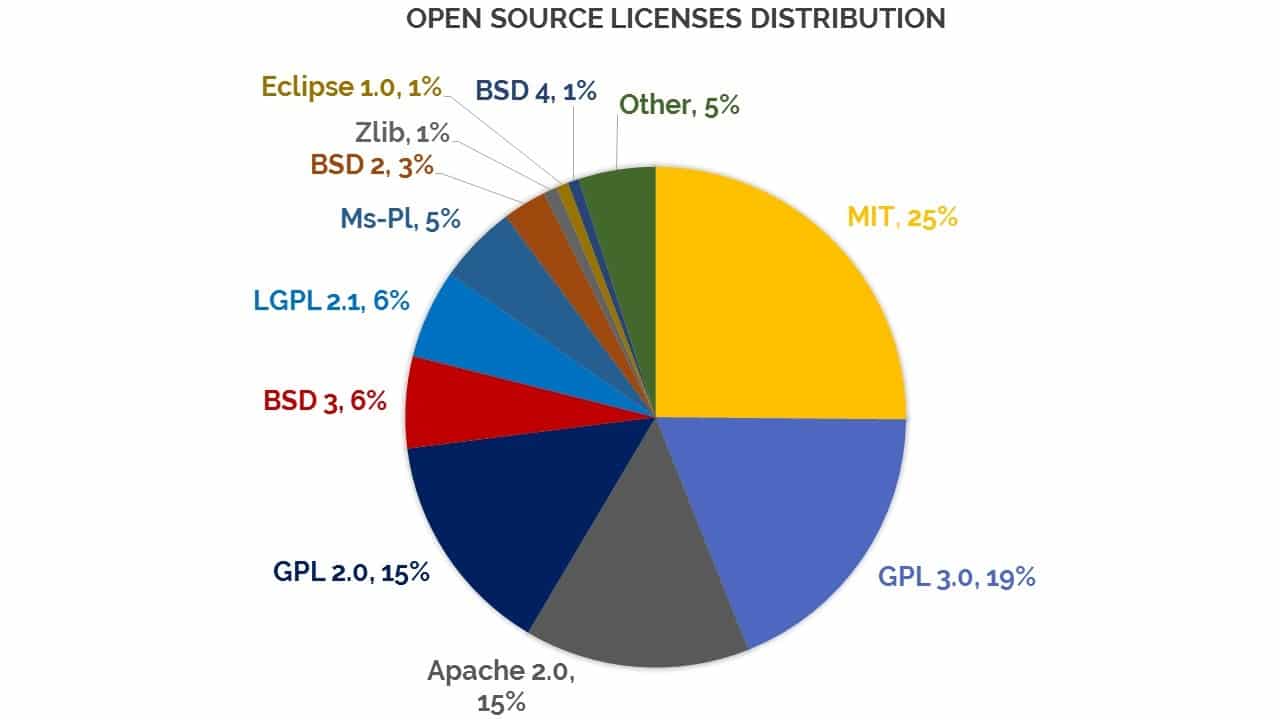
According to our research, the most common open source licenses are:
- MIT, 25%
- GPL 3.0, 19%
- Apache 2.0, 15%
- GPL 2.0, 15%
- BSD 3, 6%
- LGPL 2.1, 6%
- Ms-Pl, 5%
- BSD 2, 3%
- Zlib, 1%
- Eclipse 1.0, 1%
- BSD 4, 1%
- Other, 5%
The research
Our research team analyzed our database of over 3M open source components and 70M source files, covering 22 programming languages. The results point to two interesting trends regarding open source licenses. The first is the continued preference of authors to release code under permissive open source licenses. The second is the slightly decreasing but still staggering amount of publicly available unlicensed code.
#1: The continued rise of permissive open source software licenses
55% of open source components are published under a permissive license. This is a significant increase in popularity, considering 4 years ago (2012) permissive licenses covered only 40% of open source components.
With the MIT license now being the open source license for 25% of all components, we can understand that it’s become the open source license of choice for many users. This should come as no surprise, as it’s the shortest and probably least restrictive license out there. As Ben Balter, GitHub’s Government Evangelist, explains “I think a big reason for (MIT’s high usage) is that developers today are learning to code in a world that open source has already won. There’s not the same friction with closed-source software that there once was, and so developers often opt for practicality over purity…. (In addition,) it’s clearly a license optimized for developers. You don’t need a law degree to understand it, and implementation is simple.”

However, despite the rise in permissive licenses’ popularity, it’s important to note that with a 39% license distribution, the GNU GPL family, which includes GPLv3, GPLv2, and LGPLv2, is still the most used family of licenses out there.
#2: Unlicensed publicly released source
If we look at the bigger picture of open source software license usage, it’s not only copyleft licenses that are seeing a decline but open source licenses in general.
If you’re asking what do I mean, then let me explain. Did you know it’s common among the younger generation of developers to do away with open source software licenses altogether? In fact, almost 80% of the code on GitHub doesn’t have any license whatsoever. But, is this really something we should be concerned about?
Most definitely yes! If a component doesn’t have an open source license, it’s still under copyright, and so it’s not open source. Consequently, commercial organizations can’t use that code in their commercial products without (knowingly or not) committing copyright infringement. That means there’s a lot of software out there going untapped.
GitHub is doing many things to get that percentage to drop, but it’s ultimately up to the community to take responsibility to ensure its members are playing by the rules. So, next time you’re using or sharing open source code, do yourself (and the community) a favor and look for an open source license, permissive or otherwise.