Leave no container unturned
Analyze the contents of container images to identify security vulnerabilities ahead of deployment – and address potential risks.
Challenges
More abstraction. Less time.
Cloud-native development brings new potential risks—and at the same time, adds another level of abstraction between the security team and the code. But while application security complexity has increased, development schedules have shrunk.

Fast vs. Secure
Staying on top of vulnerabilities buried deep across multiple containers is a huge challenge. And with frequent updates and deployments, it’s nearly impossible to keep up, let alone get ahead, of security risks.
High volume overload
The sheer volume of images and dependencies takes far too long to scan. And when everything is shipped at speed, vulnerabilities can easily slip through.
Dependency neglect
Open source libraries and packages incorporated in containers rarely get checked for dependency updates, which means that external risks may be skipped over.
Opportunities
Cut through container complexity
Simplifying container security starts by giving time back to security teams, getting them actionable insights quickly, knowing which vulnerabilities to prioritize and which pose no threat, and building a clear view across the SDLC.

Gain a clear view across the SDLC
Leveraging container security and SCA in tandem cover everything from single images to entire registries.
Quickly know what matters
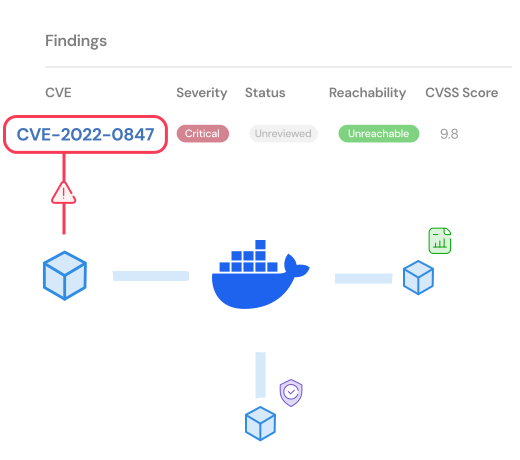
Container-level reachability and runtime monitoring quickly identify what risks are exploitable and what can be safely ignored.
Keep your secrets safe
Discover unprotected sensitive information before malicious actors do.
The solution
Mend AppSec
Development to deployment coverage for cloud-native applications
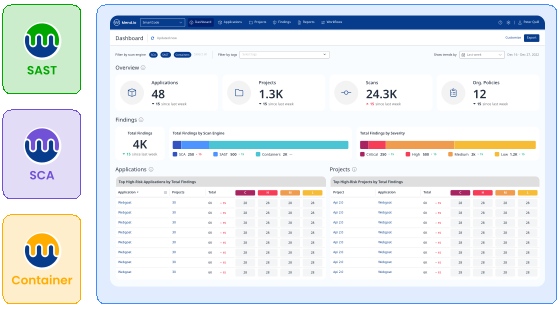
From scanning images and K8s to secrets handling and reachability analysis, the platform helps you identify and remediate vulnerabilities – before and after deployment.
Discover Mend AppSec

“One of our most indicative KPIs is the amount of time for us to remediate vulnerabilities and also the amount of time developers spend fixing vulnerabilities in our code base, which has reduced significantly. We’re talking about at least 80% reduction in time.”


“When the product you sell is an application you develop, your teams need to be fast, secure and compliant. These three factors often work in opposite directions. Mend provides the opportunity to align these often competing factors, providing Vonage with an advantage in a very competitive marketplace.”


“The biggest value we get out of Mend is the fast feedback loop, which enables our developers to respond rapidly to any vulnerability or license issues. When a vulnerability or a license is disregarded or blocked, and there is a policy violation, they get the feedback directly.”


FAQs
How does Mend.io secure containers across the SDLC?
Mend AppSec analyzes container images for vulnerabilities and compliance issues before deployment: from single images to entire registries, with container security and SCA working in tandem from development to deployment.
How does Mend.io apply reachability analysis to containers?
Container-level reachability analysis determines which vulnerabilities in an image are actually reachable and exploitable at runtime, so teams can prioritize reachable risk instead of treating every CVE in every image layer the same.
For program-level guidance, read building strong container security.
Does Mend.io detect secrets in container images?
Yes. Mend AppSec scans images for exposed secrets such as credentials, keys, and tokens, helping teams find sensitive data left behind in an image before it becomes a production risk.
Does Mend.io integrate with Kubernetes?
Yes. Mend AppSec integrates with Kubernetes environments to identify deployed images and add deployment context, showing teams not just what is vulnerable, but what is actually deployed and where. Integrations support Kubernetes environments including Amazon EKS, Microsoft AKS, Google GKE, and native Kubernetes.
Can Mend.io’s container scanning run on premises?
Yes. Container images can be scanned directly with the Mend CLI from your own build and CI/CD environments, including through a self-contained CLI option for SCA and container scanning. This gives teams more flexibility to scan images within controlled environments rather than relying only on registry-based scanning.
Stop managing alerts.
Start reducing risk.
Join the teams reducing remediation effort by 75%.