
Part of Mend AppSec:
Mend SCA
Software composition analysis for AI powered development
Mend SCA protects AI native applications by identifying and remediating open source risks, strengthening your AI initiatives and ensuring your models and data stay protected from emerging threats.
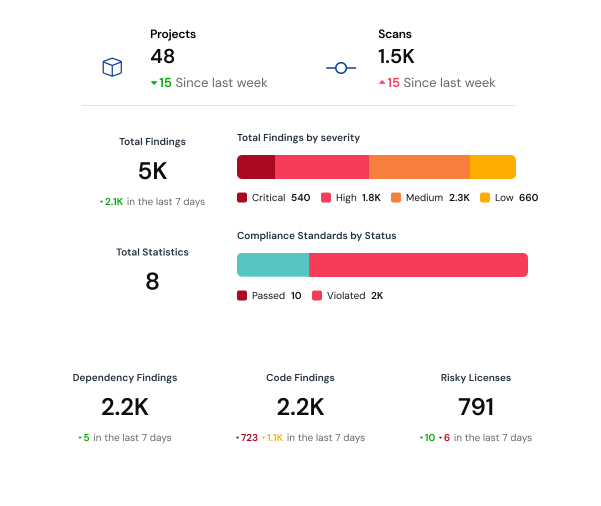







Proactively tackle open source security and compliance risks
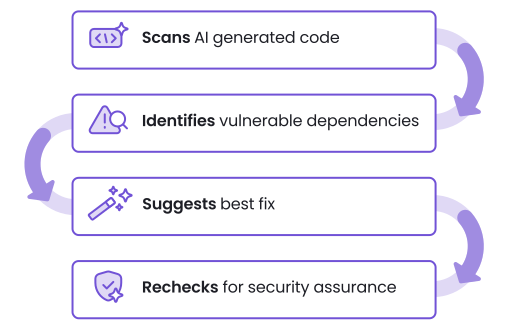
Agentic SCA delivery for AI code assistants, before code submission
Autonomously find and fix open source vulnerabilities, before committing to the repo.
Mend SCA feeds vulnerability information with reachability analysis into AI code assistants for rapid remediation of open source vulnerabilities, directly in the AI workflow.
Zero in on true risks without the noise
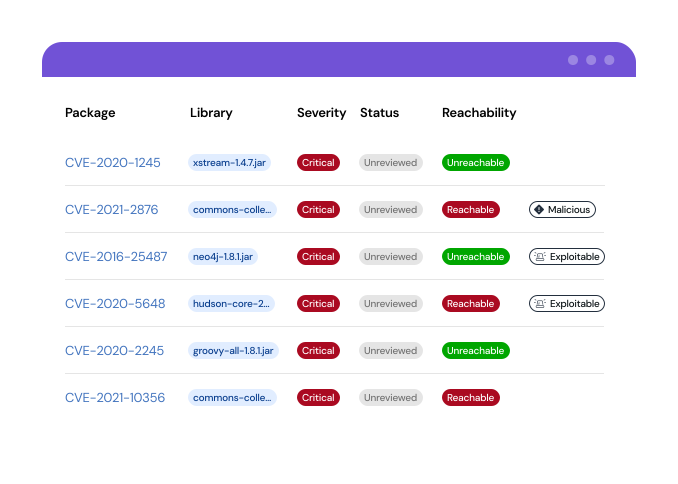
Pinpoint vulnerabilities that are truly reachable and exploitable, specific to your application and its AI components.
Mend SCA employs a unique reachability analysis, showing whether your code interacts with vulnerable functions in both direct and transitive dependencies that pose a threat to your AI models.
Prioritize threats based on severity
Use comprehensive vulnerability analysis to see true risks affecting your application, including those powered by AI.
Mend SCA uses CVSS 4.0 severity ratings to gauge the potential impact of vulnerabilities affecting your applications and incorporates EPSS exploitability data to assess the likelihood each vulnerability will be exploited.

Govern compliance of organizational standards
Give your legal team the visibility and control needed to ensure open source components meet organizational standards as you innovate with AI.
When Mend SCA detects license types that violate company policy, it issues real-time alerts with automatic remediation capabilities and can even block license violations before they become part of your code base.

Demonstrate transparency of your supply chain
Mend SCA generates a precise inventory of a software’s open source components, detailing all libraries and dependencies.
Easily export your SBOM in standardized formats (SPDX, CycloneDX) and import third-party SBOMs while leveraging VEX data to meet government and customer requirements with AI transparency.

Continuous integration. Continuous security.
Mend SCA lives where your developers work. With broad integration into IDEs, repositories, registries, and CI/CD pipeline, we provide automated risk remediation and policy enforcement that works while you code, build, deploy, and improve your applications.

Explore Mend SCA, part of Mend AppSec
Open source risk management for AI driven development

Learn more about how we can help

Proactively manage open source components and dependency risks

Halt malicious packages throughout the SDLC

Increase visibility into software components and vulnerabilities
Trusted by security teams all over the world


If we look at the number of PRs created by Mend SCA that were merged and compare that to the cost of developers doing that manually, then we have saved considerable developer time.


One of our most indicative KPIs is the amount of time for us to remediate vulnerabilities and also the amount of time developers spend fixing vulnerabilities in our code base, which has reduced significantly. We’re talking about at least 80% reduction in time.


When the product you sell is an application you develop, your teams need to be fast, secure and compliant. These three factors often work in opposite directions. Mend provides the opportunity to align these often competing factors, providing Vonage with an advantage in a very competitive marketplace.


The biggest value we get out of Mend is the fast feedback loop, which enables our developers to respond rapidly to any vulnerability or license issues. When a vulnerability or a license is disregarded or blocked, and there is a policy violation, they get the feedback directly.
Mend SCA FAQs
What is Mend SCA?
Mend SCA is a software composition analysis tool that identifies, prioritizes, and remediates security and license risks in the open source components your applications depend on. It uses reachability analysis, CVSS 4.0 and EPSS prioritization, SBOM generation, and automated policy enforcement to eliminate noise so developers fix what’s actually exploitable. It is included in Mend AppSec.
How does Mend SCA’s reachability analysis work?
Mend SCA traces the full call graph from your code through direct and transitive dependencies to determine whether your application actually invokes the vulnerable function inside a flagged package. Findings that aren’t reachable are deprioritized, eliminating the majority of CVEs that don’t pose real risk to your specific application.
How does Mend SCA prioritize vulnerabilities using CVSS 4.0 and EPSS?
Mend SCA combines CVSS 4.0 severity scoring with EPSS data, which estimates the probability a CVE will actually be exploited in the wild. Together with reachability, these signals create a risk-adjusted backlog that surfaces the most critical, exploitable vulnerabilities first.
Which open source licenses does Mend SCA flag?
Mend SCA detects every license attached to your direct and transitive dependencies, including copyleft (GPL, AGPL, LGPL), permissive (MIT, Apache 2.0), and dual-licensed packages. Teams define policies — for example, blocking AGPL in commercial products — and Mend SCA enforces them automatically in pull requests.
Does Mend SCA generate and ingest SBOMs in SPDX and CycloneDX?
Yes. Mend SCA produces SBOMs in the SPDX and CycloneDX standards, ingests third-party SBOMs from vendors, and applies VEX (Vulnerability Exploitability eXchange) data to communicate the exploitability of each component — meeting U.S. Executive Order 14028 requirements and customer security questionnaires.
Does Mend SCA detect malicious open source packages?
Yes. Beyond known CVEs, Mend SCA flags malicious packages — typosquats, dependency-confusion attacks, and packages containing data-exfiltration or backdoor code — using Mend.io’s continuously updated threat intelligence on the open source supply chain.
Which programming languages and package managers does Mend SCA support?
Mend SCA supports more than 200 programming languages and frameworks across major ecosystems — JavaScript/npm, Python (pip, Poetry), Java (Maven, Gradle), .NET (NuGet), Go, Ruby, PHP, Rust, Swift — plus container layers, infrastructure-as-code, and AI frameworks.
What’s the difference between Mend SCA and Mend Renovate?
Mend SCA detects and prioritizes open source vulnerabilities and license risks across your codebase. Mend Renovate automatically generates pull requests to update outdated dependencies.
How does Mend SCA integrate with CI/CD pipelines?
Mend SCA runs where the code already moves. It plugs into GitHub, GitLab, Bitbucket, and Azure DevOps, cloud or self-hosted, and the Mend CLI runs in whatever CI system you already use. A build can be gated on policy, so a package with a blocked license or a reachable critical vulnerability never reaches the artifact.
Explore SCA resources


Stop managing alerts.
Start reducing risk.
Join the teams reducing remediation effort by 75%.