


Best dependency management tools in 2026
Discover the leading solutions helping engineering teams reduce technical debt and open source security risks as they scale.
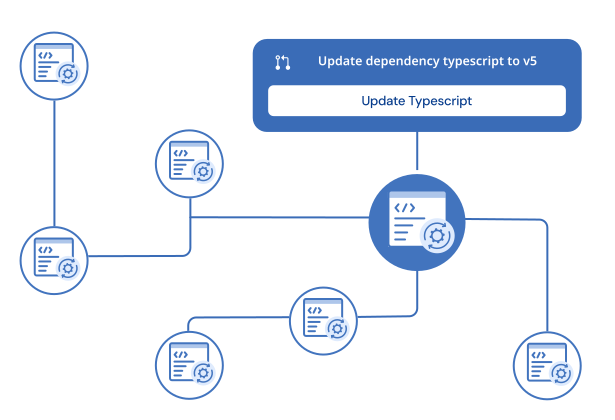
Understanding Dependency Management
What dependency management is and why it matters
Dependency management tools monitor the lifecycle, maintenance, and vulnerability status of third-party packages to ensure your software remains secure, modern, and performant.

Cut technical debt
Avoid development roadblocks created by accumulating technical debt from outdated dependencies.
Automate patching
Automatically generate pull requests for security fixes the moment a patch is available.
Secure the software supply chain
Ensure only packages that meet your organization’s security, license, and maintenance criteria are used.
Choosing Dependency Management
Choosing the right dependency management tool
Modern dependency management solutions go beyond just listing CVEs; they use confidence data to prioritize updates that provide the most security value with the least amount of breaking-change risk.
Automated dependency updates
Continuously detect and open PRs for outdated dependencies automatically across all repositories.
Predictive compatibility checks
Use merge confidence ratings to determine if a dependency update is safe to merge without breaking your build.
Frictionless developer workflows
Deliver update PRs directly into the developer’s environment, complete with release notes and changelogs.
How today’s dependency management tools compare
| Capability | Legacy dependency management tools | Modern dependency management tools | Mend Renovate |
|---|---|---|---|
| Update strategy | Manual updates once a year | Periodic alerts for new versions | Continuous, automated PRs with merge confidence grouping |
| Risk assessment | Only flags known CVEs | Flags outdated versions | Identifies breaking changes and provides Merge Confidence ratings |
| Breaking change prevention | No insights | Requires manual changelog research | Crowdsourced success data from millions of builds |
| Integration | CLI manual scans | Limited to specific Git hosts | Universal support |
| Security response | Reactive patching after breach | Flags vulnerable versions | Immediate remediation via automated, tested PRs |
Don’t just take our word for it: Why teams choose Mend.io
Dependabot:
“It’s basically the ‘good’ enough” option that’s better than nothing but frustrating if you need actual strategic dependency management.”


Mend.io:
“Renovate creates an issue which lists the status of all dependencies in the repository, which it keeps updated. It then creates PRs for each dependency update, which can then have CI run individually to give an indication of any issues with the update. It’s downright excellent.”


Snyk:
“We are forced to use Snyk–it’s basically infuriating support and false positives. I would try to avoid it if possible–it’s also insanely expensive, and despite that the support is hilariously bad.”

Mend.io:
“The pricing is reasonable and scalable, making it a good fit for our growing business.”

Snyk:
“Too much unnecessary false positives, policy overrides, hard and complex to manage and track alerts.”

Mend.io:
“Well, the dashboards are nice, the user interface is also good & some policy enforcement features are nice.”

Dependabot:
“Dependabot is essentially a GitHub-only feature. While there are ways to run it locally or on other platforms, it’s not designed for that, making it inaccessible for teams using other version control systems or specialized repository setups.”

Mend.io:
“Renovate isn’t special with how it authenticates… Renovate runs against GitLab, Bitbucket and I believe other platforms too.”
Snyk:
“Customer support is slow to respond, usually not helpful and ended up escalating to a developer, that’s when we lost all contact and did not get a solution to a clear bug that prevents us from using the product.”
Mend.io:
“The customer support team is knowledgeable and responsive, and the documentation is thorough and easy to understand.”


Dependabot:
“It’s basically the ‘good’ enough” option that’s better than nothing but frustrating if you need actual strategic dependency management.”
Mend.io:
“Renovate creates an issue which lists the status of all dependencies in the repository, which it keeps updated. It then creates PRs for each dependency update, which can then have CI run individually to give an indication of any issues with the update. It’s downright excellent.”


Snyk:
“We are forced to use Snyk–it’s basically infuriating support and false positives. I would try to avoid it if possible–it’s also insanely expensive, and despite that the support is hilariously bad.”
Mend.io:
“The pricing is reasonable and scalable, making it a good fit for our growing business.”


experience
Snyk:
“Too much unnecessary false positives, policy overrides, hard and complex to manage and track alerts.”
Mend.io:
“Well, the dashboards are nice, the user interface is also good & some policy enforcement features are nice.”


Dependabot:
“Dependabot is essentially a GitHub-only feature. While there are ways to run it locally or on other platforms, it’s not designed for that, making it inaccessible for teams using other version control systems or specialized repository setups.”
Mend.io:
“Renovate isn’t special with how it authenticates… Renovate runs against GitLab, Bitbucket and I believe other platforms too.”


Snyk:
“Customer support is slow to respond, usually not helpful and ended up escalating to a developer, that’s when we lost all contact and did not get a solution to a clear bug that prevents us from using the product.”
Mend.io:
“The customer support team is knowledgeable and responsive, and the documentation is thorough and easy to understand.”
FAQs
What is dependency management?
Dependency management refers to the overall health of your project’s external libraries. It measures how up-to-date your dependencies are, how quickly you adopt security patches, and whether you are stuck on “abandonware”—libraries that are no longer maintained by their authors.
Why does dependency management matter?
Outdated dependencies are a major source of technical debt. The longer you wait to update, the harder the eventual migration becomes due to breaking changes. Good dependency management ensures your application remains compatible with modern environments and secure against newly discovered threats.
How do I measure dependency management?
Common metrics include:
- Version Lag: How many versions behind the current release you are.
- Update Frequency: How often your team merges dependency PRs.
- Vulnerability MTTR: The Mean Time to Remediate a security flaw once it’s detected.
What is Mend Renovate?
Mend Renovate is the industry-leading tool for automated dependency updates that minimizes technical debt by keeping libraries current. Unlike basic bots, it uses merge confidence ratings and customizable merge confidence workflows to automate the merging of minor or patch updates once they have cleared automated safety tests. By allowing teams to group and schedule updates, it maximizes dependency health while removing the manual “grunt work” of staying up to date.
