


Mend.io vs HiddenLayer
Stop threats before they reach runtime.
HiddenLayer protects deployed models from adversarial attacks. But threats to your AI applications start long before deployment—in your supply chain, your system prompts, and your development workflows. Mend AI secures the full lifecycle, so you’re not waiting for production to find out what went wrong.

Mend AI and HiddenLayer comparison
|
Feature |
Mend AI |
HiddenLayer |
|---|---|---|
 Platform scope |
Full lifecycle coverage. AI security and AppSec in one solution — no separate tools required. |
Point solution. Primarily focuses on AI model scanning and runtime defense. |
 Shadow AI discovery |
Automatic. Inventories models, agents, and RAGs across the entire supply chain. |
Focuses on AI asset visibility within specific environments. |
 System prompt hardening |
Built-in. Automatically identifies logic flaws and insecure descriptions in prompts. |
Partial (via Guardrails) but lacks automated structural analysis. |
|
Remediation & automation |
Actionable fixes. Provides code-level remediation and automated policy enforcement. |
Detection and blocking-focused; less focused on developer “fix” workflows. |
 Governance & policy |
Enterprise-wide. Centralized policy engine maps risks to global compliance standards. |
Model-centric governance; less focus on broader application security. |
Why teams choose Mend AI over HiddenLayer
AI visibility that starts at the source
Mend AI maintains a real-time, continuous inventory of all AI components across your supply chain mapped to their vulnerabilities, licenses, and malicious package risks before they ever reach production.
HiddenLayer’s asset visibility is focused on models within specific deployed environments. Components that enter your stack through the supply chain, or models used outside monitored infrastructure, fall outside that scope.
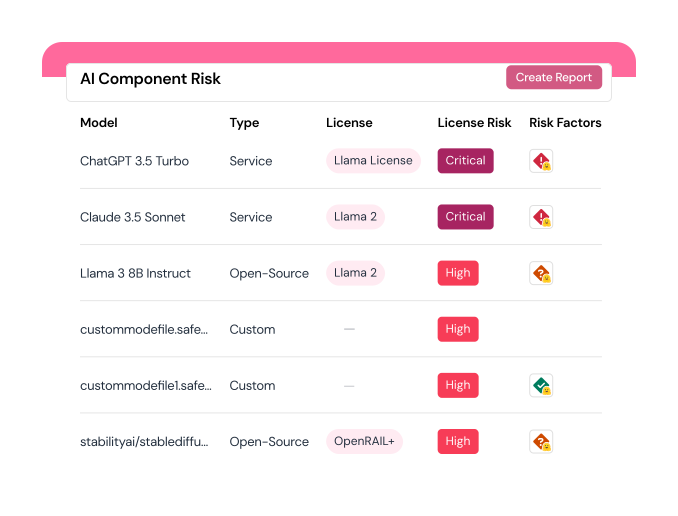
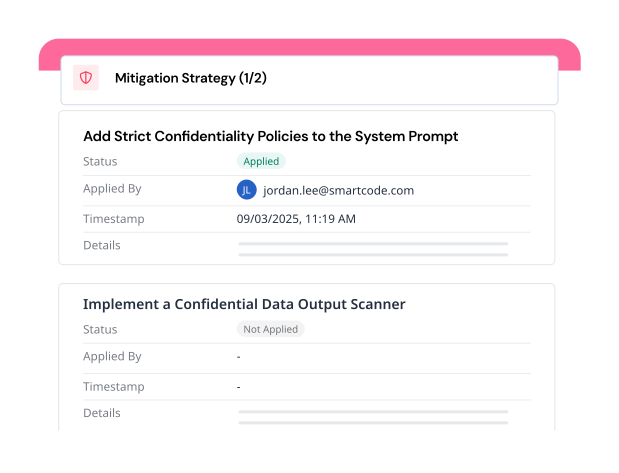
Prompt security before the model goes live
Mend AI automatically scans system prompt content for logic flaws, insecure descriptions, and exploitable structures — identifying risks at the source, before a user ever has the chance to exploit them at runtime.
HiddenLayer’s guardrails intercept prompt-based threats at the point of interaction. Mend AI hardens the prompt itself so there’s less for a runtime filter to catch in the first place.
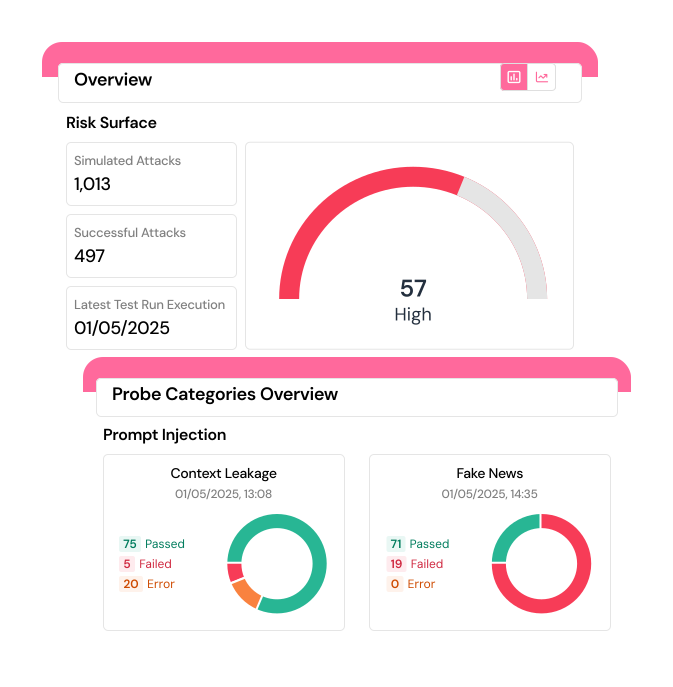
Adversarial testing that informs the full picture
Mend AI runs customizable red team campaigns simulating prompt injection, context leakage, data exfiltration, bias exploitation, and hallucination-based attacks.
HiddenLayer focuses on model scanning and runtime behavioral defense rather than structured adversarial testing of conversational AI. If your program requires pre-deployment LLM red teaming, that gap remains.
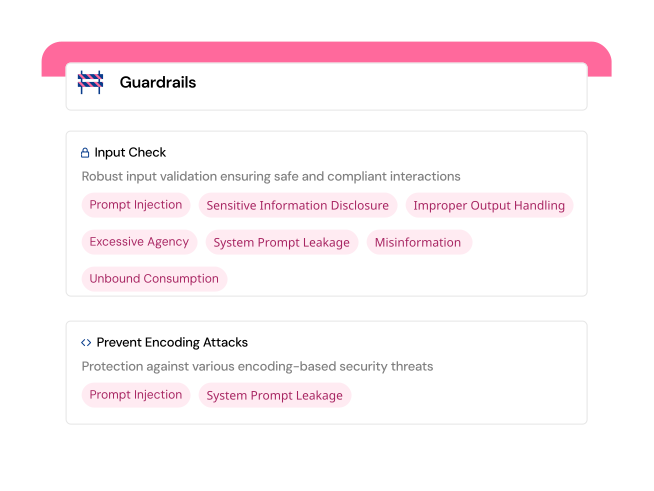
Defense built into every stage — including production
Mend AI applies real-time safety filters between your users and your AI models, defending against unpredictable behavioral threats as they happen.
Where HiddenLayer focuses on runtime model defense in isolation, Mend AI connects what it learns pre-deployment to how it protects in production. Threats that are caught earlier mean fewer incidents for your runtime layer to handle.
Governance that spans more than the model layer
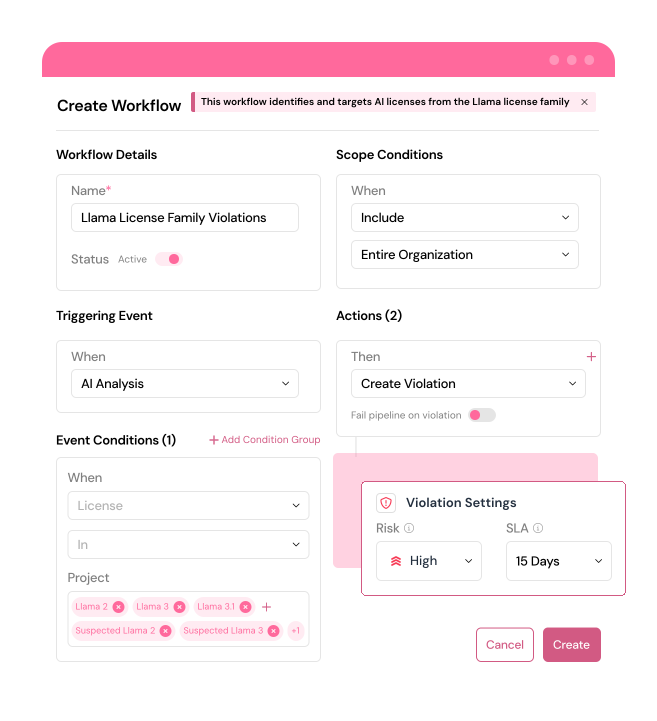
Mend AI’s policy engine lets teams define and enforce rules across every AI component in the SDLC triggering automated workflows when something falls out of compliance.
HiddenLayer’s governance is model-centric, focused on monitoring and protecting deployed models. Broader application-layer policy enforcement and developer-facing remediation workflows are outside its primary scope.
Not sure where your AI security gaps are?
Our compliance assessment maps your current posture against global AI security standards and delivers a personalized readiness report in under 5 minutes.
Frequently asked questions
Why do AI powered applications need a dedicated security solution over traditional AppSec?
Traditional AppSec focuses on static code and known vulnerabilities. AI introduces “non-deterministic” behavioral risks — like prompt injection and hallucinations — that exist outside the source code. Runtime defense tools can intercept these threats when they appear, but they can’t address how they entered your environment in the first place.
Mend AI secures the full lifecycle — catching risks at the supply chain and development layer so fewer threats reach production to begin with.
Why should security teams prioritize AI security now?
The speed of AI adoption has created a “Shadow AI” crisis. Without dedicated AI governance, organizations are unknowingly exposing sensitive data through third-party LLMs and unmonitored AI agents.
What is “Shadow AI” and why is it a risk?
Shadow AI refers to AI models or frameworks integrated into your environment without official IT approval. Runtime defense tools can only protect models they know about and have been configured to monitor. Mend AI automatically discovers hidden components across your supply chain — ensuring every model in your environment is accounted for, governed, and secured before it reaches a production context.
How does the Red Teaming process work?
Mend AI performs AI security testing by simulating adversarial attacks tailored to Large Language Models (LLMs). This allows teams to continuously assess how your models respond to malicious inputs, ensuring they remain resilient as both the model and the threat landscape evolve.
What exactly is “System Prompt Hardening”?
System Prompt Hardening is the process of securing the underlying instructions that guide a model’s behavior. Runtime guardrails intercept prompt-based attacks as they happen. Mend AI takes a different approach, analyzing the actual content of your prompts before deployment to eliminate the logic flaws and insecure structures that make those attacks possible in the first place.
We already have runtime model protection. Do we still need Mend AI?
Runtime protection is strongest when it’s connected to what happened before deployment. Mend AI combines runtime defense with supply chain visibility, system prompt hardening, and pre-deployment red teaming — so your runtime layer is informed by everything upstream.
Models entering your environment through the supply chain are already inventoried and assessed. Prompts are hardened before a user ever interacts with them. When a threat does reach production, Mend AI’s runtime protection is already working with full context on what it’s defending.
How is Mend AI different from a model security tool like HiddenLayer?
HiddenLayer is purpose-built to protect deployed models — scanning for adversarial threats and blocking attacks at runtime. Runtime protection in Mend AI is connected to the full lifecycle: models are inventoried and assessed as they enter your supply chain, system prompts are hardened before deployment, adversarial red teaming validates behavior pre-production, and governance policies are enforced throughout development.
By the time a threat reaches the runtime layer, Mend AI has already reduced the attack surface at every stage upstream. HiddenLayer protects the model. Mend AI protects everything around it too.
Does Mend AI replace our existing AppSec tools, or work alongside them?
Mend AI is designed to complement your existing stack for teams already running AppSec tooling. For teams evaluating a more consolidated approach, Mend AI is part of the broader Mend.io solution — which includes SAST, SCA, and dependency management — so you can expand coverage without adding vendors.
How does Mend AI handle compliance requirements for AI systems?
Mend AI generates AI Bills of Materials (AI-BoM) for all models, datasets, and frameworks in your applications — supporting emerging regulatory requirements including the EU AI Act. Policy enforcement workflows can be configured to align with internal governance standards and flag violations automatically before they become audit findings.
