


Mend.io vs Mindgard
Red teaming is just one piece. Mend AI covers the rest.
Mindgard does automated red teaming. But testing how your model behaves under attack is only part of securing an AI application. Mend AI delivers end-to-end security for your AI models, from vetting model integrity and supply chain risk to runtime protection.

Mend AI and Mindgard comparison
|
Feature |
Mend AI |
Mindgard |
|---|---|---|
 Platform scope |
Full lifecycle coverage. AI security and AppSec in one solution — no separate tools required. |
Point solution. Primarily focuses on automated red teaming and testing. |
 Shadow AI discovery |
Automatic. Inventories models, agents, and RAGs across the entire supply chain. |
Discovery via attack surface mapping (reconnaissance style). |
 System prompt hardening |
Built-in. Automatically identifies logic flaws and insecure descriptions in prompts. |
Manual/Simulated tests; identifies gaps but lacks automated remediation. |
|
Remediation & automation |
Actionable fixes. Provides code-level remediation and automated policy enforcement. |
Testing-focused; provides evidence for teams to fix manually. |
 Governance & policy |
Enterprise-wide. Centralized policy engine maps risks to global compliance standards. |
Audit-aligned reporting; focused on testing results rather than policy enforcement. |
Why teams choose Mend AI over Mindgard
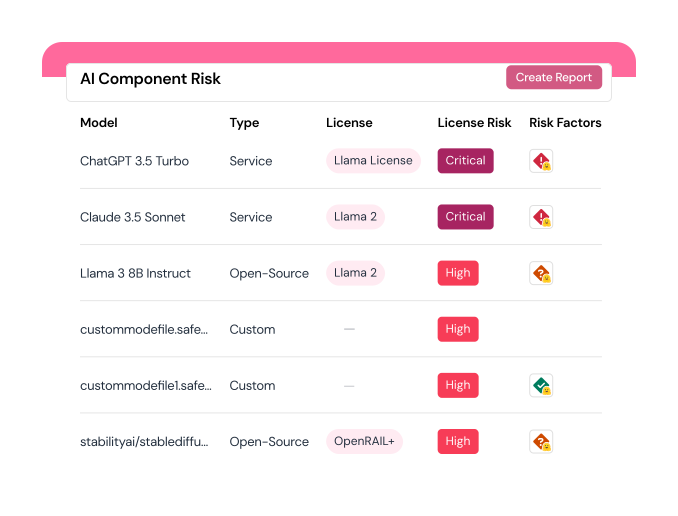
AI visibility that goes beyond attack surface mapping
Mend AI maintains a real-time, continuous inventory of all AI components across your supply chain — open source models, third-party agents, RAG pipelines, and shadow AI — mapped to vulnerabilities, licenses, and malicious package risks.
Mindgard’s discovery is reconnaissance-oriented, mapping your attack surface to inform testing. Mend AI goes further, tying what it finds to actionable supply chain risk so you know not just what’s exposed, but what’s exploitable.
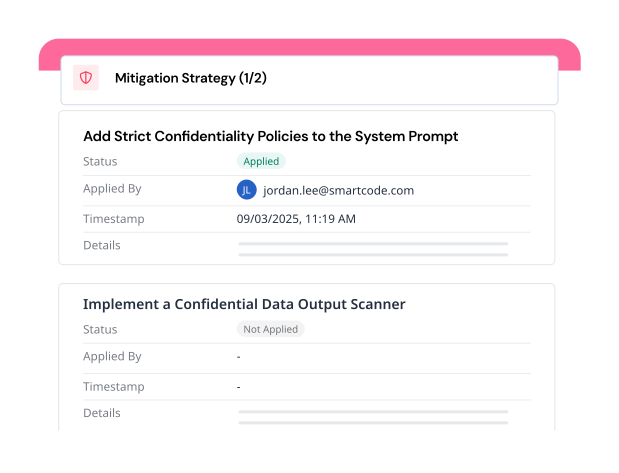
Prompt security built in, not simulated
Mend AI automatically scans system prompt content for logic flaws, insecure descriptions, and exploitable structures that could allow a user to manipulate or bypass your AI’s intended behavior — before any adversarial testing is needed.
Mindgard can surface prompt vulnerabilities through simulated attacks, but doesn’t harden the prompt itself.
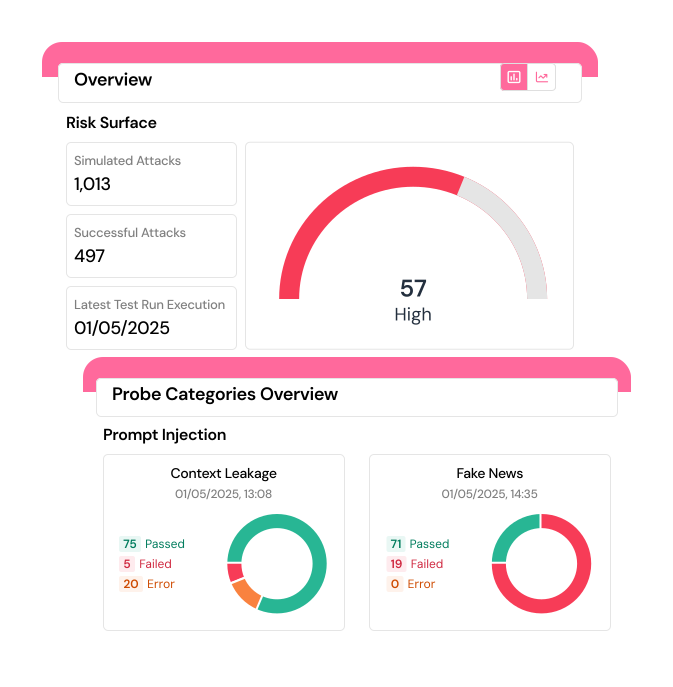
Adversarial testing that’s part of a bigger picture
Mend AI runs customizable red team campaigns simulating prompt injection, context leakage, data exfiltration, bias exploitation, and hallucination-based attacks.
Mindgard is purpose-built for automated red teaming. But testing in isolation means findings don’t connect to your broader security posture, remediation workflows, or policy enforcement.
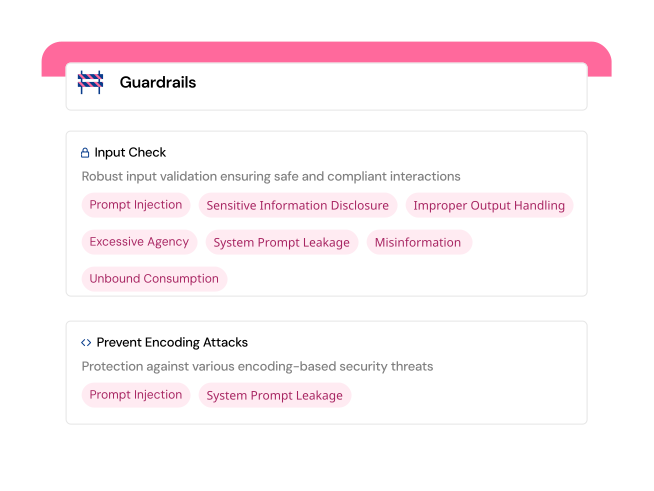
Defense that follows your AI into production
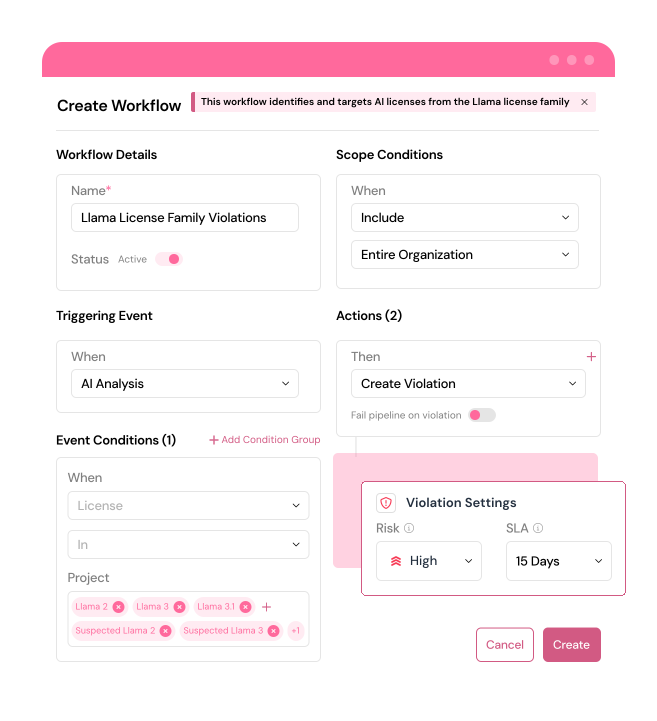
Mend AI’s policy engine and governance workflows continue enforcing AI security controls post-deployment — monitoring for behavioral drift and flagging violations as they occur.
Mindgard’s focus is on pre-deployment testing and audit-ready reporting. What happens after your model ships, and how violations are enforced automatically, falls outside its primary scope.
Governance that acts on what testing finds
Mend AI’s policy engine lets teams define granular rules for every AI component in the SDLC — triggering automated workflows when a model, agent, or prompt falls out of compliance. Findings from red teaming feed directly into enforcement, not just a report.
Mindgard produces detailed testing results and audit-aligned reporting, but remediation and policy enforcement require manual follow-through.
Not sure where your AI security gaps are?
Our compliance assessment maps your current posture against global AI security standards and delivers a personalized readiness report in under 5 minutes.
Frequently asked questions
Why do AI powered applications need a dedicated security solution over traditional AppSec?
Traditional AppSec focuses on static code and known vulnerabilities. AI introduces “non-deterministic” behavioral risks — like prompt injection and hallucinations — that exist outside the source code. And while adversarial testing tools can simulate how those risks are exploited, they don’t address the supply chain, governance, and remediation workflows needed to actually close them.
Mend AI handles both the testing and everything that comes after.
Why should security teams prioritize AI security now?
The speed of AI adoption has created a “Shadow AI” crisis. Without dedicated AI governance, organizations are unknowingly exposing sensitive data through third-party LLMs and unmonitored AI agents.
What is “Shadow AI” and why is it a risk?
Shadow AI refers to AI models or frameworks integrated into your environment without official IT approval. These create blind spots for data leakage across your AI supply chain. Adversarial testing tools can only test what they know about — if a model or agent isn’t in scope, it isn’t tested.
Mend AI automatically discovers hidden components first, ensuring nothing falls outside your security coverage.
How does the Red Teaming process work?
Mend AI performs AI security testing by simulating adversarial attacks tailored to Large Language Models (LLMs). This allows teams to continuously assess how your models respond to malicious inputs, ensuring they remain resilient as both the model and the threat landscape evolve.
What exactly is “System Prompt Hardening”?
System Prompt Hardening is the process of securing the underlying instructions that guide a model’s behavior. Unlike adversarial testing that reveals how a prompt can be exploited after the fact, Mend AI analyzes the actual content of your prompts proactively — identifying logic flaws and insecure structures before they become attack vectors.
We already use a red teaming tool. Do we still need Mend AI?
Adversarial testing tells you where your AI is vulnerable. Mend AI tells you why — and fixes it. Supply chain risks, insecure prompt logic, ungoverned AI components, and lack of policy enforcement are all vectors that red teaming surfaces but can’t remediate on its own.
Mend AI integrates testing findings into automated workflows so gaps get closed, not just documented.
How is Mend AI’s red teaming different from a dedicated tool like Mindgard?
Mindgard is purpose-built for automated adversarial testing — it goes deep on model-level attack simulation. Mend AI’s red teaming is designed to be part of a broader security workflow: findings connect directly to supply chain data, prompt hardening, governance policies, and remediation.
If your program needs standalone depth in red teaming, Mindgard is strong. If you need red teaming that feeds into a complete security posture, Mend AI is built for that.
Does Mend AI replace our existing AppSec tools, or work alongside them?
Mend AI is designed to complement your existing stack for teams already running AppSec tooling. For teams evaluating a more consolidated approach, Mend AI is part of the broader Mend.io solution — which includes SAST, SCA, and dependency management — so you can expand coverage without adding vendors.
How does Mend AI handle compliance requirements for AI systems?
Mend AI generates AI Bills of Materials (AI-BoM) for all models, datasets, and frameworks in your applications — supporting emerging regulatory requirements including the EU AI Act.
Policy enforcement workflows can be configured to align with internal governance standards and flag violations automatically before they become audit findings.
