


Mend.io vs Snyk
Why AppSec and AI Security teams choose Mend.io
Snyk is racing to become an AI security company. Mend.io already is one, without sacrificing the AppSec foundation your team depends on.
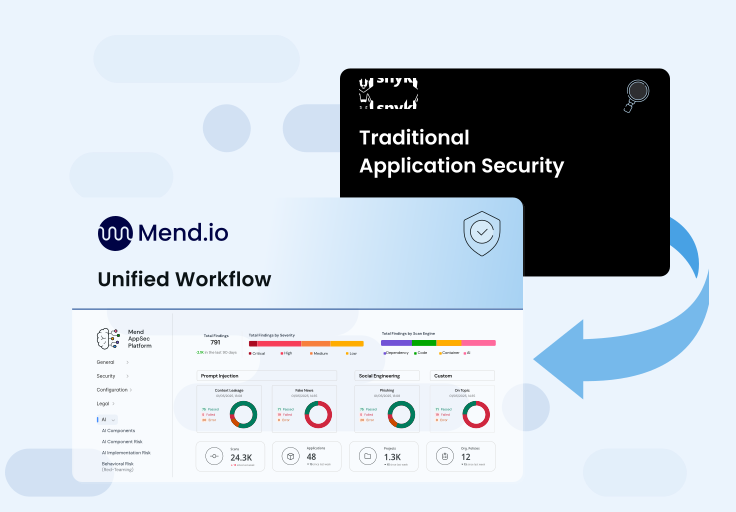






Mend.io and Snyk comparison
|
Feature |
Mend.io |
Snyk |
|---|---|---|
 AI component inventory & AI BoM |
Continuously inventories AI models, agents, RAGs, and frameworks in applications. Generates AI Bills of Materials. |
Provides AI component discovery — but requires a separate product layer; not native to core AppSec workflows. |
 Red teaming |
Built-in adversarial testing of AI model behavior, prompt injection, and system prompt hardening. |
Agent Guard in private preview. Not yet GA. |
 Reachability & risk-based prioritization |
AI-powered triage and reachability analysis filter out non-exploitable findings — teams focus on real risk, not alert queues. |
Risk scoring improves prioritization, but users report high false-positive volumes at enterprise scale requiring manual triage. |
 License compliance |
File-level detection, conflict analysis, and legal insights — proactively blocks non-compliant licenses. |
Lacks conflict resolution and detailed legal guidance. |
 Scan reliability |
High-performance, comprehensive scans (Mend SAST scans 10x faster with +38% better precision and +48% better recall than traditional tools) that run on commit. |
Silent failures, missed detections, CLI inconsistencies, complaints of high false positives and negatives, particularly in SAST findings |
 Dependency management |
Leverages data from 1.7 billion Mend Renovate installs to recommend the optimal dependency upgrade path. No beta version suggestions. |
Flawed suggestions, outdated caches |
Why enterprises are switching from Snyk to Mend.io
Scan accuracy that actually reduces risk
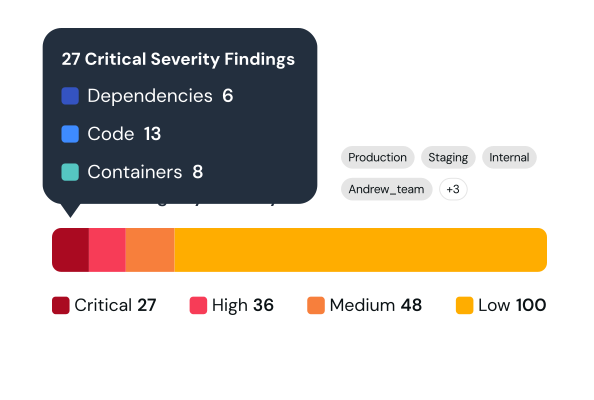
Mend SAST scans 10× faster with +38% better precision and +48% better recall than traditional tools — with no file size restrictions. Every commit. Every file.
Snyk users report noisy SAST results and a 1MB file cap that silently skips critical code.
AI security that’s production-ready today
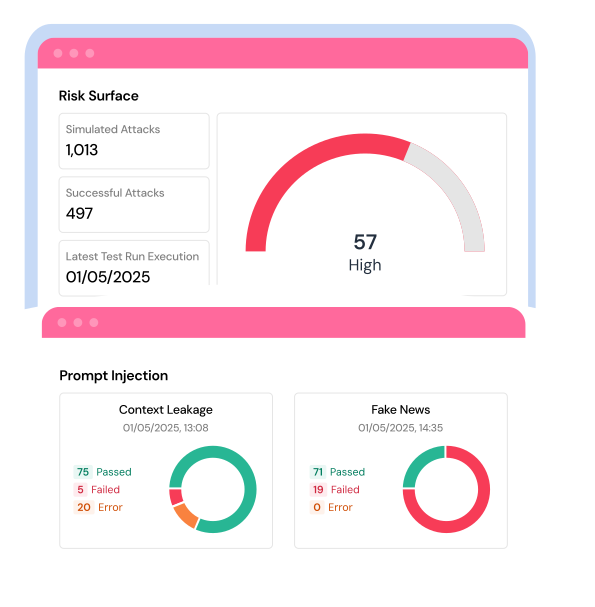
Mend AI delivers continuous AI component inventory, AI BoM generation, system prompt hardening, and adversarial red teaming — all GA and integrated into the core platform.
Snyk’s Agent Guard (for agentic app security) remains in private preview. Coverage is still catching up.
License risk governance that goes deep
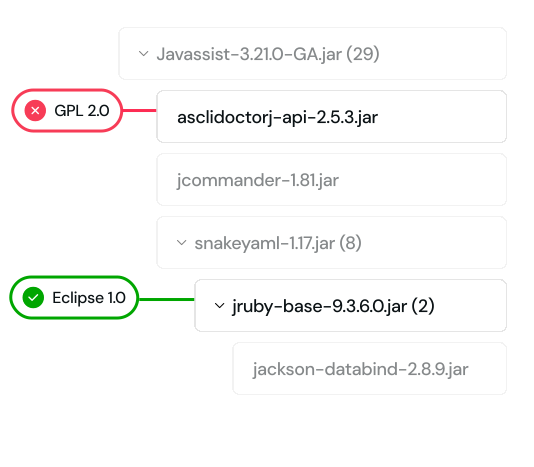
Mend detects license conflicts at the file level, flags incompatibilities, and provides actionable legal insights — not just a list of licenses.
Snyk identifies licenses but lacks conflict analysis, leaving legal and compliance teams to manually resolve issues.
Simple pricing that scales with you
Mend.io offers simple, transparent pricing with no scan limits or hidden upsells.
Snyk’s tiered per-product pricing piles on extra contracts and add-ons.

Faster, simpler deployment
Mend.io deploys in minutes — cloud-native and already integrated into your SCM, CI/CD, and IDEs. No queues. No downtime. Just coverage from day one.
Snyk users report challenges integrating with tools, requiring manual workarounds that slow time-to-value.

Don’t just take our word for it: Why teams choose Mend.io
Snyk:
“The security analysis is very primitive and often flags false positive which has to be fixed with manual override or skipping the PR validation check.”


Mend.io:
“The accuracy of vulnerability detection is impressive, and we have rarely encountered false positives.”

Snyk:
“Snyk is an expensive solution.”

Mend.io:
“The pricing is reasonable and scalable, making it a good fit for our growing business.”
Snyk:
“Too much unnecessary false positives, policy overrides, hard and complex to manage and track alerts.”

Mend.io:
“The user interface is intuitive and easy to navigate, even for non-technical users.”
Snyk:
“Integrations with other systems and platforms, such as Bamboo and JFrog Artifactory, have proven challenging and need enhancement.”
Mend.io:
“The integration with our existing tools (like JIRA and Jenkins) was seamless, saving us a lot of time and effort.”
Snyk:
“Customer support is slow to respond, usually not helpful and ended up escalating to a developer, that’s when we lost all contact and did not get a solution to a clear bug that prevents us from using the product.”
Mend.io:
“The customer support team is knowledgeable and responsive, and the documentation is thorough and easy to understand.”


Snyk:
“The security analysis is very primitive and often flags false positive which has to be fixed with manual override or skipping the PR validation check.”
Mend.io:
“The accuracy of vulnerability detection is impressive, and we have rarely encountered false positives.”


Snyk:
“Snyk is an expensive solution.”
Mend.io:
“The pricing is reasonable and scalable, making it a good fit for our growing business.”


experience
Snyk:
“Too much unnecessary false positives, policy overrides, hard and complex to manage and track alerts.”
Mend.io:
“The user interface is intuitive and easy to navigate, even for non-technical users.”


Snyk:
“Integrations with other systems and platforms, such as Bamboo and JFrog Artifactory, have proven challenging and need enhancement.”
Mend.io:
“The integration with our existing tools (like JIRA and Jenkins) was seamless, saving us a lot of time and effort.”


Snyk:
“Customer support is slow to respond, usually not helpful and ended up escalating to a developer, that’s when we lost all contact and did not get a solution to a clear bug that prevents us from using the product.”
Mend.io:
“The customer support team is knowledgeable and responsive, and the documentation is thorough and easy to understand.”
Frequently asked questions
What makes Mend.io’s reachability different from Snyk’s?
Mend.io’s reachability analysis focuses on identifying vulnerabilities that are actually invoked in the application’s runtime flow, using precise static code analysis to filter out unused code. This significantly reduces false positives, ensuring teams prioritize only real, exploitable risks.
In contrast, Snyk’s reachability provides a broader view by identifying potentially accessible code paths, which can increase visibility but may flag vulnerabilities that aren’t directly used. Mend’s precision helps teams save time and focus on what truly matters
How does Mend.io’s AI security compare to Snyk’s Evo AI-SPM?
Mend AI is fully GA covering AI component inventory, AI Bill of Materials, behavioral risk analysis, system prompt hardening, and AI red teaming. Snyk’s Evo AI-SPM reached GA in March 2026 with discovery, risk intelligence, and policy agents, but Agent Guard (for runtime agentic security) remains in private preview. Mend AI gives security teams a complete, production-ready AI security posture today.
What’s the difference between your dependency management and Snyk’s?
The Mend.io solution leverages data from millions of repositories and 1.7 billion Mend Renovate installs to analyze package age, adoption trends, and build failure rates to pinpoint the optimal upgrade path— the newest, most stable, least vulnerable library version that provides the most significant risk reduction. With automated remediation, customers can further accelerate MTTR.
While Snyk does offer some dependency management, it struggles with accurate dependency upgrades, even suggesting ‘beta’ version upgrades that are not even possible.
How does pricing compare?
Mend.io offers simple, transparent pricing with no scan limits or hidden upsells. Mend AppSec delivers full platform coverage across code, open source, containers, and AI inventory for up to $1,000 per developer per year.
For teams focused on securing AI, Mend AI Premium adds advanced AI component inventory, AI component risk insights, system prompt hardening, AI red teaming, and proactive policies and governance for up to $300 per developer per year.
Available within the Platform or as a stand-alone product, Mend Renovate Enterprise delivers enterprise-grade dependency automation for up to $250 per developer per year.
What’s the difference between how Mend.io and Snyk handle large files for SAST scanning?
Mend SAST provides comprehensive, fast scanning with no file size restrictions. This ensures that critical vulnerabilities in large files are not missed, allowing for deeper and more reliable security insights.
Snyk has a 1MB file size limit, which impacts the comprehensiveness of your project’s security analysis. If your codebase includes critical files exceeding 1MB, they won’t be scanned. To maintain full visibility and security coverage, adjustments like refactoring are required.
Does Mend.io have any scan limits or restrictions I need to know about?
No. The platform is designed to scale with your organization’s needs.
