


Mend.io vs Sonatype
Is Sonatype giving you everything you need?
Open source is only part of your risk. Mend.io secures your entire SDLC, without adding vendors.
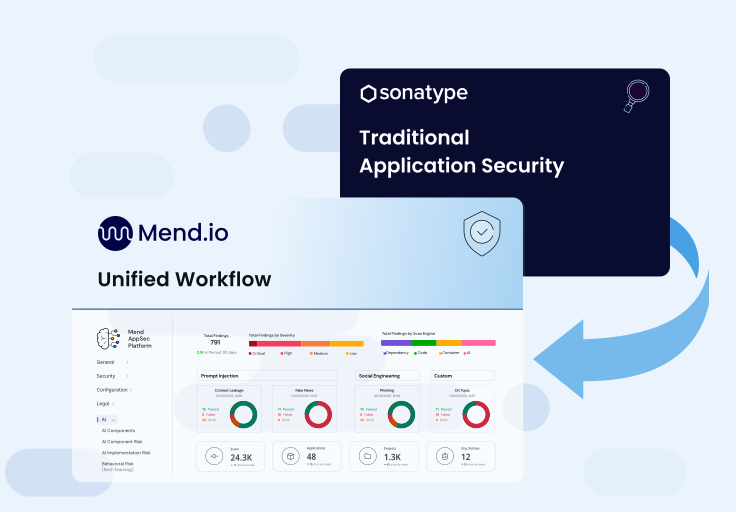






Mend.io and Sonatype comparison
|
Feature |
Mend.io |
Sonatype |
|---|---|---|
 Custom code scanning |
High-performance SAST that scans 10× faster with +38% better precision and +48% better recall than traditional tools. No file size limits. |
No SAST capability. Sonatype’s focus is exclusively on open source and supply chain risk — proprietary code vulnerabilities are out of scope. |
 AI component inventory & AI BoM |
Continuously inventories AI models, agents, RAGs, and frameworks in applications. Generates AI Bills of Materials. |
No full AI component risk analysis or AI BoM generation. |
 Red teaming |
Built-in adversarial testing of AI model behavior, prompt injection, and system prompt hardening. |
No AI red teaming capability. |
 Advanced reachability analysis |
Precise static analysis confirms runtime invocation — significantly reducing false positives and alert fatigue. |
No, but offers “Call flow analysis” (limited scope) |
 Automated dependency updates |
Mend Renovate — backed by 1.7B installs — automates dependency PRs with Merge Confidence scoring and optimal upgrade path recommendations. |
No native automated PR workflow equivalent to Mend Renovate. |
 Pricing |
Transparent pricing. No scan limits. |
Complex pricing – full coverage requires separate purchases. |
Why enterprises are switching from Sonatype to Mend.io
Your proprietary code has vulnerabilities too
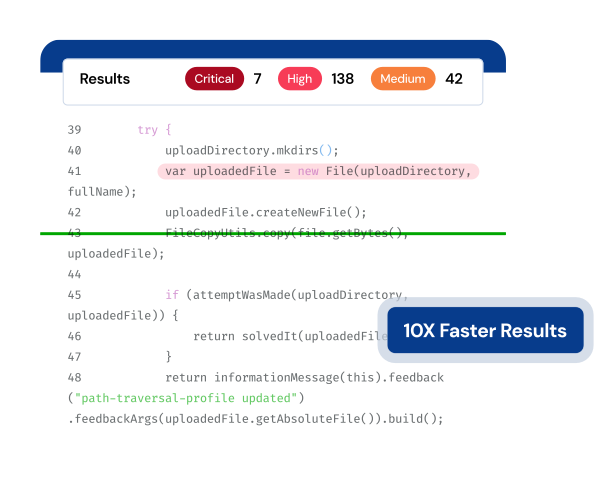
Mend SAST scans custom code 10× faster with +38% better precision and +48% better recall than traditional tools — running on every commit, with no file size limits and no overnight scan queues.
Sonatype has no SAST capability. Teams that rely on it exclusively have no visibility into vulnerabilities introduced in their own code — a significant blind spot for any AppSec program.
AI security beyond the supply chain
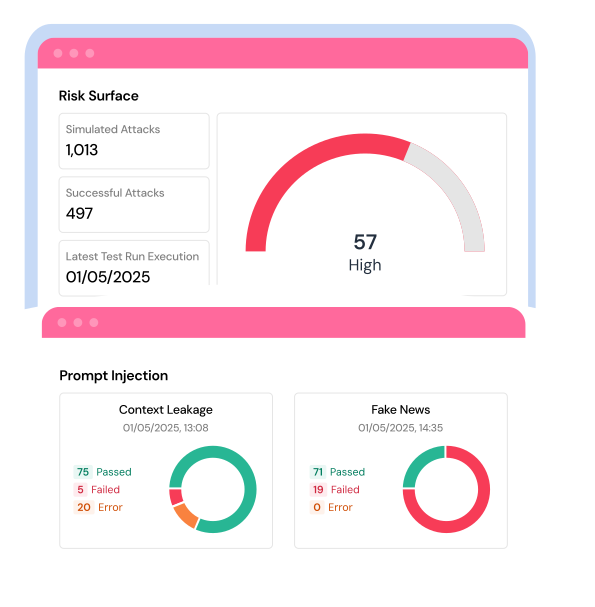
Mend AI inventories AI models and agents, generates AI Bills of Materials, hardens system prompts, and runs adversarial red teaming — covering the full AI attack surface, not just model provenance.
Sonatype AI SCA governs AI/ML model usage in the supply chain but does not offer AI red teaming, system prompt hardening, or behavioral AI risk analysis.
Prioritization that cuts through the noise
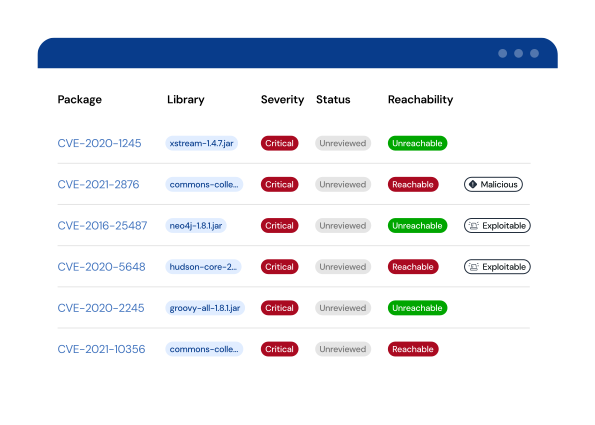
Mend.io’s reachability analysis confirms whether a vulnerable function is actually invoked at runtime — so developers triage only real, exploitable risks rather than a flood of theoretical alerts.
Sonatype’s false positive rate — particularly in JavaScript and Python ecosystems — is a frequently cited pain point. Call flow analysis covers some gaps but is limited in scope.
Simple pricing that scales with you
Mend.io offers simple, transparent pricing with no scan limits or hidden upsells.
Achieving comparable coverage with Sonatype requires purchasing Lifecycle, Repository Firewall, Guide, and AI SCA separately — making total cost unpredictable and procurement complex.

Don’t just take our word for it: Why teams choose Mend.io
Sonatype:
“Can be expensive for smaller organizations.”


Mend.io:
“The pricing is reasonable and scalable, making it a good fit for our growing business.”

Sonatype:
“While Sonatype Lifecycle offers a wide range of features, we’ve found that it tends to flag a high number of false positives, especially when dealing with JavaScript and Python dependencies. This can be time-consuming for our development team as they have to manually investigate each alert to determine if it’s a real issue or not.”

Mend.io:
“The accuracy of vulnerability detection is impressive, and we have rarely encountered false positives.”
Sonatype:
“The UI could be improved. The error messages can be made clearer.”

Mend.io:
“The user interface is intuitive and easy to navigate, even for non-technical users.”
Sonatype:
“We have run into issues with Nexus and various plug-ins specifically maven from time to time.”
Mend.io:
“The integration with our existing tools (like JIRA and Jenkins) was seamless, saving us a lot of time and effort.”

Sonatype:
“Could use more comprehensive documentation and training resources.”
Mend.io:
“The customer support team is knowledgeable and responsive, and the documentation is thorough and easy to understand.”


Sonatype:
“Can be expensive for smaller organizations.”
Mend.io:
“The pricing is reasonable and scalable, making it a good fit for our growing business.”


Sonatype:
“While Sonatype Lifecycle offers a wide range of features, we’ve found that it tends to flag a high number of false positives, especially when dealing with JavaScript and Python dependencies. This can be time-consuming for our development team as they have to manually investigate each alert to determine if it’s a real issue or not.”
Mend.io:
“The accuracy of vulnerability detection is impressive, and we have rarely encountered false positives.”


experience
Sonatype:
“The UI could be improved. The error messages can be made clearer.”
Mend.io:
“The user interface is intuitive and easy to navigate, even for non-technical users.”


Sonatype:
“We have run into issues with Nexus and various plug-ins specifically maven from time to time.”
Mend.io:
“The integration with our existing tools (like JIRA and Jenkins) was seamless, saving us a lot of time and effort.”


Sonatype:
“Could use more comprehensive documentation and training resources.”
Mend.io:
“The customer support team is knowledgeable and responsive, and the documentation is thorough and easy to understand.”
Frequently asked questions
Does Sonatype offer SAST or container security?
No. Sonatype’s platform is built around software composition analysis (SCA), supply chain governance, and open source intelligence. It does not offer SAST for proprietary code or comprehensive container security with reachability analysis.
Teams that rely solely on Sonatype have meaningful blind spots in their AppSec coverage. Mend.io covers all of these in a single platform.
How does Sonatype Guide compare to Mend Renovate?
Sonatype Guide is an MCP-based tool that intercepts AI coding assistant package recommendations and steers them toward secure components. It is primarily designed to improve AI-assisted development workflows.
Mend Renovate automates dependency update PRs for existing codebases across public and private packages — backed by data from 1.7 billion installs — with Merge Confidence scoring and safe upgrade path recommendations. Renovate’s PR automation has no direct equivalent in Sonatype’s current product lineup.
How does pricing compare?
Mend.io offers simple, transparent pricing with no scan limits or hidden upsells. Mend AppSec delivers full platform coverage across code, open source, containers, and AI inventory for up to $1,000 per developer per year.
For teams focused on securing AI, Mend AI Premium adds advanced AI component inventory, AI component risk insights, system prompt hardening, AI red teaming, and proactive policies and governance for up to $300 per developer per year.
Available within the Platform or as a stand-alone product, Mend Renovate Enterprise delivers enterprise-grade dependency automation for up to $250 per developer per year.
How does Sonatype’s AI SCA compare to Mend AI?
Sonatype AI SCA focuses on detecting and governing AI/ML models within the open source supply chain. Mend AI covers this and goes further: continuous AI component inventory across models, agents, RAGs, and frameworks; AI Bill of Materials generation; system prompt hardening; and adversarial AI red teaming.
If your concern is AI model provenance in the supply chain, Sonatype is relevant. If you need to secure the full AI application stack, Mend AI is the more complete solution.
Is Sonatype a better fit if we only care about open source risk?
Sonatype has deep expertise in open source governance and supply chain intelligence. For organizations whose primary concern is open source component risk and supply chain policy enforcement, Sonatype is a credible choice.
However, most enterprise AppSec programs also need to address proprietary code vulnerabilities, container risks, and AI security — areas where Mend.io provides substantially broader coverage in a single solution.
