
Mend.io vs GitHub Advanced Security (GHAS)
Compare Mend.io and GitHub Advanced Security
GHAS wasn’t designed for AI-generated code, containers, or multi-repo environments. Mend.io was built for the attack surface you actually have.
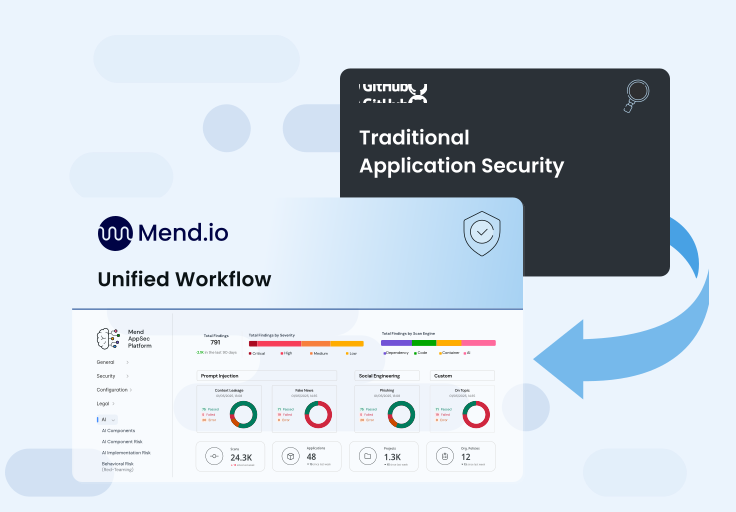






How Mend.io and GHAS compare
|
Feature |
Mend.io |
GHAS |
|---|---|---|
 Supported Ecosystems |
Supports a wide range of development environments, repositories (e.g., GitHub, Azure, GitLab, Bitbucket, or self-hosted solutions), IDEs, package managers, and CI/CD tools, offering flexibility across various ecosystems. |
GitHub and Azure DevOps ecosystem only |
 AI & AppSec Coverage |
AI, SAST, SCA, Container, and automated dependency updates |
SAST, secrets, dependency updates; incomplete for modern AI risk |
 Accuracy, Speed, & Scalability |
High-performance, comprehensive scans (Mend SAST scans 10x faster with +38% better precision and +48% better recall than traditional tools) that run on commit. Built to manage large-scale applications across diverse environments. |
False positives, struggles to accurately detect and prioritize more complex risks. Performance degradation and increased build times for large-scale applications. These only worsen with an increased code volume from AI-generated code. |
 Risk Prioritization |
Reachability and exploitability-based |
Lacks reachability and insight into whether something is invoked within the application’s execution flow |
 Malicious Package Detection |
Behavioral analysis, heuristics, threat intelligence |
Limited to dependency manifests |
 Transitive Dependency Analysis |
Deep visibility, leverages data from 1.7 billion Mend Renovate installs to recommend the optimal dependency upgrade path— the newest, most stable, least vulnerable library version that provides the most significant risk reduction. |
Incomplete, noisy suggestions |
 Policies, Workflows, & Reporting |
Rich pre-built templates, custom policy builders, and powerful workflows to enforce risk tolerances, embed guardrails, and ensure compliance |
Lacks sophisticated workflows, centralized reporting, and unified policy management, no out-of-the-box controls, requires custom scripts and third-party integrations for enforcement |
|
Operationalization |
Global configuration, high adoption for both developers and AppSec |
Steep learning curve, custom queries required |
Why enterprises are switching from GitHub Advanced Security to Mend.io
Built for AI
As AI-generated code accelerates development, GitHub Advanced Security leaves teams buried in alert fatigue, slow scans, and growing backlogs. Mend.io delivers high-precision detection, automated remediation, and AppSec workflows that actually scale.
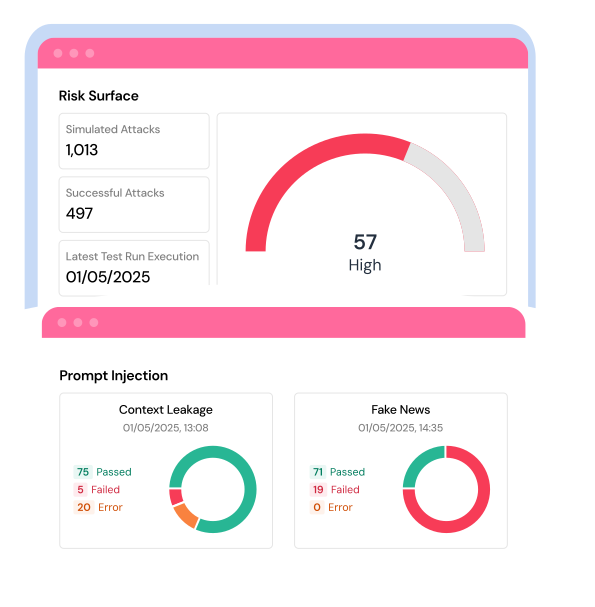
Secure all your code, not just what’s in GitHub
If your stack spans multiple repos, containers, or AI components, GHAS won’t cover it. Mend.io provides unified security coverage across GitHub, Bitbucket, GitLab, Kubernetes, and beyond.
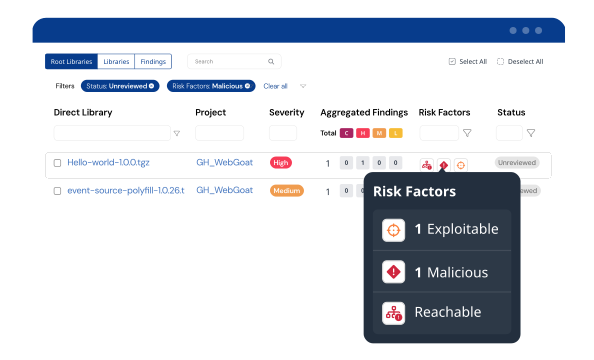
Detect and block malicious packages
GHAS analyzes dependency manifests but lacks malicious behavioral analysis. Mend.io proactively identifies and blocks malicious packages using ML models, heuristics, and real-time threat intelligence.
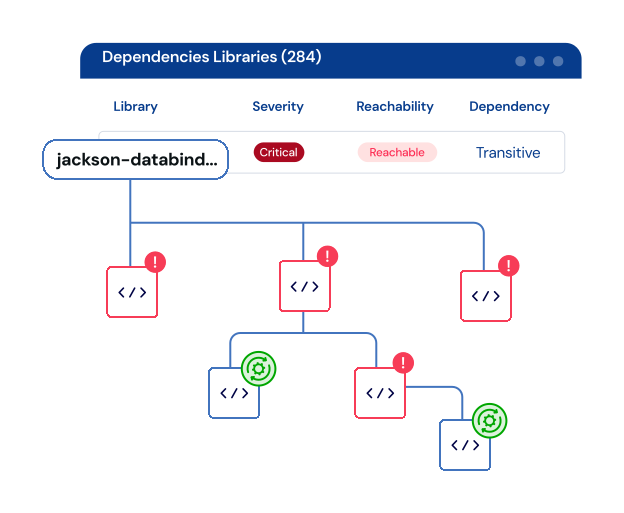
Precision for both direct and transitive dependencies
GHAS dependency graphs miss transitive risks. Mend.io combines multiple scanning methods with data from 1.7 billion Mend Renovate installs to provide precise upgrade paths and deeper visibility.
Improve controls for compliance and SLAs
GHAS lacks robust policy management, forcing reliance on custom scripts. Mend.io delivers enterprise-grade compliance with pre-built templates, policy builders, and automated enforcement.

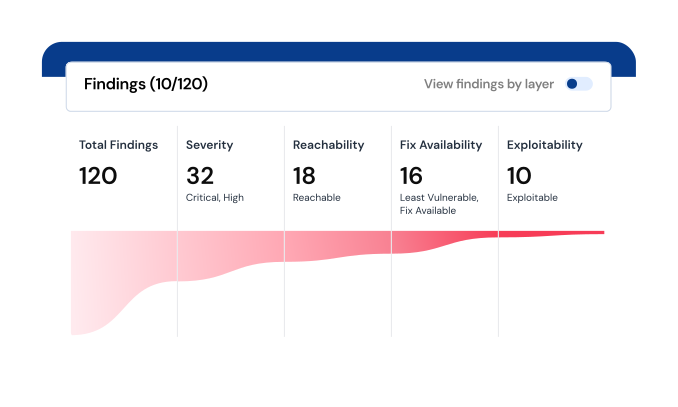
Get reachability and exploitability insights
GHAS identifies vulnerabilities but can’t deeply assess reachability. Mend.io traces vulnerabilities through execution flow, focusing on what’s actually at risk.
Dev-focused, AppSec-optimized
GHAS prioritizes the developer experience but poses significant challenges for cross-functional and AppSec teams. Mend.io brings the best of both worlds with dev-centric tools and enterprise-grade products for maximum impact.

Don’t just take our word for it: Why teams choose Mend.io
GitHub Enterprise:
“GitHub Enterprise sales and pricing is very opaque and arbitrary… It is a very frustrating process to deal with. So we stopped our expansion plan on GitHub (Advanced Security and GitHub Actions).”


Mend.io:
“The pricing is reasonable and scalable, making it a good fit for our growing business.”

GitHub Enterprise:
“Notification settings are quite course-grained. It’s taken me months to get mine in good order. I’m pretty sure most of our developers just leave the default settings and are overwhelmed by the flood.”
Mend.io:
“The accuracy of vulnerability detection is impressive, and we have rarely encountered false positives.”

GitHub Enterprise:
“More helpful information is required regarding security. A central dashboard is required for dependable management of issues and dependencies across thousands of repositories.”
Mend.io:
“The user interface is intuitive and easy to navigate, even for non-technical users.”
GitHub Enterprise:
“Some of the options for integrating more of a testing component seem a little bit lacking – can customize portions of it to get the job done, but would love to see more of a focus on that.”
Mend.io:
“The integration with our existing tools (like JIRA and Jenkins) was seamless, saving us a lot of time and effort.”
GitHub Enterprise:
“Customer support is terrible. They are very slow to reply, even if you are in a crisis… It takes a day for someone to read what you sent.”
Mend.io:
“The customer support team is knowledgeable and responsive, and the documentation is thorough and easy to understand.”


GitHub Enterprise:
“GitHub Enterprise sales and pricing is very opaque and arbitrary… It is a very frustrating process to deal with. So we stopped our expansion plan on GitHub (Advanced Security and GitHub Actions).”
Mend.io:
“The pricing is reasonable and scalable, making it a good fit for our growing business.”


GitHub Enterprise:
“Notification settings are quite course-grained. It’s taken me months to get mine in good order. I’m pretty sure most of our developers just leave the default settings and are overwhelmed by the flood.”
Mend.io:
“The accuracy of vulnerability detection is impressive, and we have rarely encountered false positives.”


experience
GitHub Enterprise:
“More helpful information is required regarding security. A central dashboard is required for dependable management of issues and dependencies across thousands of repositories.”
Mend.io:
“The user interface is intuitive and easy to navigate, even for non-technical users.”


GitHub Enterprise:
“Some of the options for integrating more of a testing component seem a little bit lacking – can customize portions of it to get the job done, but would love to see more of a focus on that.”
Mend.io:
“The integration with our existing tools (like JIRA and Jenkins) was seamless, saving us a lot of time and effort.”


GitHub Enterprise:
“Customer support is terrible. They are very slow to reply, even if you are in a crisis… It takes a day for someone to read what you sent.”
Mend.io:
“The customer support team is knowledgeable and responsive, and the documentation is thorough and easy to understand.”
Frequently asked questions
What’s the difference between GHAS coverage and Mend.io?
GHAS works exclusively within the GitHub or Azure DevOps ecosystem, and lacks native security coverage for containers and AI components.
Mend.io offers rich coverage across a variety of repos, including GitHub, Bitbucket, Azure, and GitLab.
Are Dependabot and Mend Renovate the same thing?
They share a common goal: keeping dependencies updated and secure. Here’s how they differ:
Dependabot, limited to GitHub, uses YAML configuration and creates separate pull requests for each dependency. Its upgrade suggestions are based on lock files but lack regex-based rules, advanced configurations, and the same level of compatibility or risk assessment as Renovate.
Mend Renovate supports numerous ecosystems, offers extensive configuration, automates and groups pull requests, and identifies optimal update paths tailored to your architecture. It comes in Community and Enterprise versions, adding features like merge confidence, APIs, cloud hosting, and enterprise scalability. Mend AppSec incorporates all Mend Renovate features.
Why should I choose Mend.io if I already use GitHub repos and GHAS includes static analysis and dependencies?
If your priority is ‘good enough to start,’ GHAS checks the box. If you’re focused on meaningful AppSec impact, Mend.io offers deeper ecosystem coverage, more precise scan engines, reachability-based prioritization, richer policy and workflow tools, and adoption support for both developers and AppSec teams.
Doesn’t GitHub Advanced Security include customer support?
GitHub does not typically provide dedicated support as part of its core offering. Instead, it relies on GitHub’s standard or premium support tiers, which cover a range of services across the GitHub platform, including GHAS.
Mend.io provides dedicated customer support at no additional cost.
Stop managing alerts.
Start reducing risk.
Join the teams reducing remediation effort by 75%.