
Mend Renovate vs GitHub Dependabot
Why choose Mend Renovate Enterprise over GitHub Dependabot?
Dependabot is a fine starting point. Past a few repos, the missing grouping, limited ecosystem coverage, and lack of merge-risk signal create the toil automation was supposed to remove. Mend Renovate Enterprise is built for the scale, breadth, and noise control large engineering teams need.
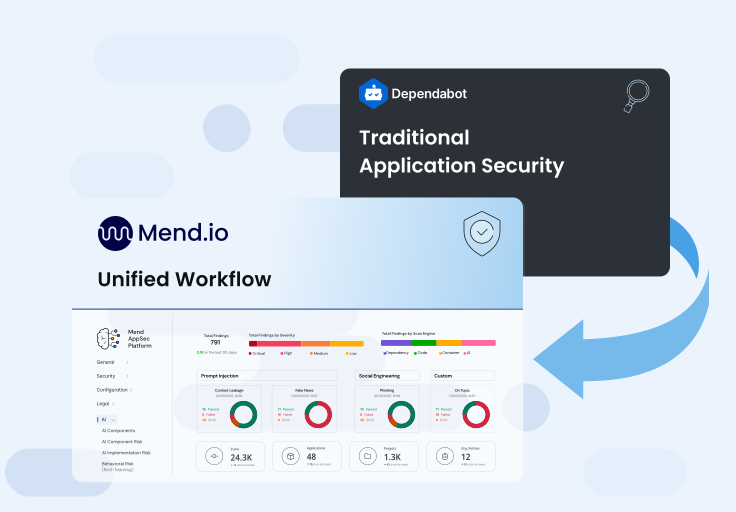






How Mend Renovate Enterprise and Dependabot compare
|
Feature |
Mend Renovate Enterprise |
GitHub Dependabot |
|---|---|---|
 Package manager & ecosystem coverage |
90+ package managers and ecosystems supported. |
Limited to roughly 30 supported ecosystems. |
 Monorepo & grouped updates |
Native monorepo awareness with flexible grouping rules (by package, manager, semver level, or custom logic) so one PR can cover dozens of related updates. |
Basic grouping introduced more recently, but limited control. Often produces high volumes of single-package PRs that overwhelm developer queues. |
 Merge Confidence ratings |
Predictive scoring on each update shows the likelihood it will merge cleanly without breaking the build, plus age, adoption, and test status signals. |
No equivalent. Developers must evaluate every PR’s risk manually. |
 Private package & registry support |
Full support for private packages across all major registries with a single configuration model. |
Supports private registries, but configuration is per-ecosystem and historically has had gaps and limitations across ecosystems. |
|
Platform coverage beyond GitHub |
Works across GitHub, GitLab, Bitbucket, and Azure DevOps. |
GitHub-only. No path forward if any part of your codebase lives elsewhere. |
 Enterprise scale & support |
Built to run across thousands of repositories with dedicated enterprise support, SLAs, and an account team. |
Best-effort GitHub support. No dedicated success resources for dependency automation specifically. |
Why teams switch from Dependabot to Mend Renovate Enterprise
Fewer PRs, more merges
Renovate’s grouping engine and Merge Confidence ratings cut PR noise. Group all dev dependencies, all minor updates, or all updates from a single vendor into one reviewable PR — and let Merge Confidence flag the ones safe to auto-merge.
Dependabot tends to flood developer queues with single-package PRs. Even with its newer grouping options, control is limited and there’s no predictive signal to help developers decide what’s safe to merge.

Built for monorepos and platform engineering
Renovate was designed with monorepos in mind. It understands workspace structures, shared dependencies, and complex repo layouts — so one configuration can manage hundreds of packages cleanly.
Dependabot’s monorepo support is bolted on rather than built in, and many platform teams end up writing custom tooling to fill the gaps.

Works wherever your code lives
Renovate runs on GitHub, GitLab, Bitbucket, and Azure DevOps. Acquisitions, mergers, and BU-level platform choices don’t break your dependency strategy.
Dependabot only works on GitHub. If any part of your organization is on a different SCM, you’re maintaining two different approaches — or none at all.

Enterprise scale, with humans behind it
Mend Renovate Enterprise is built to run across thousands of repositories and is backed by a dedicated enterprise support team, SLAs, and an account team that helps you operationalize it.
Dependabot is a free GitHub feature. There’s no dedicated dependency-automation support team, no SLAs, and no roadmap influence when something doesn’t work the way you need it to.

Don’t just take our word for it: Why teams choose Mend.io
Dependabot:
“The lack of transitive dependency support for 73% of ecosystems makes it unsuitable for serious security programs.”


Mend.io:
“Renovate creates an issue which lists the status of all dependencies in the repository, which it keeps updated. It then creates PRs for each dependency update, which can then have CI run individually to give an indication of any issues with the update. It’s downright excellent.”


Dependabot:
“Dependabot might be free, but the cost of missing vulnerabilities in your dependency tree could be much higher than investing in proper SCA tooling.”
Mend.io:
“The pricing is reasonable and scalable, making it a good fit for our growing business.”

Dependabot:
“Dependabot opened thousands of PRs against unaffected repositories, generating a nonsensical made up CVSS v4 score.”

Mend.io:
“Our previous solution couldn’t keep up with the scale of our development projects. Mend Renovate Enterprise’s horizontal scaling and priority job queue has been incredibly reliable, ensuring that our critical dependencies are always up-to-date.”

Dependabot:
“Dependabot is essentially a GitHub-only feature. While there are ways to run it locally or on other platforms, it’s not designed for that, making it inaccessible for teams using other version control systems or specialized repository setups.”

Mend.io:
“Renovate isn’t special with how it authenticates… Renovate runs against GitLab, Bitbucket and I believe other platforms too.”
Dependabot:
“It’s basically the ‘good’ enough” option that’s better than nothing but frustrating if you need actual strategic dependency management.”
Mend.io:
“The customer support team is knowledgeable and responsive, and the documentation is thorough and easy to understand.”


Dependabot:
“The lack of transitive dependency support for 73% of ecosystems makes it unsuitable for serious security programs.”
Mend.io:
“Renovate creates an issue which lists the status of all dependencies in the repository, which it keeps updated. It then creates PRs for each dependency update, which can then have CI run individually to give an indication of any issues with the update. It’s downright excellent.”


Dependabot:
“Dependabot might be free, but the cost of missing vulnerabilities in your dependency tree could be much higher than investing in proper SCA tooling.”
Mend.io:
“The pricing is reasonable and scalable, making it a good fit for our growing business.”


Dependabot:
“Dependabot opened thousands of PRs against unaffected repositories, generating a nonsensical made up CVSS v4 score.”
Mend.io:
“Our previous solution couldn’t keep up with the scale of our development projects. Mend Renovate Enterprise’s horizontal scaling and priority job queue has been incredibly reliable, ensuring that our critical dependencies are always up-to-date.”


Dependabot:
“Dependabot is essentially a GitHub-only feature. While there are ways to run it locally or on other platforms, it’s not designed for that, making it inaccessible for teams using other version control systems or specialized repository setups.”
Mend.io:
“Renovate isn’t special with how it authenticates… Renovate runs against GitLab, Bitbucket and I believe other platforms too.”


Dependabot:
“It’s basically the ‘good’ enough” option that’s better than nothing but frustrating if you need actual strategic dependency management.”
Mend.io:
“The customer support team is knowledgeable and responsive, and the documentation is thorough and easy to understand.”
Frequently asked questions
Is Mend Renovate a good alternative to Dependabot for large engineering organizations?
Yes, and it’s the most common reason teams switch. Mend Renovate handles multi-SCM estates, monorepos, grouped PRs, and 90+ ecosystems from one configuration. Mend Renovate Enterprise adds the scale, support, and Merge Confidence workflows that large organizations need.
Can Mend Renovate Enterprise replace Dependabot entirely?
Yes. Most teams that adopt Mend Renovate Enterprise turn Dependabot off. Running both creates duplicate PRs, conflicting signals, and noise — the exact problems automation should be solving.
What’s the difference between Renovate and Mend Renovate Enterprise?
Renovate is the open source project that started it all. It powers dependency automation for thousands of teams worldwide and is free to use. Mend Renovate Enterprise builds on that foundation with enterprise-grade scale, dedicated support, advanced controls, Merge Confidence workflows, and integration with the broader Mend.io solution.
Do I have to leave GitHub to use Mend Renovate Enterprise?
No. Mend Renovate Enterprise works inside GitHub, it just isn’t limited to it. Teams running across GitHub, GitLab, Bitbucket, and Azure DevOps get a single dependency automation strategy instead of one per platform.
What is Merge Confidence and why does it matter?
Merge Confidence is a predictive rating that scores how likely a dependency update is to merge cleanly without breaking your build. It uses package age, adoption signals, and test outcomes from across the broader user base. The result: developers can confidently auto-merge low-risk updates and focus their attention on the ones that actually need review.
How does pricing compare?
Dependabot is free as part of GitHub. Mend Renovate Enterprise is available within Mend AppSec or as a stand-alone product for up to $250 per developer per year.
For teams looking at the full picture, Mend AppSec delivers full platform coverage across code, open source, containers, and AI inventory for up to $1,000 per developer per year. Mend AI adds prompt hardening, AI red teaming, and runtime guardrails for up to $300 per developer per year.
How long does it take to roll out Mend Renovate Enterprise?
Most teams are running across their initial repository set within hours, not weeks. The configuration uses presets and inheritance, so you can establish org-wide defaults once and let individual teams tune from there.
Stop managing alerts.
Start reducing risk.
Join the teams reducing remediation effort by 75%.