AI based remediation workflows
Security teams are overwhelmed by the volume of vulnerabilities. AI based remediation automates the process, allowing teams to focus on strategic work.
Challenges
As development speed increases, remediation efforts can’t keep pace.
Manual remediation efforts and lack of context cause time consuming processes that ultimately result in vulnerabilities being stuck in the backlog waiting to be fixed.

Remediation backlogs
As AI accelerates code generation, the sheer volume of new code is growing exponentially, creating an explosion in security findings and a massive remediation backlog.
Lack of context
Developers often lack context needed to fix vulnerabilities effectively, particularly with complex SAST findings or transitive open-source dependencies. This leads to slow, inefficient fixes and increased mean time to remediation (MTTR).
Time-consuming workflows
The manual process of identifying, prioritizing, and fixing flaws in both custom code and open-source libraries is a major drain on time and resources, diverting attention from proactive security measures.
Opportunities
Leverage AI for autonomous remediation.
AI based remediation helps organizations keep pace by quickly fixing vulnerabilities and reducing the time and resources needed for manual intervention.

Automated SAST remediation
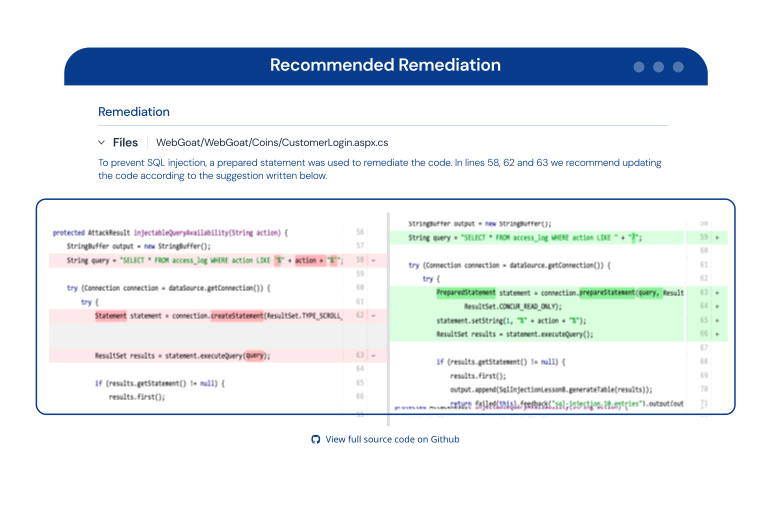
Reduce remediation time from hours to minutes. AI can analyze SAST findings, understand the application’s code and context, and generate precise, developer-ready code fixes.
Streamlined SCA remediation
Minimize the risk of breaking changes. For open-source vulnerabilities, AI can identify the correct version update or patch to remediate a flaw. It can also analyze the dependency graph to recommend the most efficient fix.
Increased efficiency and focus
Receive clear, actionable fixes directly in developer’s workflow, and free up time for security professionals to focus on high-impact tasks like threat modeling and architecture reviews, by automating the most labor-intensive parts of the remediation workflow with AI.
The solution
Mend AppSec
Mend AppSec pairs high-precision SAST and reachability-driven SCA with AI-powered remediation — turning security findings into developer-ready fixes delivered directly in the workflow, so backlogs shrink instead of growing.
Discover Mend AppSec


“One of our most indicative KPIs is the amount of time for us to remediate vulnerabilities and also the amount of time developers spend fixing vulnerabilities in our code base, which has reduced significantly. We’re talking about at least 80% reduction in time.”


“When the product you sell is an application you develop, your teams need to be fast, secure and compliant. These three factors often work in opposite directions. Mend provides the opportunity to align these often competing factors, providing Vonage with an advantage in a very competitive marketplace.”


“The biggest value we get out of Mend is the fast feedback loop, which enables our developers to respond rapidly to any vulnerability or license issues. When a vulnerability or a license is disregarded or blocked, and there is a policy violation, they get the feedback directly.”


FAQs
How does Mend.io automate vulnerability remediation with AI?
Mend.io combines AI powered fixes for SAST findings with automated dependency updates for open source dependencies. For outdated dependencies Mend Renovate can automate and manage fix pull requests directly in developer workflows. Mend SCA uses this insight to drive remediation for SCA findings.
Mend SAST and Mend SCA are part of Mend AppSec.
How does automated remediation work for Mend SAST findings?
Mend SAST analyzes each finding, understands the code and its context, and generates a high-confidence, developer-ready code fix, reducing remediation time from hours to minutes. Developers can review the proposed changes in the platform or supported repository integrations and create a pull request to apply the fix.
How does Mend.io handle open source vulnerabilities?
Mend SCA identifies available fixes and recommends upgrade paths using either Least Vulnerable Package or First Fix strategies. Least Vulnerable Package evaluates the dependency tree to identify versions that provide meaningful risk reduction, while automatically opening pull requests that update supported manifests and lock files. Mend Renovate can also keep dependencies current and add Merge Confidence signals to help teams decide how updates should be delivered or merged.
Will Mend.io’s AI-generated fixes break my code?
The risk is minimized by design. Fixes are generated with full code context, and dependency updates are validated against your dependency graph before they’re recommended.
How much time does Mend.io’s automated remediation save?
Mend.io customers report at least 80% reduction in mean time to remediate (MTTR) and in developer time spent fixing vulnerabilities.
For remediation strategy beyond tooling, read the vulnerability remediation guide.
Stop managing alerts.
Start reducing risk.
Join the teams reducing remediation effort by 75%.