Table of contents
Related resources


9-Step AI Governance Implementation Strategy and the Solutions to Know

TL;DR: AI governance solutions help organizations inventory, secure, and monitor AI systems. Best for AI security and shadow AI: Mend AI; enterprise risk and compliance: Credo AI and IBM watsonx.governance; model monitoring: Fiddler AI.
Effective AI governance implementation involves establishing a cross-functional committee, compiling an AI bill of materials (AI-BOM) to identify risks, and implementing policies based on frameworks like NIST AI RMF. Key strategies include defining clear accountability (RACI matrix), automating compliance checks, and conducting regular audits for bias and performance drift. AI governance solutions like Mend.io, Strac, and Grip Security can accelerate and simplify AI governance efforts.
What is AI governance?
AI governance refers to the frameworks, policies, and processes that organizations use to direct and control the development, deployment, and monitoring of artificial intelligence systems. It establishes a structured approach to ensure that AI technologies are designed and used responsibly, ethically, and in compliance with legal and regulatory standards. This involves setting up guidelines for data usage, model development, risk management, accountability, and transparency throughout the AI lifecycle.
Effective AI governance addresses the unique risks associated with AI, such as bias, lack of explainability, and unintended outcomes. It requires collaboration between technical, legal, and business stakeholders to create standards that guide AI innovation while minimizing negative impacts. By integrating governance into every phase of AI projects, organizations can build trust, ensure compliance, and drive sustainable value from their AI investments.
This is part of a series of articles about AI governance.
AI governance solutions at a glance
The table below summarizes the key differences between the solutions covered in this section. We explore each one in more detail further down.
| Category | Solution | Best For | Key Strengths | Things to Consider |
|---|---|---|---|---|
| AI Security and Shadow AI Governance | Mend AI | Securing AI components in applications across the SDLC | AI-BOM inventory, red teaming, policy enforcement | SAST capabilities still maturing |
| AI Security and Shadow AI Governance | Strac | Real-time DLP for employee AI usage | Browser-level prompt DLP, agentless deployment | Narrow, usage-focused scope |
| AI Security and Shadow AI Governance | Grip Security | Identity-driven discovery of AI and SaaS apps | Shadow AI and SaaS visibility tied to identities | Setup complexity and learning curve |
| AI Security and Shadow AI Governance | Knostic | Access controls for enterprise LLMs and search | Need-to-know enforcement, prompt gateway | Narrow knowledge-layer focus |
| Enterprise AI Governance, Risk, and Compliance Platforms | Credo AI | Policy-based governance and compliance workflows | Policy packs, AI registry, evidence automation | Sits outside the runtime execution path |
| Enterprise AI Governance, Risk, and Compliance Platforms | IBM watsonx.governance | Connecting AI risk to enterprise risk programs | Governance graph, 200+ frameworks, guardrails | Setup needs specialized knowledge |
| Enterprise AI Governance, Risk, and Compliance Platforms | Holistic AI | Testing and inventory across the AI estate | 40+ tests, discovery, control mapping | Limited runtime enforcement |
| Enterprise AI Governance, Risk, and Compliance Platforms | OneTrust AI Governance | Extending GRC programs to AI systems | Inventory, risk tiering, runtime guardrails | Steep learning curve |
| Enterprise AI Governance, Risk, and Compliance Platforms | ServiceNow AI Control Tower | Governing AI inside the ServiceNow ecosystem | Discovery, access control, lifecycle governance | Value tied to ServiceNow adoption |
| Enterprise AI Governance, Risk, and Compliance Platforms | Collibra AI Governance | Linking AI governance to data governance | Unified registry, trust score, lineage | Complex configuration |
| Enterprise AI Governance, Risk, and Compliance Platforms | Microsoft Purview | Data security and AI oversight in Microsoft 365 | DSPM for AI, DLP, information protection | Strongest within Microsoft ecosystem |
| AI Observability and Model Monitoring | Fiddler AI | Monitoring model and agent behavior in production | 100+ metrics, guardrails, root-cause analysis | Learning curve for newcomers |
| AI Observability and Model Monitoring | Arize AI | Tracing and evaluating LLM and agent applications | Open-standard tracing, large-scale evals | Requires engineering instrumentation |
| AI Observability and Model Monitoring | Monitaur | Lifecycle governance for regulated industries | Control library, simulation, decision logging | Oriented to insurance and finance |
Why AI governance matters in today’s IT environment
AI governance has become a critical priority as artificial intelligence transitions from experimental use to core infrastructure across industries. Organizations no longer use AI only in isolated pilots; AI now influences high-stakes decisions in areas such as finance, healthcare, hiring, and security. This widespread adoption increases both the value and the risk of AI, making structured governance necessary.
Here are the main drivers of AI governance at organizations today:
- Rapid expansion of global regulation: Governments worldwide are introducing stricter and more complex AI laws, such as the EU AI Act and emerging U.S. and state-level regulations, requiring organizations to implement formal governance frameworks to remain compliant.
- Pronounced AI risks: Issues such as bias, lack of transparency, data privacy concerns, and security vulnerabilities can lead to legal exposure, reputational damage, and financial loss if not managed properly. Without governance, organizations struggle to maintain accountability, auditability, and control over increasingly autonomous systems.
- Building trust with stakeholders: As AI systems take on more decision-making responsibilities, organizations must demonstrate that these systems are fair, explainable, and aligned with ethical standards. Governance frameworks support transparency and human oversight, which are key to adoption and long-term success.
- Competitive advantage: Companies that invest in AI governance can scale AI more confidently, reduce project failure rates, and create sustainable business value. In contrast, organizations that lag behind risk falling into the gap between rapid AI adoption and insufficient oversight.
You can’t govern AI you can’t see
Build a governed AI inventory, classify risk by data sensitivity and decision authority, and score your maturity without slowing your teams down.
Key challenges in implementing AI governance
AI governance strategies must contend with several significant hurdles. Here are the primary challenges facing organizations attempting to implement AI governance frameworks.
Fragmented ownership across teams
In many organizations, AI projects are distributed across multiple departments, such as data science, IT, compliance, and business units. Each team may have its own priorities, processes, and risk tolerances, leading to fragmented ownership of AI systems. This lack of unified oversight makes it difficult to enforce consistent governance practices, resulting in gaps or redundancies in controls and documentation.
Fragmented ownership also complicates decision-making and slows the implementation of governance initiatives. Without clear coordination, teams may develop conflicting policies, duplicate efforts, or miss compliance requirements. To address this, organizations need mechanisms to align stakeholders, assign responsibilities, and ensure collaboration throughout the AI lifecycle.
Lack of clear accountability
AI systems often operate in complex environments where responsibility for outcomes is distributed across developers, data owners, business leaders, and external partners. This diffusion of accountability makes it difficult to determine who is responsible for managing risks, ensuring compliance, or responding to incidents. As a result, governance tasks can be overlooked.
Clear accountability is necessary for AI governance. Organizations must define roles and responsibilities for each phase of the AI lifecycle, including model development, deployment, and monitoring. By establishing accountability frameworks, organizations can assign decision rights, clarify escalation paths, and ensure that governance policies are enforced consistently across teams.
Difficulty measuring AI risks
Unlike traditional IT systems, AI introduces dynamic and evolving risks, such as model drift, bias amplification, and loss of explainability. Measuring these risks requires specialized tools and expertise, as well as continuous monitoring of technical and ethical performance indicators. Many organizations lack standardized metrics and processes for assessing AI risks, making it difficult to prioritize mitigation efforts.
The absence of reliable risk measurement frameworks can create blind spots, where vulnerabilities go undetected until they cause harm. To address this, organizations must invest in risk assessment methodologies tailored to AI, covering technical failures and broader societal impacts. This supports proactive risk management and informed decision-making throughout the AI lifecycle.
Related content: Read our complete guide to AI risk management
Step-by-step AI governance implementation strategy
Implementing AI governance is a transformative journey that requires a structured, phased approach to ensure long-term success. By following a step-by-step methodology, organizations can systematically address technical, ethical, and regulatory requirements while minimizing disruption to innovation.
1. Define AI governance vision and principles
The foundation of any successful governance program is a clear articulation of the organization’s vision and core ethical principles. By defining principles such as fairness, accountability, and transparency early on, leadership sets a standard that informs every subsequent policy and technical decision.
Key actions:
- Engage senior leadership to draft a formal AI vision statement.
- Identify and document core values like privacy, security, and human oversight.
- Communicate these principles across the entire organization to ensure cultural alignment.
2. Assess regulatory and risk landscape
Understanding the complex and rapidly evolving legal environment is essential for maintaining global AI compliance and mitigating operational hazards. Organizations must conduct a comprehensive audit of applicable laws, such as the EU AI Act, alongside industry-specific standards that govern data usage and algorithmic output. Understanding your obligations across frameworks is the basis of AI compliance. This step allows teams to map potential risks, including bias and security vulnerabilities, to regulatory requirements.
Key actions:
- Map out all relevant local and international AI regulations.
- Conduct a risk assessment of current AI projects to identify high-impact areas.
- Establish a process for continuous monitoring of legal updates and technological shifts.
3. Establish governance structure
A robust governance framework requires a formal organizational structure that clearly defines oversight roles and decision-making authority. By establishing cross-functional committees comprising legal, technical, and business experts, organizations ensure that AI projects are viewed through multiple critical lenses. This structure provides the necessary checks and balances to enforce policies consistently across different departments and global offices.
Key actions:
- Form a dedicated AI Governance Committee with diverse representation.
- Assign clear roles and responsibilities using a RACI matrix.
- Define reporting lines for escalation and periodic compliance reviews.
4. Develop policies and standards
Translating high-level principles into actionable rules is the primary goal of developing internal policies and technical standards. These documents must explicitly cover the entire lifecycle, including data acquisition, model testing, deployment protocols, and transparency requirements for end-users.
Key actions:
- Draft comprehensive guidelines for data privacy and model validation.
- Standardize documentation templates for all AI development phases.
- Create enforceable security protocols for AI infrastructure and access.
5. Implement risk management processes
Effective risk management for AI involves creating dynamic processes that can identify and mitigate issues like model drift and bias in real-time. Organizations should integrate AI-specific risk assessments into their broader enterprise risk management (ERM) framework to ensure a holistic view of the technology’s impact.
Key actions:
- Set up recurring risk identification workshops for all technical teams.
- Establish impact analysis procedures for newly proposed AI use cases.
- Develop clear mitigation plans and contingency protocols for high-risk models.
6. Integrate AI governance tools
To move from manual oversight to scalable operations, organizations must adopt specialized software tools designed for model monitoring and compliance and governance. These technical solutions automate tedious governance tasks, such as tracking model performance and generating audit logs, providing real-time visibility into the health of the AI portfolio.
Key actions:
- Select and deploy tools for automated bias detection and model monitoring.
- Integrate compliance tracking software into the CI/CD pipeline.
- Regularly evaluate tool performance to ensure the tools meet evolving governance needs.
7. Embed governance across the AI lifecycle
Governance should not be a final checklist item but rather a continuous presence integrated into every stage of the AI lifecycle. This involves setting mandatory checkpoints during data collection, model training, and post-deployment monitoring to verify that standards are being met throughout. By embedding governance into the workflow, organizations foster a culture of "responsibility by design," preventing issues before they arise.
Key actions:
- Insert mandatory governance review steps into the project lifecycle.
- Train development teams on how to perform internal impact assessments.
- Create a feedback loop between technical teams and the governance committee.
8. Enable monitoring and incident response
Once AI systems are in production, continuous surveillance is necessary to detect performance degradation or unexpected ethical breaches. Organizations must implement sophisticated monitoring dashboards that track fairness metrics and security incidents, triggering automated alerts when anomalies occur. A predefined incident response protocol ensures that the organization can act quickly to disable or remediate problematic models.
Key actions:
- Define specific KPIs and fairness thresholds for production models.
- Draft an AI incident response plan with clear escalation paths.
- Conduct regular "fire drills" to test response protocols and readiness.
9. Foster organizational adoption
The ultimate success of an AI governance framework depends on its widespread adoption and the cultivation of a governance-aware culture. Leadership must actively champion these initiatives, providing the necessary resources, training, and incentives to make compliance a standard part of every employee's role.
By fostering a culture that values ethical innovation, organizations can ensure that governance is viewed as an enabler of success rather than a hurdle to be bypassed.
Key actions:
- Launch a company-wide awareness campaign about the importance of AI ethics.
- Provide specialized training for different roles, from developers to executives.
- Recognize and reward teams that demonstrate exceptional adherence to governance standards.
Notable AI governance solutions
How we selected these tools: We shortlisted AI governance solutions based on their ability to discover and inventory AI systems, detect and manage AI-specific risks, enforce policies and regulatory compliance, and monitor model and agent behavior across the AI lifecycle.
AI security and shadow AI governance
1. Mend AI

Best for: Securing AI models, agents, and components across the SDLC
Strengths: AI-BOM inventory, red teaming, and policy enforcement
Things to consider: SAST capabilities are still maturing
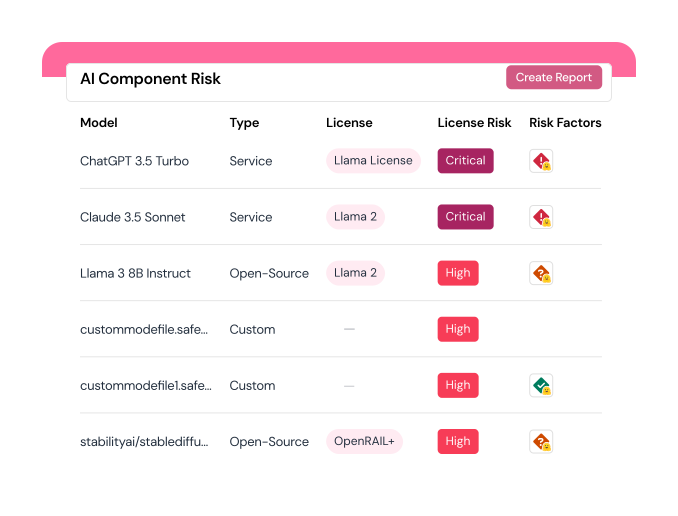
Mend AI handles the discovery and risk assessment of AI components inside applications, then ties those findings to remediation, policy enforcement, and behavioral testing. It maintains a continuous inventory of the models, frameworks, agents, RAG systems, and MCP integrations across an AI supply chain, including shadow AI that it surfaces by scanning code repositories. The platform connects identified risks to specific models so teams can address licensing issues, vulnerabilities, and malicious packages.
Key features include:
- AI supply chain management: Maintains a real-time AI-BOM inventory of models, frameworks, agents, RAG systems, and MCP integrations, including Shadow AI found by scanning code repositories.
- AI red teaming: Runs prebuilt, customizable tests against conversational AI for prompt injection, context leakage, data exfiltration, bias, hallucinations, and jailbreaks.
- System prompt hardening: Identifies risks in system prompts based on their content and structure and assigns risk scoring to flag insecure configurations.
- Policy engine and AI-SPM governance: Lets teams define and enforce rules for AI components and AI security posture management across the software development lifecycle.
- Compliance mapping: Maps controls against OWASP, NIST AI RMF, ISO/IEC 42001, and the EU AI Act across 25 technical requirements and generates a maturity report.
- AI runtime protection: Provides in-app guardrails, currently in development, that apply real-time safety filters between users and AI models.
Limitations (as reported by users on G2):
- Maturing static analysis: Some users note the static application security testing capabilities are newer relative to the platform's established open source scanning.
- Interface modernization: A portion of feedback suggests the user interface could feel more contemporary in places.
- Documentation depth: Some reviewers would like more thorough documentation for certain features.

Source: Mend.io
2. Strac

Best for: Governing how employees use AI tools in real time
Strengths: Browser-level prompt DLP across major AI assistants
Things to consider: Scope is narrow and usage-focused
Strac governs how employees use AI applications by inspecting and controlling the data that flows into them. An endpoint agent discovers locally installed AI apps, MCP servers, and browser-based AI usage, giving teams visibility into shadow AI across the workforce. A browser extension applies data loss prevention to prompts in real time across tools such as ChatGPT, Copilot, Claude, and Gemini, plus dozens of other applications, with the option to block, warn, or audit.
Key features include:
- Shadow AI discovery: Uses an endpoint agent to find locally installed AI applications, MCP servers, and browser-based AI usage.
- Real-time prompt DLP: Applies a browser extension to inspect prompts across ChatGPT, Copilot, Claude, Gemini, and over 50 other tools, with block, warn, and audit actions.
- Sensitive data detection: Recognizes more than 100 sensitive data types, including secrets, and redacts data inside images and documents through OCR.
- Copilot oversharing remediation: Addresses oversharing across SharePoint, OneDrive, and Teams.
- MCP and integration DLP: Enforces data loss prevention at the Model Context Protocol boundary and across integrations such as Slack, Zendesk, Jira, Salesforce, and Drive.
- Framework mapping: Maps controls to NIST AI RMF, the EU AI Act, ISO 42001, HIPAA, PCI, and SOC 2, with audit logs and SIEM export.
Limitations (as reported by users on G2):
- Service-specific scope: Some users note the product addresses a focused set of use cases rather than serving as a single all-in-one platform.
- Features in development: A portion of feedback mentions that some capabilities are still being built out.
- Authentication issues: Some reviewers report occasional login and authentication problems.

Source: Strac
3. Grip Security

Best for: Discovering AI and SaaS apps tied to user identities
Strengths: Identity-driven visibility into shadow AI and SaaS
Things to consider: Initial setup can be complex
Grip Security discovers AI and SaaS applications across an organization and connects them to the identities that use them. This includes shadow applications that are adopted without IT approval, which the platform ties back to specific users and accounts. The approach centers on identity, so security teams can apply access controls, rotate passwords, and manage OAuth scopes for the applications it finds.
Key features include:
- AI and SaaS discovery: Finds AI and SaaS applications, including shadow apps, and ties each one to the identities that access it.
- Identity-driven security: Applies access control, password rotation, and OAuth scope management across discovered applications.
- Shadow AI risk reduction: Helps teams assess the business justification for shadow AI and act on the associated risk.
- SaaS security posture management: Detects and helps fix SaaS misconfigurations.
- Identity threat detection and response: Monitors for identity-based threats and supports response actions.
- Access lifecycle management: Extends MFA and SSO coverage and supports onboarding and offboarding of shadow SaaS.
Limitations (as reported by users on G2):
- Initial setup complexity: Some users report a complex configuration process and an associated learning curve.
- Integration-dependent coverage: A portion of feedback notes that visibility depends on the breadth and quality of available API integrations, so apps with limited integration receive less coverage.
- Cost considerations: Some reviewers cite budget and pricing as factors to weigh.

Source: Grip Security
4. Knostic

Best for: Enforcing need-to-know access for enterprise LLMs
Strengths: Knowledge-layer controls and prompt inspection
Things to consider: Focused on the knowledge and inference layer
Knostic applies access controls at the knowledge layer for enterprise large language model tools such as Microsoft Copilot, Glean, and Gemini. It enforces need-to-know boundaries so that AI assistants return information only to users entitled to see it, mapping permissions and roles to prevent the oversharing that can occur when an assistant indexes broad internal content. This addresses a gap that appears when generative AI tools surface data that users would not otherwise reach.
Key features include:
- Knowledge-layer access controls: Enforces need-to-know access for enterprise LLM tools including Copilot, Glean, and Gemini.
- Oversharing prevention: Maps permissions and roles to stop AI assistants from returning data users should not access.
- Prompt gateway: Inspects prompts and responses in real time and blocks secrets, PII, and source code.
- Prompt injection blocking: Detects and blocks prompt injection attempts.
- Data sprawl detection: Identifies AI-driven data sprawl across embeddings, indexes, and SaaS exports.
- Sensitivity labeling and coding safety: Automates sensitivity labeling and extends checks to agents, coding assistants, and MCP servers.
Limitations (based on publicly available sources):
- Knowledge-layer focus: The product concentrates on the inference and oversharing layer rather than full-lifecycle governance, so it pairs with broader DLP or governance tooling.
- Microsoft-centric value: Much of its value is concentrated in Microsoft 365 Copilot and enterprise-search environments.
- Newer vendor: As a company founded in 2023, it has limited independent review coverage.

Source: Knostic
Enterprise AI governance, risk, and compliance platforms
5. Credo AI

Best for: Policy-based governance and compliance workflows
Strengths: Policy packs, AI registry, and evidence automation
Things to consider: Sits outside the runtime execution path
Credo AI provides a governance layer that inventories AI systems and manages them against defined policies and regulations. Its registry discovers and catalogs agents, models, and applications, including shadow AI, and represents them with agent cards and a dependency graph that includes MCP server governance. The platform scores risk across AI-specific dimensions, applies an agentic risk library, and supports automated red-teaming and drift detection.
Key features include:
- AI registry and discovery: Inventories agents, models, applications, and shadow AI with agent cards, a dependency graph, and MCP server governance.
- Risk intelligence: Scores risk across AI-specific dimensions using an agentic risk library, policy inheritance, automated red-teaming, and drift detection.
- Compliance and policy engine: Provides pre-built policy packs for the EU AI Act, NIST AI RMF, ISO 42001, and SOC 2 with approval-gate workflows.
- Evidence and audit automation: Generates automated evidence and audit trails for compliance reporting.
- Runtime governance: Ingests traces, runs continuous evaluation, and supports human-in-the-loop review with remediation agents.
- Governance knowledge graph: Connects governance data across the AI estate and includes a vendor portal.
Limitations (based on publicly available sources):
- Outside the execution path: The platform centers on policy and documentation and does not sit in the runtime path, so it offers no built-in PII redaction or API gateway, and enforcement requires separate infrastructure.
- Cloud-only deployment: Its cloud-based delivery can limit on-premises or air-gapped use.
- Lighter technical monitoring: It offers less depth in technical ML monitoring than MLOps-native tools.

Source: Credo AI
6. IBM watsonx.governance

Best for: Linking AI risk to enterprise risk programs
Strengths: Governance graph, broad framework coverage, guardrails
Things to consider: Setup needs specialized knowledge
IBM watsonx.governance manages AI risk and compliance and connects it to broader enterprise risk practices. A governance graph builds a connected map of an organization's AI estate, recording what AI exists, its purpose, and the controls applied to it. The platform integrates AI risk with IT, operational, third-party, and business-continuity risk, and uses AI-driven control mapping to determine which compliance requirements apply.
Key features include:
- Governance graph: Builds a connected map of the AI estate, capturing each system's purpose and applied controls.
- Integrated risk management: Connects AI risk with IT, operational, third-party, and business-continuity risk.
- Factsheets: Automatically captures model metadata into structured documentation.
- Real-time guardrails: Detects harmful content, PII, and faithfulness issues, with an evaluation studio for testing.
- Agentic monitoring: Tracks accuracy, hallucinations, context relevance, and reasoning traces for agentic systems.
- Broad framework coverage: Supports more than 200 regulatory frameworks and governs generative AI and ML across IBM, AWS, Azure, and OpenAI.
Limitations (as reported by users on G2):
- Specialized setup: Some users note that setup and integration require specialized knowledge, particularly in hybrid environments.
- Maturity in some areas: A portion of feedback observes that certain areas feel newer than long-established GRC products.
- Usability and cost: Some reviewers mention that the experience and documentation could be more streamlined and cite a high perceived cost.

Source: IBM
7. Holistic AI

Best for: Testing and inventory across the AI estate
Strengths: Discovery, 40+ tests, and control mapping
Things to consider: Runtime enforcement is more limited
Holistic AI organizes AI governance around identifying, testing, and enforcing controls across an organization's AI systems. Its discovery and automated inventory scanning covers cloud, code, and SaaS environments, detecting models, agents, APIs, and pipelines across providers such as AWS, Azure, GitHub, and Databricks, surfacing shadow AI and classifying systems by risk, owner, and lifecycle stage. The platform runs more than 40 tests covering bias, fairness, toxicity, hallucination, prompt injection, and adversarial robustness.
Key features include:
- AI discovery and inventory: Scans cloud, code, and SaaS to detect models, agents, APIs, and pipelines across 20+ integrations and surfaces shadow AI.
- Risk classification: Classifies systems by risk, owner, and lifecycle stage.
- Testing suite: Runs more than 40 tests for bias, fairness, toxicity, hallucination, prompt injection, and adversarial robustness, plus AI red teaming.
- Framework mapping: Maps risk scores to the EU AI Act, NIST, ISO 42001, and NYC Local Law 144.
- Enforcement controls: Provides control mapping, gap analysis, deployment gates, approval workflows, and kill switches.
- Guardian agents: Uses agents that watch and alert, and others that act and enforce policies.
Limitations (based on publicly available sources):
- Assessment orientation: The platform leans toward assessment, testing, and discovery, with more limited enforcement at the request-processing point.
- No built-in prompt redaction: It does not provide built-in prompt PII detection and redaction and is not a multi-provider API gateway.
- Open-source dependencies: Some integrations rely on an open-source library that needs coding and configuration.

Source: Holistic AI
8. OneTrust AI Governance

Best for: Extending GRC programs to AI systems
Strengths: Inventory, risk tiering, and runtime guardrails
Things to consider: Steep learning curve
OneTrust AI Governance brings AI systems into an organization's broader governance, risk, and compliance practices. It catalogs models, datasets, agents, and vendors in a central inventory with ownership, lifecycle, and dependency information, then assigns risk tiers using templates based on the EU AI Act, NIST, and ISO 42001. Compliance workflows handle intake, approval, attestation, and automated evidence collection.
Key features include:
- AI cataloging and risk assessment: Maintains a central inventory of models, datasets, agents, and vendors with ownership, lifecycle, and dependencies.
- Risk tiering: Assigns risk tiers using EU AI Act, NIST, and ISO 42001 templates.
- Compliance workflows: Manages intake, approval, attestation, and automated evidence collection.
- Posture monitoring: Ingests telemetry across AI platforms to track drift, quality, safety, and performance and detect violations in real time.
- Runtime guardrails: Filters prompts and outputs, blocks or allows by policy, and masks or redacts data.
- Agent and MCP governance: Registers agents, enforces permissions, and applies MCP policy enforcement with audit logs.
Limitations (as reported by users on G2):
- Learning curve: Some users report a steep learning curve and complex configuration that benefits from planning and training. This feedback reflects the broader OneTrust technology risk and compliance platform.
- Interface density: A portion of feedback notes the interface can feel cluttered and would benefit from a refresh.
- Cost for smaller teams: Some reviewers cite high cost, particularly for smaller teams.

Source: OneTrust
9. ServiceNow AI Control Tower

Best for: Governing AI inside the ServiceNow ecosystem
Strengths: Discovery, access control, and lifecycle governance
Things to consider: Value is tied to ServiceNow adoption
ServiceNow AI Control Tower governs AI systems across an organization from within the ServiceNow platform. It inventories AI agents, models, and MCP servers from both first-party and third-party sources, and tracks the identity, access, and exposure associated with each AI action. Security features include least-privilege enforcement, prompt injection blocking, and a kill switch that uses the Veza access graph.
Key features include:
- AI discovery: Inventories agents, models, and MCP servers from first-party and third-party sources.
- Action security: Tracks identity, access, and exposure, enforces least privilege, blocks prompt injections, and provides a kill switch via the Veza access graph.
- Lifecycle governance: Governs AI activity across its lifecycle with integrated controls and continuous compliance for NIST and the EU AI Act.
- Agent observability: Captures metrics and log traces with runtime observability through Traceloop.
- Value measurement: Tracks adoption and return on investment.
- Ecosystem connectivity: Runs on the ServiceNow AI Platform and CMDB with about 30 connectors across AWS, GCP, Azure, SAP, Oracle, and Workday.
Limitations (based on publicly available sources):
- Learning curve and setup: Analyses note a steep learning curve and complex setup that benefits from experienced administrators and ServiceNow expertise. This reflects the broader ServiceNow platform and Control Tower.
- Total cost of ownership: Licensing and overall cost are cited as considerations.
- Ecosystem dependence: Value depends on ServiceNow adoption and CMDB data quality, which may add complexity for smaller teams or simpler stacks.

Source: ServiceNow
10. Collibra AI Governance

Best for: Connecting AI governance to data governance
Strengths: Unified registry, trust score, and lineage
Things to consider: Configuration can be complex
Collibra AI Governance, delivered through its AI Command Center, ties AI oversight to an organization's existing data governance practices. A unified registry acts as a single system of record for use cases, models, and agents and tracks each across its lifecycle. A trust score combines signals such as documentation, data integrity, lifecycle stage, and regulatory factors into a universal measure that supports approve, stage, remediate, and retire decisions.
Key features include:
- Unified registry: Records use cases, models, and agents as a single system of record with lifecycle tracking.
- Trust score: Combines documentation, data integrity, lifecycle, and regulatory signals into a universal score for governance decisions.
- AI traceability and lineage: Follows the path from source datasets through training, inference, and deployment, stitching model and agent registries together.
- Policy-driven compliance: Uses EU AI Act and NIST templates with risk ratings.
- Developer tooling: Provides a CLI that captures use cases from code and syncs models and metadata.
- Platform-agnostic coverage: Works across AWS, Azure, Google, Databricks, SAP, and MLflow, and includes an MCP server.
Limitations (as reported by users on G2):
- Learning curve: Some users report a steep learning curve and complex configuration involving hierarchies and lineage diagrams.
- Option overload: A portion of feedback notes that the breadth of flexible options can be overwhelming, with pricing and adoption cited as challenges.
- Reporting limits: Some reviewers see room for improvement in reporting, and note that connector limits in the initial package can raise cost.

Source: Collibra
11. Microsoft Purview

Best for: Data security and AI oversight in Microsoft 365
Strengths: DSPM for AI, DLP, and information protection
Things to consider: Strongest within the Microsoft ecosystem
Microsoft Purview approaches AI governance through data security and compliance across an organization's data estate. Its data security posture management, including a dedicated capability for AI, discovers AI usage, identifies sensitive data risks, and surfaces interactions with third-party generative AI sites. Information protection classifies and labels sensitive data, and data loss prevention works across apps, browsers, and endpoints, including actions such as blocking users from pasting into ChatGPT.
Key features include:
- DSPM for AI: Discovers AI usage, sensitive data risks, and third-party generative AI site interactions.
- Information protection: Classifies and labels sensitive data.
- Data loss prevention: Prevents data loss across apps, browsers, and endpoints, including blocking pasting into AI tools.
- Insider risk management: Detects data theft and leaks with adaptive protection.
- Data governance and audit: Provides a unified catalog with lineage and records AI interactions as compliance events.
- Compliance Manager: Supplies regulatory templates that include AI regulations, with AI-aware DLP for Entra-registered AI apps.
Limitations (as reported by users on G2):
- Setup complexity: Some users report complex initial setup, particularly in diverse IT environments.
- Ecosystem focus: A portion of feedback notes the product is strongest within the Microsoft ecosystem, with more limited connectivity for legacy, custom, or non-Microsoft sources.
- Performance and interface changes: Some reviewers mention that continuous scanning adds performance overhead and that frequent interface changes relocate features.

Source: Microsoft
AI observability and model monitoring
12. Fiddler AI

Best for: Monitoring model and agent behavior in production
Strengths: 100+ metrics, guardrails, and root-cause analysis
Things to consider: Learning curve for those new to monitoring
Fiddler AI monitors AI systems during development and in production, covering both generative AI applications and predictive machine learning. It structures agent observability across application, session, agent, trace, and span levels, and provides deep diagnostics for root-cause analysis. The platform tracks more than 100 metrics, including hallucination, toxicity, PII and PHI exposure, and drift, and issues real-time alerts to reduce the time needed to identify and resolve issues.
Key features include:
- Testing and observability: Evaluates models in development and monitors production across application, session, agent, trace, and span levels for generative and predictive systems.
- Metric tracking: Monitors more than 100 metrics including hallucination, toxicity, PII and PHI exposure, and drift, with real-time alerts.
- Diagnostics and guardrails: Detects hallucinations, toxicity, bias, leakage, jailbreaks, and policy violations and can pause, reroute, or escalate.
- Governance and GRC: Connects AI behavior to KPIs, records decisions and actions, and maintains audit trails for frameworks such as GDPR, HIPAA, and SR 11-7.
- Ownership tracking: Records ownership and approvals across AI systems.
- Flexible deployment: Supports OpenTelemetry, RBAC, SOC 2, and VPC, on-premises, or air-gapped environments.
Limitations (as reported by users on G2):
- Learning curve: Some users new to AI monitoring report a learning curve and would like more guidance for beginners.
- No free tier: A portion of feedback notes the absence of a free tier.
- Pricing predictability: Some reviewers find usage-based pricing less predictable and would like more intuitive dashboard creation.

Source: Fiddler AI
13. Arize AI

Best for: Tracing and evaluating LLM and agent applications
Strengths: Open-standard tracing and large-scale evaluation
Things to consider: Requires engineering instrumentation
Arize AI provides observability and evaluation for LLM and agent applications, built around open standards. It traces application behavior using OpenInference and OpenTelemetry, capturing every LLM call and agent trajectory. Evaluation runs at the span, trace, and session level at scale, including LLM-as-a-judge methods applied online and offline, so teams can measure quality across large volumes of activity.
Key features include:
- Tracing: Captures every LLM call and agent trajectory using OpenInference and OpenTelemetry.
- Evaluation: Runs span, trace, and session evaluations at scale, including LLM-as-a-judge, online and offline.
- Iterative improvement: Supports prompt testing and harnesses for continual improvement.
- AI engineering agent: Provides an agent that runs evaluations, debugs, and suggests improvements.
- Data connectivity: Stores agent trajectories and connects to BigQuery, Databricks, and Snowflake.
- Broader observability: Includes an open-source observability project and machine learning and computer vision observability for drift, performance, and bias, with 40+ integrations.
Limitations (as reported by users on G2):
- Instrumentation effort: Some users note the platform is engineering-centric and requires non-trivial instrumentation and schema setup, which adds friction for non-technical users.
- Documentation volume: A portion of feedback finds the extensive documentation overwhelming for beginners and would like more guided walkthroughs.
- Cost at scale: Some reviewers report costs can escalate with large trace and embedding volumes and find pricing less transparent.

Source: Arize AI
14. Minotaur

Best for: Lifecycle governance for regulated industries
Strengths: Control library, simulation, and decision logging
Things to consider: Oriented to insurance and finance
Minotaur supports AI governance across the full lifecycle with a structure built around defining, managing, and automating governance work. It provides policy templates, program design support, and a risk assessment methodology, alongside education resources. A management layer maintains a complete inventory of use cases and models, includes a common controls library of 33 controls, and supports collaborative workflows and vendor governance for third-party AI.
Key features include:
- Governance definition: Provides policy templates, program design, a risk assessment methodology, and education resources.
- Inventory and controls: Maintains a complete inventory of use cases and models with a common controls library of 33 controls.
- Vendor governance: Supports collaborative workflows and governance for third-party AI.
- Simulation and monitoring: Runs pre-deployment simulation and production monitoring, with synthetic simulations that produce letter grades.
- Continuous validation: Validates for drift and bias and logs decisions on an ongoing basis.
- Compliance evidencing: Maps activity to NIST AI RMF, ISO 42001, and the EU AI Act and automatically evidences roughly 40 percent of controls.
Limitations (based on publicly available sources):
- Regulated-industry orientation: The platform is oriented to insurance and financial services, with narrower breadth outside those verticals.
- Configuration effort: It deliberately avoids using AI to govern AI, relying on structured controls and validation that require more configuration.
- Production prerequisite: It expects customers to already have AI models in production, and it is a smaller, niche vendor.

Source: Minotaur
Conclusion
AI governance is no longer optional as AI systems become embedded in critical business processes. Organizations need structured approaches to manage risks, ensure compliance, and maintain trust. By combining clear governance frameworks with dedicated tools and processes, teams can move from reactive oversight to proactive control. This enables safer scaling of AI while aligning innovation with regulatory and ethical expectations. For a step-by-step blueprint, download Mend.io's AI Security Governance Framework.