Table of contents
Related resources


Best AI security posture management vendors: Top 6 in 2026

What are AI security posture management (AI-SPM) vendors?
AI security posture management (AI-SPM) vendors, such as Mend.io, Wiz, and Microsoft Defender, provide platforms that discover, monitor, and secure AI models, pipelines, and data. These tools mitigate risks like model theft, data leakage, and insecure integrations.
The main goal of AI-SPM vendors is to help organizations identify vulnerabilities in AI assets, manage risks across the AI supply chain, and enforce governance and compliance policies. These vendors use automated discovery, real-time monitoring, and advanced analytics to offer comprehensive visibility into the security status of AI models, data, and supporting infrastructure.
As AI adoption grows, so do the unique threats targeting AI systems, such as model poisoning, prompt injection, and data leakage. AI-SPM vendors address these challenges by offering specialized solutions that go beyond traditional security approaches. Their services typically include asset inventories, continuous risk assessments, policy enforcement, and runtime protections tailored to the AI lifecycle.
Key capabilities of AI-SPM vendors
AI asset discovery and AI-BOM
AI asset discovery is a core capability for AI-SPM vendors, enabling organizations to automatically identify AI-related assets across their environments. This includes models, datasets, APIs, and the infrastructure components that support AI workloads. Asset discovery provides a real-time inventory, which is critical for maintaining visibility into what needs protection and for understanding the potential attack surface.
An AI bill of materials (AI-BOM) extends this concept by detailing the components, dependencies, and lineage of each AI asset. With an AI-BOM, organizations can track third-party models, open-source libraries, and proprietary data sources used within their AI systems. This level of transparency supports risk assessments, helps identify vulnerable components, and supports compliance with regulations that require documentation of digital supply chains.
AI supply chain and component risk management
AI supply chain risk management focuses on evaluating and reducing risks introduced by third-party models, libraries, and data sources. AI-SPM vendors scan dependencies for known vulnerabilities, monitor for malicious code, and assess the trustworthiness of suppliers. This approach helps prevent supply chain attacks that could compromise AI systems at any point in their lifecycle.
Component risk management also includes version control and continuous monitoring of updates or changes in the AI stack. By maintaining a current view of all components and their risk profiles, organizations can respond to new threats or patch vulnerabilities before exploitation. This capability is important for safeguarding the integrity and reliability of AI-powered applications.
Learn more in our detailed guide to AI risk management
System prompt security and hardening
System prompt security addresses threats targeting the natural language prompts or instructions that drive many AI models, especially large language models (LLMs). Vendors provide tools to detect and block prompt injection attacks, where adversaries manipulate prompts to subvert model behavior or extract sensitive information. Prompt hardening ensures that only authorized and well-formed prompts are processed by AI systems.
Hardening also includes input validation, sanitization, and context-aware controls around prompt handling. These measures reduce the risk of unintended outputs or actions resulting from malicious or malformed prompts. By securing the interaction layer between users and AI models, organizations can protect both model integrity and sensitive data.
AI governance, policy enforcement, and compliance
AI governance is a core capability of AI-SPM vendors, enabling organizations to define, enforce, and monitor policies related to AI usage and security. Governance tools provide centralized controls to ensure that AI systems operate within established risk tolerances and regulatory requirements. This includes enforcing access controls, monitoring model usage, and tracking compliance with industry standards.
Policy enforcement mechanisms automate the application of governance rules across the AI lifecycle. This may include pre-deployment checks, continuous compliance monitoring, and audit trails to support regulatory reporting. By integrating governance and compliance into the development and deployment pipeline, AI-SPM vendors help organizations ensure consistent adherence to policies.
Runtime protection and AI guardrails
Runtime protection defends AI systems against active threats and misuse during operation. AI-SPM vendors offer real-time monitoring and enforcement of guardrails to prevent unauthorized actions, data leakage, or adversarial manipulation. Guardrails can include output filtering, anomaly detection, and automated response mechanisms to contain suspicious activity.
These protections safeguard both the model and its outputs in production environments. By continuously evaluating system behavior and enforcing dynamic rules, runtime protection capabilities help maintain the reliability, safety, and ethical use of AI systems. This is especially important for AI applications deployed in sensitive or high-stakes domains where security breaches can have significant impact.
Learn more in our detailed guide to AI guardrails
You can’t govern AI you can’t see
Build a governed AI inventory, classify risk by data sensitivity and decision authority, and score your maturity without slowing your teams down.
Notable AI security posture management vendors
AI-native security platforms
1. Mend.io

Mend.io is an application and AI security platform that secures AI components across the full software development lifecycle, from initial discovery through production. Its Mend AI product integrates with Mend AppSec to deliver unified posture management across code, open source dependencies, and AI components in a single workflow.
Key features include:
- AI asset discovery and AI-BOM generation: Inventories all AI components including models, agents, RAG pipelines, MCPs, and inference providers across the codebase. Surfaces shadow AI that conventional tools miss and exports a governed AI-BOM in SPDX and CycloneDX formats for security and compliance teams.
- AI supply chain and component risk management: Continuously monitors discovered AI components for known vulnerabilities, malicious models, and licensing risks. Maps each component to actionable risk so teams know not just what is present, but what is exploitable.
- System prompt hardening: Analyzes the actual content of LLM system prompts to detect logic flaws, insecure descriptions, and exploitable structures before deployment. Provides automated labeling to guide remediation at the source rather than surfacing issues after the fact.
- Automated red teaming: Runs OWASP LLM Top 10 attack patterns against every build via CI/CD-integrated adversarial simulation. Produces audit-ready evidence mapped to relevant compliance frameworks including EU AI Act, NIST AI RMF, and ISO 42001.
- Runtime guardrails and policy enforcement: Enforces behavioral controls on deployed agents and models inside the customer's own infrastructure, with data never leaving the environment. Teams can define and enforce granular rules for all AI components throughout the SDLC, with automated workflows that block, alert, and escalate on violations.
2. Wiz AI-SPM
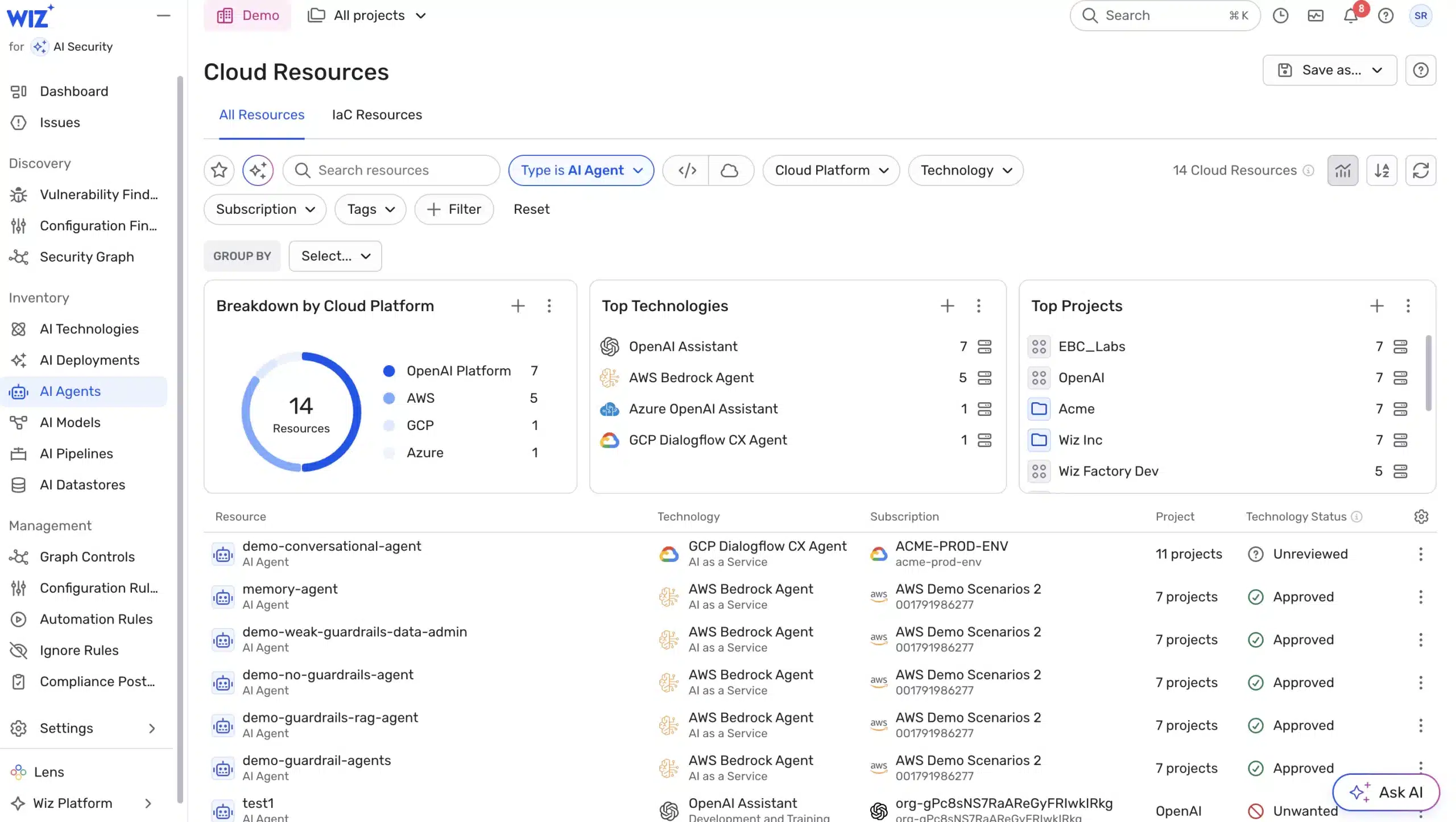
Wiz AI-SPM is an AI security platform that secures AI systems across their lifecycle, from development to runtime. It provides visibility into AI pipelines by discovering models, services, and dependencies without requiring agents. The platform builds a structured view of AI components using an AI-BOM and correlates them with infrastructure, identities, and data.
Key features include:
- Agentless AI discovery and inventory: Automatically discovers and catalogs AI models, agents, services, and SDKs across PaaS, SaaS, and custom deployments without requiring agents
- AI-BOM and component mapping: Builds a detailed inventory of AI components, including models, frameworks, libraries, and dependencies
- AI service catalog and connectivity mapping: Maps how AI services interact with applications, infrastructure, and data sources
- AI tool identification: Identifies and classifies tools accessible to AI agents
- Misconfiguration detection: Uses built-in security rules to detect insecure configurations, unsafe deployments, and logic flaws in AI services
3. Microsoft Defender for Cloud

Microsoft Defender for Cloud is a CNAPP solution that includes AI security posture management capabilities to secure AI workloads across multicloud and hybrid environments. It provides visibility into AI systems from development to runtime by continuously discovering AI applications, agents, and their components across platforms such as Azure, AWS, and GCP.
Key features include:
- AI workload discovery across multicloud: Continuously discovers AI applications and workloads across Azure, AWS, and GCP services such as Azure OpenAI, Amazon Bedrock, and Google Vertex AI
- AI agent discovery (preview): Identifies and inventories AI agents deployed through services like Azure AI Foundry and Copilot Studio
- AI-BOM generation: Builds a detailed bill of materials that includes application components, data, and AI artifacts from code to cloud
- Full lifecycle visibility: Provides visibility into AI systems across development, deployment, and runtime environments
- Vulnerability detection in dependencies: Scans AI libraries such as TensorFlow, PyTorch, and LangChain for vulnerabilities in code and container images

Traditional ASPM vendors expanding into AI security
4. ArmorCode

ArmorCode is an application security posture management (ASPM) platform with AI security capabilities that provides a unified view of risk across applications, infrastructure, and AI assets. It aggregates and normalizes findings from multiple security tools, including code scanners, cloud security tools, and manual assessments, to reduce fragmentation.
Key features include:
- Unified security data ingestion: Aggregates and normalizes findings from code scanners, cloud tools, infrastructure security tools, and penetration testing reports into a single platform
- Centralized risk visibility: Provides a view of application and AI security posture
- AI-driven risk prioritization: Uses correlation and risk scoring to identify and prioritize critical vulnerabilities based on context and business impact
- Finding correlation across sources: Groups and correlates findings from different tools to reduce duplication
- Automated security workflows: Triggers automated remediation actions, approvals, and policy-driven processes
5. Cycode

Cycode is an ASPM platform that delivers real-time visibility, prioritization, and remediation of application security risks across the software development lifecycle, from code to cloud. It integrates with security tools and development environments, allowing organizations to aggregate and correlate vulnerabilities from multiple sources. Using its Context Intelligence Graph, Cycode connects code, pipelines, infrastructure, and ownership data.
Key features include:
- End-to-end ASPM coverage: Provides application security posture management across pipeline security, application security, and runtime risk from code to cloud
- Broad tool integration (ConnectorX): Connects with third-party security tools, scanners, and infrastructure to aggregate vulnerabilities into a unified platform
- Real-time risk visibility: Delivers continuous visibility into security posture across codebases, pipelines, and cloud environments
- Native and integrated scanning: Supports native scanners as well as external tools for SAST, SCA, IaC, container security, and related areas
- Context intelligence graph (CIG): Maps relationships between code, infrastructure, configurations, and ownership to provide risk traceability across the SDLC

6. Legit Security

Legit Security is an AI-native ASPM platform that unifies application security across the software development lifecycle, from code to cloud. It integrates with development and security tools to provide a consolidated view of vulnerabilities, misconfigurations, secrets, and AI-related risks. The platform orchestrates and correlates findings from multiple scanners, reducing duplication and highlighting impactful issues.
Key features include:
- Code-to-cloud visibility: Integrates across the development pipeline to provide a unified view of vulnerabilities, misconfigurations, secrets, and AI-related risks
- Security tool orchestration: Coordinates existing scanners and tools, aggregating findings into a single platform
- Correlation and deduplication: Correlates and removes duplicate findings to reduce noise and highlight critical security issues
- Root cause remediation: Identifies chokepoints where a single fix can resolve multiple vulnerabilities
- Contextual risk scoring: Prioritizes risks based on business criticality, compliance requirements, API exposure, internet accessibility, and GenAI usage

Conclusion
AI Security Posture Management (AI-SPM) is critical for organizations leveraging AI, as it addresses the unique and evolving security threats targeting these systems. These solutions provide comprehensive protection by offering core capabilities such as AI asset discovery, supply chain risk management, system prompt hardening, and runtime protection. By integrating governance, policy enforcement, and continuous monitoring throughout the AI lifecycle, AI-SPM helps maintain the integrity, compliance, and safe operation of AI systems.