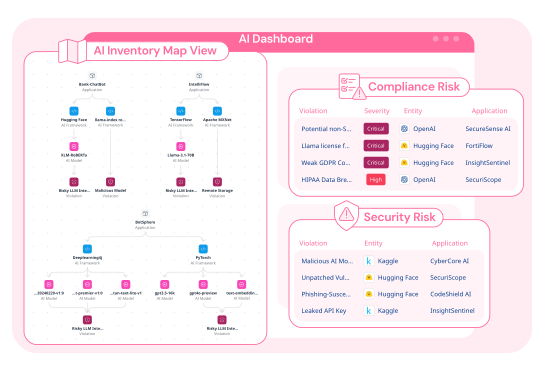
Automated AI Bill of Materials (AI-BOM) Management
Gain complete visibility into every AI component powering your applications — from models and frameworks to RAG pipelines, model context protocols (MCPs), and Shadow AI — continuously updated and always audit-ready.

Challenges
AI development moves fast. Manual inventories can’t keep up.
With teams rapidly adopting third-party models, open source datasets, and AI-powered libraries, maintaining an accurate AI component inventory is nearly impossible without automation.

Constant change
New AI models, fine-tuned versions, and training datasets are introduced constantly — making it nearly impossible to track what’s running in production.
Manual processes
Manually cataloging AI models, their provenance, and associated risks across every application and team guarantees blind spots and compliance gaps.
Incomplete visibility
Vulnerabilities in models, poisoned training data, and unlicensed AI assets can go undetected until it’s too late.
Opportunities
Beyond inventory to active AI risk management
Meeting compliance requirements is a critical first step. The real value is using that visibility to proactively manage risk across your entire AI supply chain.

Eliminate blind spots
Build a continuous AI component inventory by automatically discovering every Shadow AI component, model, framework, MCP, and RAG pipeline across your stack.
Stay ahead of AI vulnerabilities
Continuously monitor your AI supply chain for known vulnerabilities, malicious models, and compromised training data — with up-to-the-minute risk assessments.
Prioritize real risk
Reachability analysis and runtime context focus remediation on what’s actually exploitable.
The solution
Mend AI
Mend AI automates your AI bill of materials, delivering complete visibility into every AI component in your software — including Shadow AI, models, frameworks, MCPs, and RAG pipelines. It automatically scans your applications to build a comprehensive, machine-readable AI asset inventory in SPDX and CycloneDX formats, so your team always knows what’s running, where it came from, and whether it can be trusted.

Discover Mend AI

“One of our most indicative KPIs is the amount of time for us to remediate vulnerabilities and also the amount of time developers spend fixing vulnerabilities in our code base, which has reduced significantly. We’re talking about at least 80% reduction in time.”


“When the product you sell is an application you develop, your teams need to be fast, secure and compliant. These three factors often work in opposite directions. Mend provides the opportunity to align these often competing factors, providing Vonage with an advantage in a very competitive marketplace.”


“The biggest value we get out of Mend is the fast feedback loop, which enables our developers to respond rapidly to any vulnerability or license issues. When a vulnerability or a license is disregarded or blocked, and there is a policy violation, they get the feedback directly.”


FAQs
How does Mend.io build and maintain an AI-BOM?
Mend AI continuously scans your codebase and automatically discovers every AI component (models, frameworks, agents and agent configurations, and MCPs), keeping the inventory live and audit-ready as your applications change.
What does Mend.io’s AI-BOM capture that an SBOM misses?
A traditional SBOM inventories software packages and dependencies. Mend.io’s AI-BOM inventories all AI components, including AI technologies and frameworks, models and inference providers, system prompts, and indicators of AI architectures such as agents.
For the fundamentals, read what an AI bill of materials is.
How does Mend.io detect shadow AI?
Continuous automatic discovery. Every AI component in the codebase is surfaced, including models and agents no one registered as well as AI components called by your code, eliminating the blind spots manual inventories leave behind.
What formats does Mend.io’s AI-BOM export to?
AI Technologies and AI Models data can be exported to CSV. Mend AI can also generate AI Inventory and AI Models Security Findings reports in JSON, XML, or Excel formats.
Can Mend.io’s AI-BOM detect malicious models?
Yes. Mend AI assesses your AI supply chain for known vulnerabilities, malicious models, and compromised training data, with up-to-the-minute risk assessments.
How does Mend.io’s AI-BOM support compliance audits?
Regulations like the EU AI Act require verifiable evidence that AI systems have been inventoried. Mend.io’s continuously updated AI-BOM gives auditors that evidence without manual assembly.