Table of contents
Related resources


Top 13 AI code review tools for vulnerability detection in 2026

TL;DR: AI code review tools use machine learning to scan code for security vulnerabilities before release. Top picks: Mend.io for unified code security, Snyk for developer-first scanning, Checkmarx for enterprise SAST, and CodeRabbit for AI PR reviews.
What are AI code review tools for vulnerability detection?
AI powered code review tools for vulnerability detection find security flaws while code is still in development:
These tools combine traditional static application security testing (SAST) with large language models (LLMs) and context-aware agents, so they read what the code is meant to do, where older scanners only match patterns. That’s how they catch business logic flaws, hardcoded secrets, and data flow vulnerabilities with fewer false positives.
Core approaches to AI vulnerability detection:
- AI-enhanced SAST: Analyzes source code without executing it. It tracks data flows across multiple files to identify issues like SQL injections, cross-site scripting (XSS), and improper authorization.
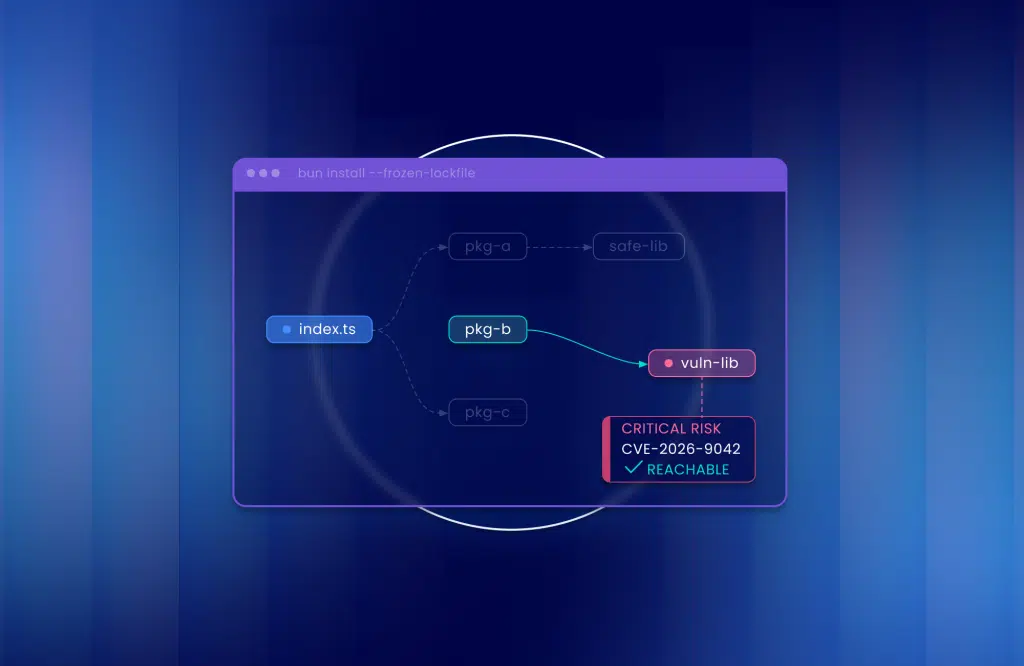
- AI powered software composition analysis (SCA): Scans third-party dependencies. AI performs “reachability analysis” to check whether your code can actually execute a vulnerable library function. That cuts open source alert noise.
- LLM-assisted vulnerability explanation: Uses large language models to explain security findings in plain language, including root cause, potential impact, and recommended remediation steps.
- Dependency and supply chain risk detection: Continuously analyzes third-party packages, dependencies, and software supply chains to identify vulnerable, malicious, or poorly maintained components before they introduce risk.
Related content: Read our guide to AI code review tools
This is part of a series of articles about SAST.
AI code review tools for vulnerability detection at a glance
The table below compares the tools in this guide: what each one suits best, its main strengths, and what to weigh before you adopt it. Each tool gets a fuller write-up further down.
| Category | Solution | Best for | Key strengths | Things to consider |
|---|---|---|---|---|
| AI powered application security platforms | Mend.io | Securing human and AI-generated code in the repo | Fast incremental SAST, AI fixes, secrets scanning, on premises | UI feels dated |
| AI powered application security platforms | Snyk | Developer-first security across code, deps, containers | DeepCode AI detection, autofixes, reachability prioritization | False positives and cost that scales with team size |
| AI powered application security platforms | Checkmarx | Enterprises needing broad-language SAST with governance | Hybrid deterministic plus AI engine, IDE and PR fix guidance | Long scans, steep setup, and higher cost |
| AI powered application security platforms | Veracode | Regulated enterprises scanning source and compiled code | 100+ languages, taint path analysis, CI/CD policy gates | Slower scans and admin-led false-positive handling |
| AI powered application security platforms | Aikido Security | Dev teams wanting consolidated, low-noise AppSec scanning | SAST with AI autofix, reachability triage, IDE and PR feedback | Lighter enterprise reporting and runtime coverage |
| AI powered application security platforms | Endor Labs | Teams managing open source and AI-generated code risk | Reachability-based SCA, AI code review, malicious-package detection | Newer platform with evolving UI and onboarding |
| AI-enhanced SAST and static code analysis tools | SonarQube | Teams enforcing code quality and security at merge | SAST and taint analysis across 35+ languages, quality gates | Tuning needed for noise; heavier on large codebases |
| AI-enhanced SAST and static code analysis tools | Semgrep | Teams wanting customizable, pattern-based SAST | Rule-plus-AI detection, reachability, fast CI/CD scans | Out-of-the-box noise and custom-rule learning curve |
| AI-enhanced SAST and static code analysis tools | Codacy | Teams standardizing quality and security across repos | SAST, SCA, secrets, IaC, and AI PR reviews in one place | Style-level noise and limited rule customization |
| AI code review assistants | CodeRabbit | Teams adding AI review to pull request workflows | Line-by-line PR reviews, summaries, 40+ linters and scanners | Comment noise and limited security depth |
| AI code review assistants | Qodo | Teams pairing PR review with automated test generation | Multi-agent PR review, rules enforcement, test generation | Slower on large repos; tests may need edits |
| AI code review assistants | CodeAnt AI | Teams unifying AI review, SAST, and pentesting | PR review with SAST, secrets, IaC, and one-click fixes | Occasional false positives and style nitpicks |
| AI code review assistants | Greptile | Teams wanting whole-codebase context in PR reviews | Repo-graph indexing, agent swarm review, custom rules | Noisy reviews, no auto-fix, per-review overages |
Read our detailed guide to source code review tools
Why vulnerability detection matters in modern code review
The larger a codebase gets, the more security issues slip past manual review. Vulnerabilities such as injection flaws, insecure authentication logic, exposed secrets, and dependency risks can stay hidden until someone exploits them. Catch them early in development and the fix costs less, with less risk reaching production.
AI powered vulnerability detection scans code continuously for known weakness patterns and risky coding practices. Developers can fix security problems before code reaches production, even when your team ships fast.
Benefits of vulnerability detection in code review:
- Identifies security flaws early, when they cost less to fix.
- Detects common vulnerabilities such as SQL injection, cross-site scripting (XSS), and insecure deserialization.
- Helps enforce secure coding standards across development teams.
- Reduces the risk of security incidents, data breaches, and compliance violations.
- Provides consistent analysis across large and complex codebases.
- Supports CI/CD pipelines by automating security checks during development.
- Highlights risky dependencies and third-party library vulnerabilities.
- Allows developers to prioritize and fix critical security issues faster.
How AI code review tools detect vulnerabilities
AI-enhanced SAST
AI-enhanced static application security testing (SAST) uses machine learning models to analyze source code or compiled code without executing it. These models train on large datasets of known vulnerabilities and secure coding practices, so they recognize patterns and anomalies that point to security risks. Because they read code context, data flows, and control structures, AI powered SAST tools detect common vulnerabilities, such as SQL injection or cross-site scripting, and subtler issues in logic or insecure APIs.
How AI improves SAST:
Traditional SAST relies on predefined rules and can generate high numbers of false positives. AI-enhanced SAST adapts to new coding patterns and learns from developer feedback. Noise drops, accuracy rises, and your security team spends its time on real threats.
AI powered software composition analysis (SCA)
AI powered software composition analysis (SCA) automatically identifies the open source components and third-party libraries in a codebase. These tools analyze dependencies in depth, flag outdated or vulnerable components, and recommend context-aware fixes. They also track vulnerability databases in real time, so a newly discovered threat gets flagged as soon as it’s published.
How AI improves SCA:
AI recognizes patterns in how your code uses libraries, predicts some risks before official advisories come out, and cuts false positives. Your team can deal with supply chain risks sooner and shrink the attack surface.
LLM-assisted vulnerability explanation
Code review tools now use large language models (LLMs) to explain detected vulnerabilities in detailed, readable language. When a tool finds a potential issue, the LLM describes the root cause, impact, and remediation steps in natural language. Developers at any experience level can understand the finding quickly and act on it without extensive research.
How AI improves vulnerability explanation:
LLMs also put each vulnerability in the context of the surrounding code and project architecture. They adapt explanations to the specific use case, which removes ambiguity when you decide how to fix it.
Dependency and supply chain risk detection
Dependency and supply chain risk detection identifies vulnerabilities that come from third-party packages, plugins, or external services integrated into the software. AI powered tools continuously monitor the entire dependency tree and cross-reference it with vulnerability databases, exploit repositories, and threat intelligence feeds. This real-time analysis detects new risks promptly, so your team can respond before attackers exploit them.
How AI improves dependency supply chain risk detection:
Beyond known issues, AI systems assess the overall health and security posture of dependencies by evaluating maintainer activity, update frequency, and historical incident records. That gives you a fuller risk assessment.
Related content: Read our guide to SAST vs. SCA
Key features to look for in AI code review tools
1. Vulnerability coverage
An AI code review tool is only as useful as the vulnerabilities it covers. That means supporting a wide range of vulnerability types, from standard OWASP Top Ten issues like injection and authentication flaws to more advanced threats such as insecure deserialization or business logic vulnerabilities. Good tools update their detection models regularly, so they keep up as new vulnerabilities appear.
Depth of coverage also matters. The best tools analyze all layers of an application, including front-end, back-end, APIs, and infrastructure-as-code scripts. They should support the programming languages and frameworks your team uses. Broad, deep coverage reduces blind spots, so you find and fix security risks before they reach production.
2. Context-aware autofixing
Context-aware autofixing means the AI tool suggests or applies code fixes that fit the specific context of the vulnerability. Instead of offering generic patches, these tools analyze the surrounding code, dependencies, and application logic to generate precise recommendations. That lowers the risk of a fix introducing new bugs or breaking functionality.
Remediation goes faster because developers accept or review suggested changes inside their workflow. The tool may explain the fix or reference best practices alongside it, which teaches developers and improves code quality over time. Autofixes keep getting more accurate as AI models improve.
3. Intelligent noise reduction
Intelligent noise reduction cuts the false positives and irrelevant alerts that overwhelm developers and make code review tools less useful. AI powered tools learn from historical feedback, user actions, and code context, and refine their detection over time. They prioritize high-confidence findings and suppress low-impact or duplicate issues, so your security team works on the most severe vulnerabilities first.
Noise matters most in large or fast-moving projects, where alert fatigue leads to missed threats. Fewer false alarms also build developer trust in the tool. Developers who trust the tool keep using it, which makes code reviews faster and your security posture stronger.
4. Pull request integration
Pull request integration allows AI code review tools to analyze code changes automatically as part of the pull request workflow in version control systems like GitHub, GitLab, or Bitbucket. The tool catches vulnerabilities and code quality issues before changes merge into the main branch, so fewer security flaws reach production. Developers get feedback immediately, which simplifies review.
Pull request integration also lets your team enforce security policies and review standards consistently across all contributions. AI tools add comments, suggestions, or required status checks directly in the pull request interface, where developers and security teams can discuss them.
5. IDE integration
IDE integration brings AI code review capabilities directly into developers’ preferred integrated development environments, such as Visual Studio Code, IntelliJ IDEA, or Eclipse. These tools surface vulnerabilities, code smells, and suggestions in real time as developers write code. Developers fix issues early, with less context switching and rework.
Good IDE integration also drives adoption, because security checks become part of writing code instead of a separate step afterward. AI powered suggestions and explanations teach developers secure coding practices as they work. If your developers won’t open a separate dashboard, the IDE is where the tool has to meet them.
6. CI/CD compatibility
CI/CD compatibility means the AI code review tool plugs into your continuous integration and continuous deployment pipelines and runs security checks as part of every build and release. Your team catches vulnerabilities and code quality issues before code ships to production, and every release meets the same standard. Automated scanning also reduces manual effort.
With CI/CD integration, security becomes a shared responsibility embedded throughout the development lifecycle. AI tools can block builds on critical findings, generate compliance reports, and give developers and operations teams findings they can act on. You keep pace with fast development cycles without letting new vulnerabilities through.
7. Business logic vulnerability detection
Business logic vulnerability detection finds security issues that stem from the way an application is designed and operates rather than from coding mistakes alone. These vulnerabilities can include flaws in authorization workflows, transaction processing, pricing logic, rate-limiting controls, or approval processes. AI code review tools analyze code paths, user actions, and application behavior patterns to find situations where legitimate functionality could be abused to bypass intended business rules.
Business logic flaws are hard to detect because they depend on context and are often unique to one application. AI models improve detection by correlating code behavior with expected workflows and highlighting unusual or risky conditions that rule-based scanners may miss. Your team finds these weaknesses earlier and reduces the risk of fraud, privilege escalation, and other attacks that exploit application logic.
Notable AI code review tools for vulnerability detection
How we selected these tools: We shortlisted AI code review tools based on their ability to detect security vulnerabilities in source code, including static analysis coverage, dependency and supply chain analysis, autofix capabilities, noise reduction, and integration with IDEs, pull requests, and CI/CD pipelines.
AI powered application security platforms
1. Mend.io
Best for: Securing human and AI-generated code in the repo
Strengths: Fast incremental SAST, AI fixes, secrets scanning, on premises
Things to consider: UI feels dated; verifying some findings takes effort
Mend SAST is the static analysis component of Mend AppSec. It scans source code, whether written by developers or generated by AI, to find security vulnerabilities and hardcoded secrets across the repository and the IDE. The engine uses incremental differential scanning. It analyzes only the code that changed and skips re-scanning the entire codebase. It runs a lightweight scan at the point of code generation inside the IDE and a deeper analysis at commit.
Key features include:
- Incremental differential scanning: Analyzes only the code that changed between scans, which keeps scan times short on active repositories.
- Agentic SAST for AI assistants: Connects to AI coding tools such as Cursor, Windsurf, and Copilot so generated code is checked for vulnerabilities as it is produced.
- AI powered code fixes: Generates suggested fixes for identified vulnerabilities directly in the repository.
- Noise reduction: Groups related findings, suppresses issues on unreachable paths, and validates the call graph to cut down on irrelevant alerts.
- Secrets scanning: Detects exposed credentials, keys, tokens, and certificates in code and can fail builds when secrets are found.
- On-premises scanning: Performs the code analysis inside the customer environment so source never leaves the network perimeter.
- Broad integrations: Works with JetBrains IDEs, VS Code, and Visual Studio; GitHub, GitLab, Bitbucket, and Azure DevOps; and Jenkins, CircleCI, and GitHub Actions.
Limitations (as reported by users on G2):
- Interface feels dated: Some users would prefer a more modern, updated dashboard experience.
- On-premises integration setup: Connecting to certain on-premises tools can involve additional configuration effort.

Source: Mend.io
2. Snyk
Best for: Developer-first security across code, deps, containers
Strengths: DeepCode AI detection, autofixes, reachability prioritization
Things to consider: False positives and cost that scales with team size
Snyk is a developer security platform that covers code, open source dependencies, containers, and cloud configurations. Its DeepCode AI engine combines symbolic and generative AI with machine learning models trained on more than 25 million data flow cases across 19 languages. This engine powers Agent Fix, which generates code fixes. Snyk applies context-aware risk scoring that factors in signals such as package popularity, reachability, and exploit maturity to help prioritize which issues to address first.
Key features include:
- DeepCode AI engine: Combines symbolic and generative AI with machine learning to identify vulnerabilities in source code.
- Agent Fix autofixes: Suggests code fixes for detected issues with a reported accuracy near 85 percent.
- Risk-based prioritization: Scores findings using popularity, reachability, and exploit maturity to rank what to fix first.
- IDE real-time feedback: Surfaces issues as code is written through plugins for VS Code and JetBrains IDEs.
- Repository and pipeline scanning: Checks code across connected repositories and CI/CD pipelines.
- Custom rules: Supports user-defined detection logic through DeepCode AI Search.
Limitations (as reported by users on G2):
- False positives in code scanning: Users note that Snyk Code is less mature than the SCA capabilities and can surface findings with limited context.
- Cost at scale: Pricing for the full platform is reported as high and scales with the number of developers.
- Breaking fix suggestions: Recommended fixes sometimes propose version upgrades that can break the build.
- Scan speed on large repositories: Scans can slow down pipelines on bigger codebases.

Source: Snyk
3. Checkmarx
Best for: Enterprises needing broad-language SAST with governance
Strengths: Hybrid deterministic plus AI engine, IDE and PR fix guidance
Things to consider: Long scans, steep setup, and higher cost
Checkmarx SAST is the static analysis product within the Checkmarx One platform. It uses a hybrid approach that pairs a deterministic engine for core languages with an AI engine for emerging languages and AI-generated code. A Findings Analysis capability classifies results as true or false positives and reports a reduction in false positives by ranking findings rather than deleting them. The scanner analyzes uncompiled source from GitHub, GitLab, Azure, and Bitbucket without requiring a build, and it supports both full and incremental scans.
Key features include:
- Hybrid scanning engine: Combines a deterministic engine for established languages with an AI engine for newer and AI-generated code.
- Findings Analysis: Classifies results as true or false positives and ranks them to reduce noise.
- Adaptive scanning: Supports both full scans and incremental scans of changed code.
- Source scanning without builds: Analyzes uncompiled source pulled directly from connected repositories.
- IDE and pull request remediation: Delivers findings and AI fix guidance inside the IDE and in pull requests.
- Broad language coverage: Supports a wide range of programming languages.
- Unified platform: Operates within Checkmarx One alongside SCA, DAST, API, IaC, and container security.
Limitations (as reported by users on G2):
- False positives on less-common languages: Accuracy can drop for languages such as Kotlin, producing more noise.
- Long scan times: Scans can take a long time on large projects.
- Steep learning curve: Initial setup and configuration can be lengthy and complex.
- High cost: The platform is reported as expensive.

Source: Checkmarx
4. Veracode
Best for: Regulated enterprises scanning source and compiled code
Strengths: 100+ languages, taint path analysis, CI/CD policy gates
Things to consider: Slower scans and admin-led false-positive handling
Veracode Static Analysis is delivered as an adaptable SAST scanning service. It can analyze raw source code without compilation or scan compiled binaries when source is not available, supporting source, binary, and hybrid modes across more than 100 languages and frameworks. The engine maps data paths to find where untrusted input reaches critical functions, using a patented Crosscheck path analysis technique.
Key features include:
- Adaptable scanning service: Scans source without compilation or compiled binaries when source is unavailable, in source, binary, or hybrid modes.
- Crosscheck path analysis: Maps data paths to identify where untrusted data reaches sensitive functions.
- Wide language coverage: Supports more than 100 languages and frameworks, with full-program analysis up to 5 GB.
- CWE-aligned findings: Maps results to CWE categories for consistent classification.
- Security-Sensitive Context filtering: Narrows results to the most relevant security findings.
- IDE and pipeline integration: Connects to IDEs and CI/CD pipelines with policy enforcement.
- Framework modeling: Models common application frameworks to support analysis accuracy.
Limitations (as reported by users on G2):
- False-positive handling: Mitigating false positives is not straightforward and can depend on administrators, which adds delays.
- Scan speed and packaging friction: Scans can be slow, and binary packaging and upload steps add overhead.
- Inconsistent results: Repeated scans of unchanged code can produce different results.
- Complex licensing: Licensing is reported as complicated and expensive.

Source: Veracode
5. Aikido Security
Best for: Dev teams wanting consolidated, low-noise AppSec scanning
Strengths: SAST with AI autofix, reachability triage, IDE and PR feedback
Things to consider: Lighter enterprise reporting and runtime coverage
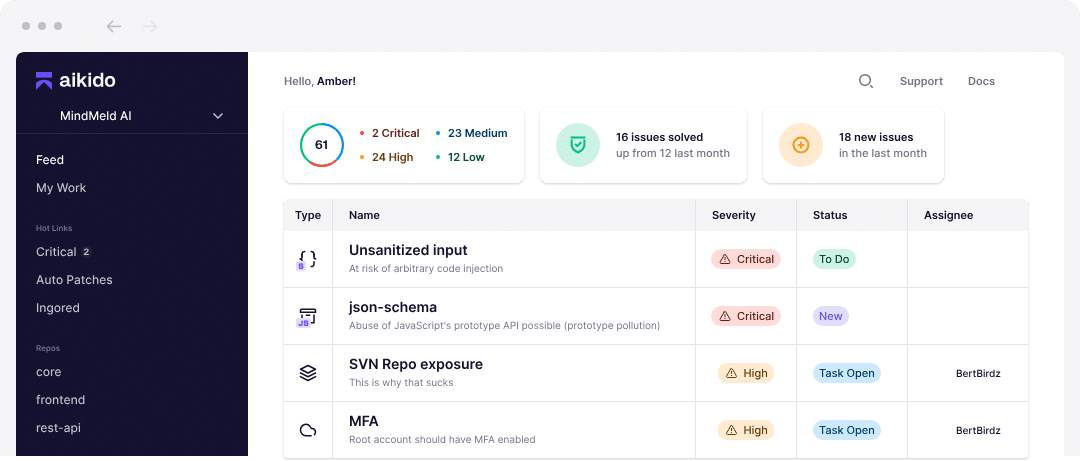
Aikido Security is an application security platform whose SAST capability finds both security and code quality issues. It surfaces fixes through the IDE, inline pull request comments, and AI-generated pull requests. A tuned ruleset reduces false positives and triages vulnerabilities that are not reachable. One-click autofixes combine deterministic logic with agentic AI. An MCP plugin connects the engine to AI coding tools so AI-generated code is scanned as it is created.
Key features include:
- Static analysis with noise reduction: Finds security and quality issues while triaging unreachable vulnerabilities to cut noise.
- One-click autofix: Generates fixes with confidence levels using deterministic and agentic AI techniques.
- MCP plugin for AI coding tools: Connects the scanning engine to AI coding assistants to check generated code.
- IDE inline feedback: Reports issues by file and line and can run a full repository scan from the editor.
- Pull request enforcement: Blocks merges based on severity, issue type, and context.
- Custom rules and severity scoring: Supports user-defined rules and context-based severity scoring.
- Broad language support: Works across GitHub, GitLab, Bitbucket, and Azure DevOps.
Limitations (as reported by users on G2):
- Lighter enterprise reporting: Advanced reporting, customization, and policy tuning are less developed for regulated enterprises.
- Agent resource use: The scanning agent can consume substantial memory.
- Limited runtime controls: The focus is on shift-left scanning, with limited deep runtime protection.
- Ramp-up to full value: The value of advanced features such as custom rules is realized only after some use.
Source: Aikido Security
6. Endor Labs
Best for: Teams managing open source and AI-generated code risk
Strengths: Reachability-based SCA, AI code review, malicious-package detection
Things to consider: Newer platform with evolving UI and onboarding
Endor Labs is an application security platform that includes AURI for agentic development. It combines agentic reasoning with deterministic program analysis to find both logic flaws and classic vulnerabilities. A code context graph maps relationships between code, dependencies, containers, and services, which enables full-stack reachability analysis across first-party code, direct and transitive dependencies, and container layers. Its products include AI SAST, AI Security Code Review for continuous pull request reviews, and secrets detection.
Key features include:
- Code context graph: Maps relationships across code, dependencies, containers, and services.
- Multi-modal detection: Uses source-to-sink taint tracking and multi-file dataflow analysis to find vulnerabilities.
- Full-stack reachability: Determines whether vulnerabilities are reachable across first-party code, dependencies, and container layers.
- AI Security Code Review: Reviews pull requests continuously and detects changes to security architecture.
- Malicious package detection: Identifies malicious open source packages in the dependency tree.
- AI coding agent integration: Provides context to Cursor, Windsurf, VS Code, and Claude Code.
- Automated remediation: Generates fixes for identified issues.
Limitations (as reported by users on G2):
- Interface refinement: The UI and user experience need further polish in places.
- Onboarding effort: Setup and onboarding could be made easier.
- Platform maturity: As a relatively new vendor, some capabilities are still maturing.
- Pricing at scale: Cost predictability at larger scale is a concern for some users.

Source: Endor Labs
AI-enhanced SAST and static code analysis tools
7. SonarQube
Best for: Teams enforcing code quality and security at merge
Strengths: SAST and taint analysis across 35 languages, quality gates
Things to consider: Tuning needed for noise; heavier on large codebases
SonarQube is an automated code review tool that analyzes code written by developers and AI across 35 languages. It performs deterministic verification of defects, vulnerabilities, and correctness issues, and works from the IDE through to CI/CD. Its Advanced Security add-on brings SAST and taint analysis, and it checks code against standards such as PCI DSS, OWASP, CWE, and STIG. An MCP server connects AI agents including Cursor, Claude, and Windsurf to its analysis.
Key features include:
- Static analysis across 35 languages: Verifies defects, vulnerabilities, and correctness issues deterministically.
- SAST and taint analysis: Adds security-focused analysis through the Advanced Security capability.
- Quality gates: Block merges when code fails to meet defined quality and security thresholds.
- Secrets and compliance checks: Detects secrets and checks code against standards such as OWASP, CWE, and PCI DSS.
- MCP server for AI agents: Connects AI coding agents to SonarQube analysis.
- IDE-to-CI/CD integration: Works with GitHub, GitLab, and Jenkins, with dashboards and pull request analysis.
- AI Code Assurance workflow: Provides a dedicated review path for AI-generated code.
Limitations (as reported by users on G2):
- False positives and rigid rules: Findings can require tuning and suppressions, particularly on legacy code.
- Complex setup: Configuration can be involved, especially on large or multi-language projects.
- Resource use on large codebases: Scans can be slow and resource-heavy, and the UI can feel sluggish at scale.
- Learning curve: Understanding rules, quality gates, and metrics takes time.

Source: SonarQube
8. Semgrep
Best for: Teams wanting customizable, pattern-based SAST
Strengths: Rule-plus-AI detection, reachability, fast CI/CD scans
Things to consider: Out-of-the-box noise and custom-rule learning curve
Semgrep is a static analysis tool that uses pattern-based rules written in a syntax that resembles source code. Its multimodal detection combines deterministic SAST for issues such as XSS and SQL injection with AI analysis for issues such as IDOR and business logic flaws. It applies organization-specific context and filters false positives using mitigating context, and it learns from how teams triage findings. Remediation guidance is delivered within pull requests, and scans can run locally, in the IDE, at pre-commit, and in CI/CD.
Key features include:
- Multimodal detection: Combines deterministic SAST with AI analysis for logic-related issues.
- Pattern-based custom rules: Lets teams write rules in a syntax that resembles the code being scanned.
- Noise reduction: Applies mitigating context and learns from triage decisions to reduce false positives.
- In-PR remediation: Provides step-by-step fix guidance inside pull requests.
- Reachability analysis: Assesses whether dependency vulnerabilities are reachable through Supply Chain analysis.
- Flexible deployment: Runs locally, in the IDE, at pre-commit, and in CI/CD pipelines.
- Broad language and rule coverage: Supports more than 30 languages with a shared rule registry.
Limitations (as reported by users on G2):
- Out-of-the-box noise: Default rules can produce false positives that require tuning and ongoing effort.
- Narrow core security focus: The core product lacks built-in secrets, IaC, and container scanning without add-ons.
- Custom rule learning curve: Writing custom rules takes time to learn.
- Limited standalone context: Assessing exploitability and reachability can require pairing with other tools.

Source: Semgrep
9. Codacy
Best for: Teams standardizing quality and security across repos
Strengths: SAST, SCA, secrets, IaC, and AI PR reviews in one place
Things to consider: Style-level noise and limited rule customization
Codacy is a code quality and security platform aimed at AI-assisted development teams. It lets teams define standards once and enforce them across projects, combining SAST, SCA, secrets detection, and IaC scanning with AI policy checks for issues such as unapproved models and prompt injection. Its AI Reviewer provides low-noise pull request feedback with fix suggestions, summaries, and automatic false-positive detection. Codacy Guardrails scans AI-generated code against policies as it is created.
Key features include:
- Unified standards enforcement: Defines quality and security standards once and applies them across projects.
- Application security scanning: Combines SAST, secrets detection, and IaC scanning.
- AI Reviewer: Delivers low-noise pull request feedback with fix suggestions and summaries.
- AI Guardrails: Checks AI-generated code against policies as it is written.
- Software composition analysis: Re-scans dependencies daily against CVE data.
- AI Risk Hub: Manages policies for AI coding usage.
- Compliance reporting: Generates SBOMs and supports SOC 2 and ISO frameworks.
Limitations (as reported by users on G2):
- Style-level noise: The tool can flag minor or low-priority stylistic issues.
- Limited rule customization: Fine-tuning and customizing rules is constrained.
- False positives on legacy code: Older codebases can generate noise that requires tuning.
- Pricing and support tiers: Pricing concerns affect smaller organizations, and support can be slower on lower tiers.

Source: Codacy
AI code review assistants
10. CodeRabbit
Best for: Teams adding AI review to pull request workflows
Strengths: Line-by-line PR reviews, summaries, 40+ linters and scanners
Things to consider: Comment noise and limited security depth
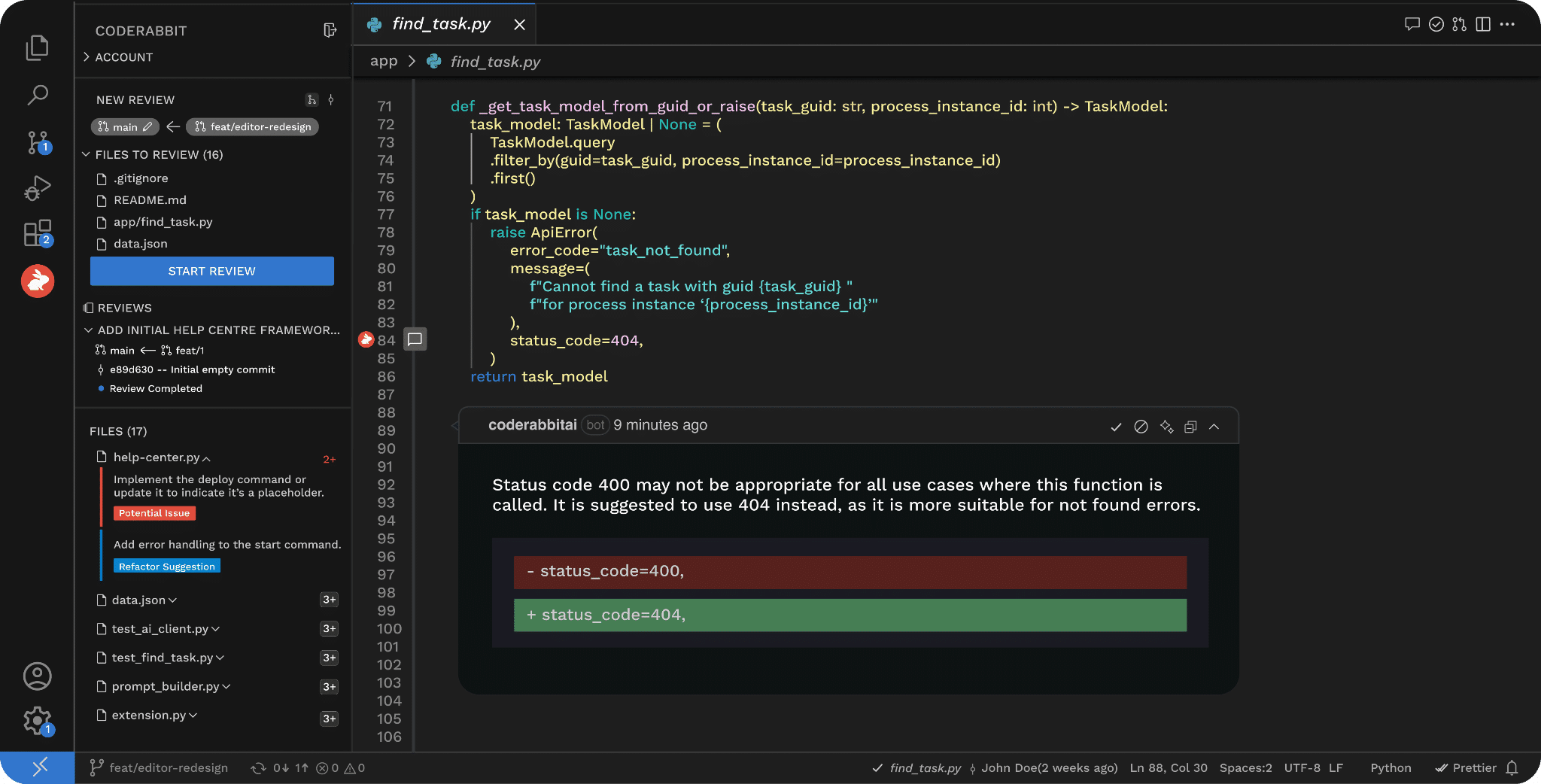
CodeRabbit is an AI code reviewer that provides context-aware, line-by-line pull request reviews along with a CLI and IDE integration. It produces pull request summaries that include a walkthrough and an architecture diagram, and it supports one-click commits and a Fix with AI option. It builds codebase context using a code graph and custom guidelines, and it pulls external context through MCP servers, linked Jira and Linear issues, and web queries. The tool runs more than 40 linters and security scanners with false-positive filtering.
Key features include:
- Line-by-line pull request reviews: Provides context-aware comments on individual changes.
- PR summaries and diagrams: Generates walkthroughs and architecture diagrams for pull requests.
- One-click and AI fixes: Supports one-click commits and a Fix with AI option.
- Codebase and external context: Draws on a code graph plus MCP servers, linked issues, and web queries.
- 40+ linters and scanners: Runs many linters and security scanners with noise filtering.
- Learning from feedback: Adapts to natural-language feedback and path or AST instructions.
- Pre-merge checks and generation: Adds pre-merge checks with unit test and docstring generation.
Limitations (as reported by users on G2):
- Comment noise: Pull request feedback can be excessive even at lower settings, and some comments are unhelpful.
- Support responsiveness: Customer support can be slow to respond.
- Depth of review: It works as a first-pass layer rather than a replacement for deep security or architectural review.
- Configuration effort: Reducing noise requires upfront configuration.
Source: CodeRabbit
11. Qodo
Best for: Teams pairing PR review with automated test generation
Strengths: Multi-agent PR review, rules enforcement, test generation
Things to consider: Slower on large repos; tests may need edits
Qodo is an AI code review platform that works across the IDE, pull requests, the CLI, and Git. Its agentic pull request review gathers context from multiple repositories, pull request history, and linked tickets, then uses specialized agents to find issues and prioritize them by severity so blockers surface first. It generates implementation-ready prompts that pair issue context with code ranges for an AI coding assistant. The platform automatically generates and enforces rules derived from organizational and historical context.
Key features include:
- Agentic PR review: Uses specialized agents to find and prioritize issues in pull requests.
- Context engine: Gathers context from multiple repositories, pull request history, and tickets.
- Severity prioritization: Ranks findings by severity so blocking issues appear first.
- Implementation-ready prompts: Produces prompts that combine issue context with relevant code ranges.
- Rules enforcement: Generates and enforces rules from organizational and historical context.
- Requirement validation: Checks code against the requirements in linked tickets.
- Flexible deployment: Supports single-tenant, multi-tenant, and on-premises setups with SOC 2 and zero data retention.
Limitations (as reported by users on G2):
- Performance on large codebases: The tool can be slow, particularly the IDE plugin on large repositories.
- Learning curve: Some features are not immediately intuitive.
- Suggestion accuracy: Suggestions are occasionally inaccurate or miss niche scenarios and need manual review.
- Generated test adjustments: Generated unit tests can require edits and may not run on the first attempt.

Source: Qodo
12. CodeAnt AI
Best for: Teams unifying AI review, SAST, and pentesting
Strengths: PR review with SAST, secrets, IaC, and one-click fixes
Things to consider: Occasional false positives and style nitpicks
CodeAnt AI is a security platform that combines AI code review, static analysis, and AI penetration testing. On the defensive side, it performs line-by-line pull request reviews that assess the impact of changes and fix both quality and security issues, and it runs AI SAST along with SCA, secrets detection, IaC scanning, and SBOM generation. It works in the IDE and CLI with push protection, and it provides inline fixes, AI learnings, pull request summaries, and quality gates.
Key features include:
- Line-by-line PR review: Reviews pull requests and assesses the impact of each change.
- AI SAST and code security: Combines SAST with SCA, secrets, IaC scanning, and SBOM generation.
- Inline fixes and quality gates: Provides inline remediation and gate checks on pull requests.
- IDE and CLI with push protection: Works in the editor and command line and blocks risky pushes.
- AI penetration testing: Maps the attack surface and tests for issues such as IDOR, SQLi, XSS, and SSRF.
- Attack surface monitoring: Performs passive reconnaissance of the attack surface.
- Broad integration and compliance: Supports many languages and frameworks including SOC 2, HIPAA, GDPR, and PCI DSS.
Limitations (as reported by users on G2):
- Occasional false positives: The tool sometimes flags issues that are not real problems.
- Focus on minor details: It can over-emphasize small stylistic points rather than the bigger picture.
- Depth of suggestions: Some users want deeper, more actionable recommendations on code and logic.
- Notifications and ramp-up: Notifications can be inefficient, and there is a learning curve.

Source: CodeAnt AI
13. Greptile
Best for: Teams wanting whole-codebase context in PR reviews
Strengths: Repo-graph indexing, agent swarm review, custom rules
Things to consider: Noisy reviews, no auto-fix, per-review overages
Greptile is an AI code reviewer that reviews and tests pull requests with full codebase context. It builds a graph index of the repository covering files, functions, and dependencies, then deploys a swarm of agents that review changes in parallel, assess impact beyond the diff, and flag issues. It catches a range of problems from style issues to security flaws and multi-file logical bugs, and it learns team standards from pull request comments. Custom rules can be written in plain English alongside repository-specific context.
Key features include:
- Codebase graph indexing: Builds a graph of files, functions, and dependencies for context.
- Agent swarm review: Uses multiple agents in parallel to review changes and assess impact beyond the diff.
- Continuous learning: Learns team standards from pull request comments over time.
- Custom rules in plain English: Lets teams define rules in natural language with repository context.
- Coding agent integration: Connects to coding agents through one-click IDE fixes, MCP, and a Claude Code plugin.
- TREX test generation: Writes and runs tests in a sandbox environment.
- Confidence scoring: Assigns confidence scores to its findings.
Limitations (based on publicly available sources):
- Review noise: Independent and community analyses report a high false-positive rate, with a large share of comments being nitpicks.
- No automated fixes: Each flagged issue becomes a manual task for the developer rather than an applied fix.
- Pricing model: Per-seat pricing with per-review overages can become costly and unpredictable during heavy sprints.
- Limited integrations: It supports only GitHub and GitLab, with no Bitbucket or Azure DevOps integration.

Source: Greptile
Conclusion
The tools in this list split along a line most buyers skip. AI review assistants read pull requests well but carry limited security depth, while application security tools go deeper and ask more of you in setup. Decide first whether you need a reviewer or a scanner, then compare noise, because a tool your developers mute protects nothing.