Software supply chain security
Keep your applications clear from malicious software packages throughout the full software development lifecycle.
Challenges
Active threats lurk in libraries
The open source packages developers rely on to get their work done also make great hiding places for bad actors seeking to cause damage to enterprise organizations.

Supply chain malware
Hackers inject malicious code into open source packages to quickly introduce vulnerabilities into tens of thousands of open source dependencies.
No time to scan
Regular code scans take time that developers often don’t have, meaning many weaknesses are accidentally missed.
The race to keep up
Open source packages are frequently updated, making it incredibly difficult for companies to stay on top of all vulnerabilities across different versions.
Opportunities
Stop supply chain threats
Prioritize and automate to secure code, protect users, and stop malicious actors in their tracks.

Integrate. Automate.
Built-in tools that find and block malicious packages like protestware, data stealers, and crypto miners reduce enterprise risk.
Centralize visibility and control
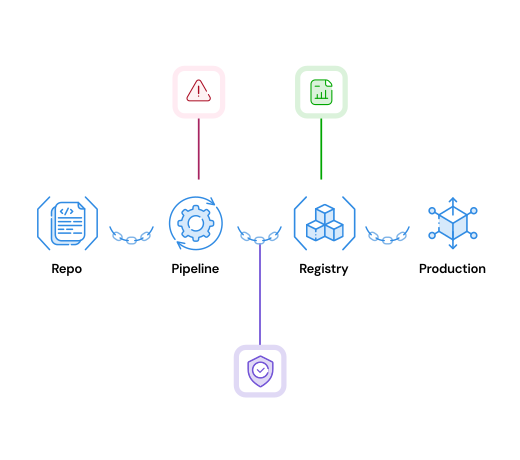
Broad coverage of repositories, CI/CD pipelines, and beyond stops malicious packages and vulnerabilities from slipping in.
Keep up with dependency updates
The key to staying a step ahead of malicious packages or exploitable vulnerabilities is automatically ensure all dependencies are kept up to date.
The solution
Find and block threats across the SDLC
Mend SCA protects repositories, CI/CD pipelines, and beyond from malicious code packages and exploitable vulnerabilities.
Discover Mend SCA

“One of our most indicative KPIs is the amount of time for us to remediate vulnerabilities and also the amount of time developers spend fixing vulnerabilities in our code base, which has reduced significantly. We’re talking about at least 80% reduction in time.”


“When the product you sell is an application you develop, your teams need to be fast, secure and compliant. These three factors often work in opposite directions. Mend provides the opportunity to align these often competing factors, providing Vonage with an advantage in a very competitive marketplace.”


“The biggest value we get out of Mend is the fast feedback loop, which enables our developers to respond rapidly to any vulnerability or license issues. When a vulnerability or a license is disregarded or blocked, and there is a policy violation, they get the feedback directly.”


FAQs
How does Mend.io protect the software supply chain?
Mend.io secures the full chain, from open source dependencies and AI models to container images. Mend AppSec maps dependencies, prioritizes exploitable vulnerabilities, and catches malicious packages and secrets before they reach production. Mend AI discovers and governs the AI components inside your applications, the models, agents, and prompts that traditional AppSec tools don’t see.
How does Mend.io block malicious packages like protestware?
Mend SCA detects malicious packages, including protestware and packages designed to steal data or inject malicious code, and supports policy enforcement to stop that risk earlier in development. That protection now extends into container images, so malicious packages embedded in container layers don’t disappear from view once software is packaged for deployment.
Why does Mend.io block malicious packages instead of just detecting them?
Malicious packages are active threats, not just vulnerable code. Catching them early and enforcing policy helps prevent a compromised component from progressing through development. Continued container scanning then catches malicious packages that make it into deployment artifacts.
Where in the pipeline does Mend.io enforce supply chain protection?
In repositories and CI/CD pipelines, with centralized visibility and control across both, so protection travels with the code from first commit to build.
How does Mend.io combine dependency updates with supply chain protection?
Mend AppSec identifies vulnerable and malicious dependencies and extends coverage into the containers; Mend Renovate keeps dependencies continuously current; and Mend AI exposes the AI components traditional dependency inventories can miss. Together, they help teams manage the software supply chain as a continuous process, not a point-in-time scan.
Stop managing alerts.
Start reducing risk.
Join the teams reducing remediation effort by 75%.