Table of contents
Related resources


Best scalable agent security posture management solutions: Top 12 in 2026

TL;DR: Agent security posture management solutions discover, secure, and govern AI agents and their models, tools, and data. Best for AppSec-led AI security: Mend.io; best for agent governance: Zenity; best for cloud-native AI-SPM: Wiz; best for SaaS agents: Obsidian.
What is agent security posture management?
Agent security posture management is the continuous process of discovering, securing, and governing AI agents and their underlying models. It reduces agent-specific risks, such as unauthorized data exfiltration, self-elevated privileges, and prompt injections, by mapping permissions and monitoring runtime behavior at scale.
Unlike traditional endpoint security, which focuses on devices or human users, this discipline targets AI powered software agents that can act independently, access sensitive data, and interact with other systems. The goal is to keep these agents inside secure boundaries so they don’t introduce new risks into your environment.
It requires continuous assessment of agents’ configurations, permissions, behaviors, and interactions. It covers discovery, identity management, access governance, and runtime monitoring, alongside mechanisms for enforcing security policies. When you know every agent and what it does, you can shrink the attack surface and respond quickly to new threats.
Key capabilities for scalable agent governance:
- Agent discovery and inventory: Continuously discover and catalog AI agents, their capabilities, owners, permissions, and deployment context to eliminate blind spots and support governance.
- Agent identity and access governance: Assign verifiable identities, enforce least-privilege access, and monitor permissions to prevent privilege escalation and unauthorized actions.
- Tool, API, and MCP server governance: Control which external tools, APIs, and MCP servers agents can access, while securing integrations and monitoring connected services.
- Data and knowledge-source protection: Restrict agent access to sensitive data and knowledge repositories using encryption, access controls, auditing, and data loss prevention.
- Memory security and state management: Protect agent memory with encryption, integrity checks, and lifecycle controls that prevent tampering and unnecessary data retention.
- Runtime monitoring and behavioral analytics: Continuously analyze agent activity to detect anomalous behavior, correlate events, and support rapid threat detection and response.
- Policy enforcement and guardrails: Apply configurable policies, execution limits, approval workflows, and runtime guardrails to keep agent actions within approved security boundaries.
Agent security posture management platforms at a glance
The table below summarizes how these solutions differ across category, best fit, strengths, and trade-offs. Each one gets a fuller review below.
| Category | Solution | Best for | Key strengths | Things to consider |
|---|---|---|---|---|
| AI and agent security posture management platforms | Mend AI | Securing AI models, agents, and prompts in applications | AI-BOM, agent inventory, red teaming, policy enforcement | Documentation and UI are maturing |
| Zenity | Governing AI agent configuration before agents run | Agent discovery, permission and config risk, guardrails | Build-time posture focus; newer category | |
| Noma Security | AI-SPM across models, agents, pipelines, MCP servers | Discovery, AI supply chain scanning, agent risk control | Suits AI/ML-mature teams; broad platform to deploy | |
| Straiker | Inventory and posture for AI agents | Agent and MCP discovery, misconfiguration detection | Young, agentic-focused product still maturing | |
| Cloud and enterprise security platforms with AI-SPM | Wiz | AI-SPM within a broader multi-cloud CNAPP | AI-BOM, attack path analysis, agentless discovery | UI complexity; cost and alert tuning at scale |
| Palo Alto Networks Prisma AIRS | End-to-end AI and agent security across the lifecycle | Agent identity, red teaming, runtime security, posture | Integration effort; strongest in Palo Alto stack | |
| Microsoft Defender for Cloud | AI-SPM for teams standardized on Azure and Microsoft | Posture insights, attack path analysis, Secure Score | Setup and pricing complexity; best within Microsoft | |
| Orca Security | Agentless AI-SPM across multi-cloud estates | AI and ML inventory, misconfiguration and data detection | Initial alert volume; agentless, no real-time blocking | |
| Cisco AI Defense | Network-layer AI security across use and development | AI asset discovery, model validation, runtime guardrails | Strongest within Cisco’s network and security cloud | |
| SaaS and identity-centric agent security | Obsidian Security | Governing AI agents operating inside SaaS | Agent discovery, least privilege, runtime guardrails | Reporting maturing; cost can rise when scaling |
| Reco | Agentic posture and monitoring across the SaaS estate | Agent and SaaS discovery, identity context, alerting | Read-only model focuses on detection, not blocking | |
| Grip Security | Identity-first visibility over SaaS, AI tools, agents | AI and SaaS discovery, identity mapping, access controls | Setup complexity; some scanning and reporting limits |
Why AI agents create a new security posture challenge
AI agents change the security model because they do more than process requests. They take actions, call tools, access data, and make decisions across systems. This creates risks that are harder to control with security practices built for human users, static applications, or traditional endpoints.
- Independent action: AI agents can execute tasks without direct human approval. A misconfigured or compromised agent may delete data, send sensitive information, or trigger workflows before your security team notices.
- Expanded access paths: Agents often connect to SaaS tools, APIs, databases, code repositories, and internal systems. Each connection increases the number of paths an attacker can abuse.
- Dynamic behavior: Agent behavior can change based on prompts, context, retrieved data, or tool responses. Static rules and preapproved workflows alone can’t keep up.
- Prompt injection risk: Attackers can manipulate agent instructions through user input, documents, web pages, or retrieved content. This can cause agents to ignore policies or expose restricted data.
- Non-human identity sprawl: Each agent may need credentials, tokens, service accounts, or API keys. Without governance, these identities can accumulate excessive permissions.
- Complex data exposure: Agents often work across structured data, unstructured files, chat history, vector databases, and RAG pipelines. Sensitive data can leak through responses, logs, tool calls, or downstream actions.
- Limited visibility: Your security team may not know which agents exist, what they can access, or how they behave at runtime.
Agent behavior isn’t defined by code alone
Five layers of agentic risk, a 12-point checklist for agents and MCP servers, and guardrails that actually hold.
Key capabilities for scalable agent governance
Agent discovery and inventory
Agent discovery and inventory come first in any agent security posture management program. You need visibility into every AI agent operating in your environment, including those dynamically instantiated or embedded within other systems. Without an accurate inventory, you can't assess risk, enforce policy, or respond to incidents. Automated discovery tools that scan networks, cloud environments, and code repositories help maintain this visibility.
Once you discover agents, catalog them with metadata, including capabilities, access rights, ownership, and deployment context. Your security team can then track each agent’s lifecycle, identify unauthorized or orphaned agents, and prioritize remediation. Continuous inventory updates capture changes, such as new deployments or decommissioned agents, quickly. That reduces blind spots.
Agent identity and access governance
Managing agent identity and access helps prevent privilege escalation and unauthorized actions. Each agent needs a unique, verifiable identity that can be tracked across systems and sessions. Centralized identity management solutions for non-human actors can automate provisioning and deprovisioning of credentials, enforce strong authentication, and provide audit trails for access attempts.
Access governance extends beyond identity to granular control over what agents can do and which resources they may access. Role-based access control (RBAC) and attribute-based access control (ABAC) models can limit permissions according to the principle of least privilege. Regular reviews of entitlements and automated detection of permission drift keep agents from accumulating excessive access over time.
Tool, API, and MCP server governance
AI agents often rely on external tools, APIs, and Model Context Protocol (MCP) servers to function. Securing these integrations matters because a vulnerability or misconfiguration in one connected system can expose the agents that depend on it. Governance includes validating the security posture of third-party APIs, monitoring tool usage, and restricting access to approved endpoints.
Control which agents can interact with specific tools or APIs, using allowlists and token management. MCP server governance includes securing communication channels, regularly patching server software, and monitoring for anomalous interactions. These measures reduce the risk of data leakage, unauthorized actions, or lateral movement across interconnected systems.
Data and knowledge-source protection
Agents frequently process sensitive data or query proprietary knowledge sources, so data protection is a priority. Agents should only access data they're authorized to use, and you should log every interaction for auditing. Encryption of data in transit and at rest reduces the risk of exposure, especially when agents operate across multiple networks or cloud services.
Knowledge-source protection also includes controlling how agents interact with internal and external databases, document repositories, and knowledge graphs. Policies should restrict access to unapproved sources or unauthorized data exports. Data loss prevention (DLP) tools, combined with granular access controls, help prevent data exfiltration and support regulatory compliance.
Memory security and state management
AI agents often maintain memory or state to support ongoing tasks or decision-making. Securing this memory matters because unauthorized access or manipulation can alter agent behavior or expose sensitive information. Enforce access controls on memory stores, using encryption and integrity-checking mechanisms to detect tampering or unauthorized reads.
State management also means agents don't retain unnecessary or outdated data. Automated mechanisms for state expiration, secure deletion, and regular audits of stored information help reduce the attack surface. Controlling how and when agents store and retrieve state limits the potential for data leakage and supports predictable behavior.
Runtime monitoring and behavioral analytics
Continuous runtime monitoring helps detect anomalous or malicious agent behavior. Agent telemetry lets you establish baselines for expected activity and spot deviations that indicate compromise, misuse, or malfunction. Behavioral analytics tools use machine learning and statistical analysis to flag suspicious patterns, such as unusual API calls, data access, or communication attempts.
Monitoring should also correlate agent actions with broader system events to support incident response and investigation. Audit logs and event streams provide a view of agent activities for automated alerting and manual review. Runtime monitoring detects threats and confirms agents operate as intended.
Policy enforcement and guardrails
Policy enforcement keeps agents within your security standards and operational requirements. Automated guardrails, such as approval workflows, execution sandboxes, or predefined action limits, prevent agents from performing unauthorized actions. These controls support compliance and reduce the impact of errors or adversarial manipulation.
Guardrails should be configurable so you can adjust enforcement for different agent types, roles, or contexts. Regular testing and validation of policies confirm they still work and don't interfere with legitimate functions. Combine policy enforcement with runtime monitoring and incident response, so a blocked action also produces an alert someone reviews.
Notable agent security posture management tools
How we selected these tools: We shortlisted agent security posture management solutions based on agent discovery and inventory, identity and access governance, tool, API, and MCP governance, data and knowledge-source protection, runtime monitoring, and policy enforcement.
AI and agent security posture management platforms
1. Mend AI
Best for: Securing AI models, agents, and prompts inside applications
Strengths: AI-BOM, agent inventory, red teaming, and policy enforcement
Things to consider: Documentation and UI are maturing
Mend AI is the AI security product within Mend.io's application security platform. It automates the discovery and risk assessment of AI components in applications, including models, frameworks, agents, and system prompts, and maintains a continuous, real-time inventory across the AI supply chain. That inventory includes shadow AI that developers adopt without security review, with each component tied to the applications that use it.
For agentic systems, Mend AI inventories agent frameworks such as LangChain and LlamaIndex alongside the models and tools they call, evaluates the risk of each step in a chain, and applies policy guardrails before agents reach production. It also runs red teaming against conversational AI and feeds results into the same policy and remediation workflows used for code findings.
Key features include:
- AI supply chain inventory and AI-BOM: Maintains a real-time inventory of every model, framework, dataset, agent, and dependency and produces an AI-BOM that updates as code changes.
- Shadow AI discovery: Scans code to surface AI models and libraries adopted without security or governance review and maps each into the AI supply chain.
- Agent and multi-step workflow coverage: Inventories agent frameworks alongside the models and tools they call and evaluates the risk of each step in a chain before agents reach production.
- System prompt hardening: Analyzes prompt content and structure, scores each prompt with AIWE scoring, identifies injection-prone or leak-prone patterns, and enforces hardened prompts through the policy engine.
- AI red teaming: Runs customizable tests for prompt injection, context leakage, data exfiltration, jailbreaks, hallucinations, and bias.
- Policy and governance: Defines and enforces rules for AI components across the SDLC.
- AI runtime protection: Applies safety filters between users and models within supported environments to defend against behavioral threats.
Limitations (as reported by users on G2):
- Documentation: Product documentation could be more complete in places.
- Interface: The user interface could be modernized.

2. Zenity
Best for: Governing AI agent configuration before agents run
Strengths: Agent discovery, permission and configuration risk, guardrails
Things to consider: Focused on build-time posture; newer category
Zenity AI Security Posture Management governs how AI agents are configured across the enterprise. It discovers agents across SaaS platforms, custom frameworks, and endpoints, then evaluates configuration and permission risk before agents operate. It reviews agent configurations, permissions, memory access, knowledge, instructions, actions, MCPs, and tool integrations across the agent lifecycle, and applies secure-by-design guardrails consistently across embedded, custom, and endpoint agents.
The platform correlates build-time risks with runtime behavior using its observability and detection-and-response capabilities and automates policy enforcement aligned to recognized frameworks. It also surfaces shadow agents created across departments and business units so they can be brought under governance.
Key features include:
- Automated agent discovery: Continuous scanning across Microsoft 365, Salesforce, OpenAI ChatGPT, custom frameworks, and endpoint agents.
- Rich agent context: Visibility into agent configurations, permissions, memory usage, tool access, and behavioral patterns.
- Shadow agent governance: Identifies unauthorized agents across business units to bring them under security oversight.
- Lifecycle configuration review: Evaluates configurations, permissions, memory, knowledge, instructions, actions, MCPs, and tool integrations across the agent lifecycle.
- Secure-by-design guardrails: Applies consistent guardrails across embedded SaaS, custom-built, and endpoint agents before they operate.
- Platform-specific coverage: Posture assessment for ChatGPT Enterprise and connected GPTs, Salesforce Agentforce, and Microsoft 365 Copilot Studio agents, plus homegrown agents on Azure AI Foundry, AWS Bedrock, or Google Vertex AI.
- Compliance monitoring: Automated policy enforcement aligned to the OWASP LLM Top 10, MITRE ATLAS, and NIST AI RMF.
Limitations (based on publicly available sources):
- Configuration emphasis: The core focus is build-time configuration and permission posture, with runtime correlation handled through separate platform modules.
- Emerging category: It is a specialized, relatively new offering in the agent governance space.
- Platform coverage: Coverage is strongest for major agent platforms and frameworks rather than every possible deployment.

3. Noma Security
Best for: AI-SPM across models, agents, data pipelines, and MCP servers
Strengths: Discovery, AI supply chain scanning, and agent risk control
Things to consider: Suits AI/ML-mature teams; broad platform to deploy
Noma AI-SPM continuously discovers, assesses, and governs AI assets across an environment, spanning models, agents, data pipelines, MCP servers, and AI powered tools. It maps the AI environment, evaluates risk with contextual understanding of model type, data sensitivity, and access level, and secures the AI supply chain against malicious models, poisoned data, vulnerable open source components, and infrastructure misconfigurations.
For agents specifically, it detects over-permissive or potentially destructive capabilities and data poisoning, and enforces policies that prevent unauthorized actions and sensitive data exposure. Noma operates as the visibility and intelligence layer of a broader platform that also includes red teaming and runtime protection, so posture findings shape runtime policy and runtime signals refine posture scores.
Key features include:
- Deep discovery and inventory: Maps every model, agent, data pipeline, MCP server, and AI tool, and how they connect.
- AI supply chain scanning: Detects malicious models, poisoned data, vulnerable open source components, and infrastructure misconfigurations before deployment.
- Agent risk management: Flags over-permissive or destructive agent capabilities and data poisoning and enforces policies against unauthorized actions.
- Contextual risk scoring: Evaluates assets by model type, data sensitivity, and access level to prioritize remediation.
- Broad integrations: Connects to 80+ data, AI, and MLOps platforms, cloud, SaaS agent platforms, and source code management.
- Deployment flexibility: Supports on-premises and SaaS so models, training data, and security events can remain in the environment.
- Compliance alignment: Maps to the OWASP Top 10, MITRE ATLAS, DASF, and the EU AI Act with audit trails and automated reporting.
Limitations (based on publicly available sources):
- ML-lifecycle orientation: Coverage is geared toward the AI/ML development lifecycle, which best fits teams with mature ML engineering practices.
- Platform breadth: Realizing full value involves deploying the wider platform and configuring many integrations.
- Newer vendor: It is a recent entrant in the AI security market.

Source: Noma Security
4. Straiker
Best for: Inventory and posture for AI agents
Strengths: Agent and MCP discovery, misconfiguration and risk detection
Things to consider: Young, agentic-focused product still maturing
Straiker Discover AI provides agent inventory and security posture management built specifically for AI agents. It gives visibility into the AI agent inventory, including the MCP servers, tools, and integrations across the agent environment, and covers builder platforms such as Bedrock AgentCore, Azure Foundry, and Microsoft Copilot Studio as well as coding agents such as Cursor, Claude Code, and GitHub Copilot.
It continuously evaluates each agent's configuration, permissions, and blast radius to surface misconfigurations, over-permissioned agents, risky MCP connections, and unsafe integrations, and maps findings to the OWASP Top 10 for Agentic Applications, MITRE ATLAS, and NIST AI RMF. Discover AI is one of three products in the Straiker suite, working alongside Ascend AI for adversarial testing and Defend AI for runtime protection.
Key features include:
- Complete agent inventory: Automatically identifies and catalogs every agent, tool, MCP server, and integration in real time.
- MCP and skills discovery: Finds MCP servers and Claude Skills connected to agents and maps how they extend agent capabilities.
- Agent-SPM: Continuously evaluates the security configuration of every agent and integration to detect over-permissioned agents and risky connections.
- Misconfiguration and vulnerability detection: Identifies agent misconfigurations, MCP and skills vulnerabilities, risky permissions, and unsafe connections.
- Agent observability: Reveals how agents interact with tools, data, and systems, surfacing unknown agents and emerging attack paths.
- Governance and compliance evidence: Provides a continuous inventory and audit trail mapped to the OWASP Agentic Top 10, MITRE ATLAS, and NIST AI RMF.
Limitations (as reported by users on Gartner Peer Insights):
- Maturing product: Reviewers note that, as a young product, parts of the tool are still maturing.
- Narrow focus: It is purpose-built for agentic AI rather than broad cloud or data posture.
- Recent entrant: The company is an early-stage vendor.

Cloud and enterprise security platforms with AI-SPM
5. Wiz
Best for: AI-SPM within a broader multi-cloud CNAPP
Strengths: AI-BOM, attack path analysis, and agentless discovery
Things to consider: Complex interface; cost and alert tuning at scale
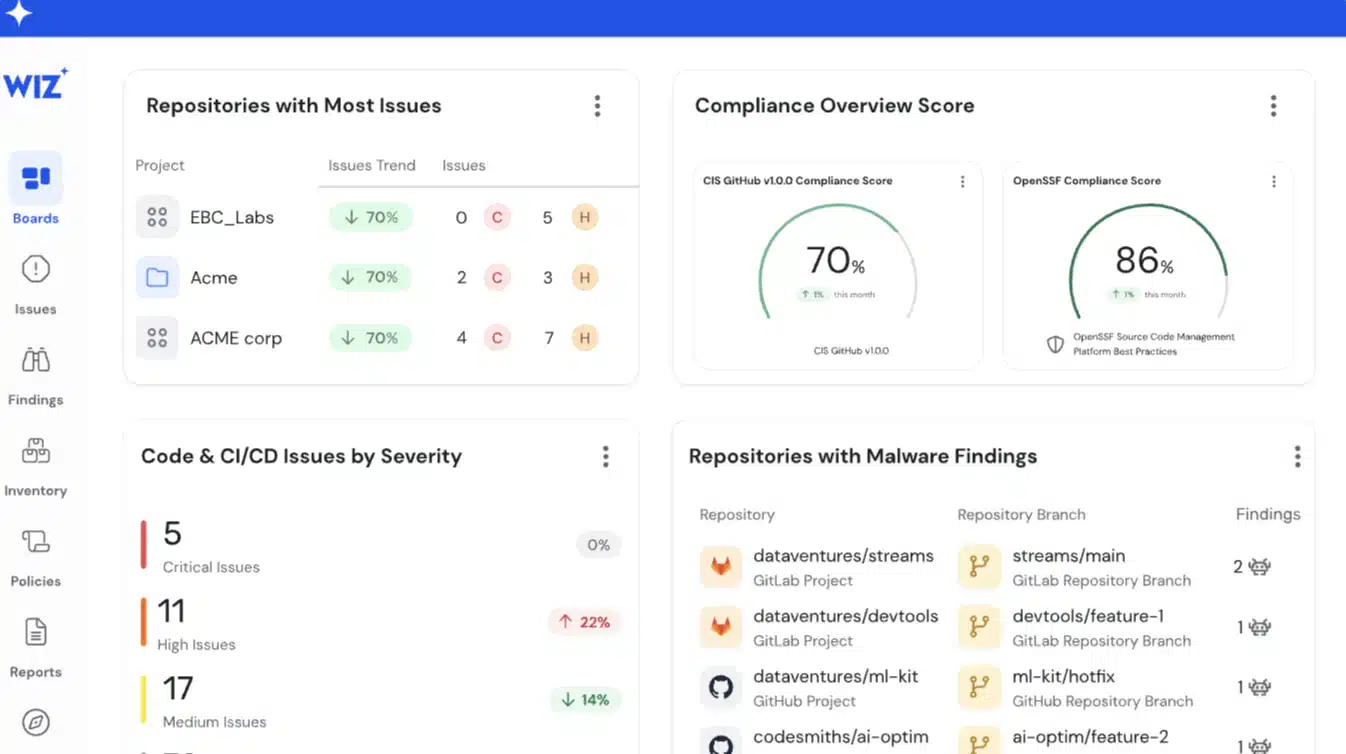
Wiz provides AI security posture management as part of its cloud-native application protection platform, securing AI models, training data, and AI services from development through runtime. It discovers AI pipelines, services, technologies, and SDKs without agents using its AI-BOM, including managed services such as AWS SageMaker and Amazon Bedrock and technologies such as OpenAI, and surfaces shadow AI on the Wiz Security Graph.
It enforces secure configuration baselines with built-in rules, identifies where AI systems can access or expose sensitive data, and detects publicly exposed inference endpoints and APIs. It uses the Security Graph to connect infrastructure, identity, models, data, and applications to find exploitable AI attack paths, and adds DSPM for AI to protect training data.
Key features include:
- AI discovery and inventory: Catalogs AI models, agents, and services across PaaS, SaaS AI applications, and custom deployments, with an AI-BOM of components and dependencies.
- AI tool identification: Identifies and classifies the tools agents can access to understand what actions they can perform.
- AI security rules: Detects AI-specific risks including insecure configurations, unsafe deployments, and logic flaws.
- Sensitive data and exposed endpoints: Identifies where AI systems can access or expose sensitive data and detects publicly exposed inference endpoints and APIs.
- AI attack path analysis: Uses the Security Graph to connect infrastructure, identity, models, data, and applications and find exploitable attack paths.
- AI runtime protection: Detects prompt injection, rogue agents, and malicious behavior targeting AI systems.
- Data security for AI: Applies DSPM controls to detect sensitive training data and remove attack paths to it.
Limitations (as reported by users on G2):
- Learning curve: The breadth of the platform and its interface can take time and training to learn.
- Reporting: Reporting and dashboards are cited as an area needing improvement.
- Alert tuning: Agentless scanning can flag findings on unused components, requiring tuning to manage noise.
- Cost: Pricing, including consumption-based features, can run higher than some alternatives.
6. Palo Alto Networks Prisma AIRS
Best for: End-to-end AI and agent security across the lifecycle
Strengths: Agent identity, red teaming, runtime security, and posture
Things to consider: Integration effort; strongest within the Palo Alto stack
Prisma AIRS is Palo Alto Networks' platform for securing AI agents, applications, models, and data from development to deployment. It discovers shadow AI by providing visibility into every AI agent, app, and model and how they connect across the environment, then continuously tests AI apps and agents, controls permissions, and monitors posture. Its agent security verifies every agent identity and enforces real-time controls to stop unauthorized actions as deployments scale.
The platform includes AI red teaming to simulate attacks against agents and applications, AI runtime security to enforce real-time safeguards against manipulation and data exposure, AI model security to scan third-party models for tampering and malicious scripts, and posture management over the data, agents, and apps in use.
Key features include:
- Agent security: Verifies agent identity and enforces real-time controls to stop unauthorized actions during live operation.
- AI discovery: Provides visibility into every AI agent, app, and model and maps how they connect across the environment.
- AI red teaming: Simulates real-world attacks across agents and applications, including multi-turn and multi-agent testing.
- AI runtime security: Monitors AI behavior and enforces real-time safeguards against manipulation, data exposure, and unsafe actions.
- AI model security: Scans third-party models for tampering, malicious scripts, and deserialization attacks.
- AI posture management: Gives visibility and control over AI data, the integrity of agents and apps, and access to deployed models.
Limitations (based on publicly available sources):
- Integration effort: Realizing full value involves enterprise integration work, and some capabilities rely on Palo Alto network or cloud components.
- Runtime overhead: Inline inspection can introduce some latency into AI interactions.
- Ecosystem fit: It is quote-based with no public free tier and is strongest for organizations already invested in the Palo Alto ecosystem.

7. Microsoft Defender for Cloud
Best for: AI-SPM for teams standardized on Azure and Microsoft
Strengths: Posture insights, attack path analysis, and Secure Score
Things to consider: Setup and pricing complexity; best within Microsoft
Microsoft Defender for Cloud delivers AI security posture management as part of its cloud-native application protection platform. Its contextual cloud security posture management gives a unified view of critical risks spanning DevOps pipelines, APIs, compute, storage, databases, serverless environments, and AI models and agents.
It provides posture insights into AI models and agents, layers on sensitive data signals, and reduces AI risk by identifying vulnerabilities and attack paths. The platform runs continuous assessments across Azure, AWS, and Google Cloud with agentless and agent-based scanning, measures posture with Microsoft Secure Score, and maps compliance against benchmarks such as CIS, ISO, and NIST.
Key features include:
- AI posture insights: Provides posture insights into AI models and agents, layered with sensitive data signals to reduce AI risk.
- Contextual prioritization: Surfaces critical risks across DevOps, APIs, compute, storage, databases, serverless, and AI using the cloud security graph.
- Attack path analysis: Uses graph-based analysis to map how an attacker could reach high-value AI workloads and prioritize remediation.
- Multicloud assessment: Runs continuous security assessments across Azure, AWS, and GCP with agentless and agent-based scanning.
- Secure Score: Measures security posture and provides actionable recommendations to improve it.
- Compliance management: Centralizes compliance against benchmarks such as CIS, ISO, and NIST with more than 450 built-in assessments.
- Security governance: Defines and tracks security governance rules at scale across cloud workloads.
Limitations (as reported by users on G2):
- Setup complexity: Configuration requires strong security and Azure expertise to reach full value.
- Alert volume: The volume of recommendations and alerts can be overwhelming.
- Pricing: Costs can add up with the number of resources monitored and are not always transparent.
- Ecosystem dependence: Value is greatest within Microsoft environments, and multi-cloud or third-party coverage needs additional configuration.

8. Orca Security
Best for: Agentless AI-SPM across multi-cloud estates
Strengths: AI and ML inventory, misconfiguration and sensitive data detection
Things to consider: Initial alert volume; agentless, no real-time blocking
Orca Security provides AI security posture management within its agentless cloud security platform, using its SideScanning technology to give visibility into deployed AI models without installing agents. It builds a complete AI and ML inventory and bill of materials for every model deployed in the cloud, including managed services such as Azure OpenAI, Amazon Bedrock and SageMaker, and Google Vertex AI, and inventories more than 50 commonly used AI software packages.
It checks that AI models are configured securely across network security, data protection, access controls, and IAM, detects sensitive data in models and training data, and finds AI access keys and tokens exposed in code repositories. It surfaces shadow AI as it appears and provides guided remediation.
Key features include:
- AI and ML inventory and BOM: Builds a complete inventory of managed and unmanaged AI models, including shadow AI, across the cloud estate.
- Misconfiguration detection: Checks AI models against best practices for network security, data protection, access controls, and IAM.
- Sensitive data detection: Uses DSPM capabilities to scan and classify data in AI projects and training data and alerts when sensitive data is found.
- Exposed key detection: Scans code repositories such as GitHub and GitLab for exposed AI access keys and tokens.
- Agentless coverage: Uses SideScanning to cover the cloud estate without deploying agents or affecting performance.
- Guided remediation: Alerts on misconfigurations, over-privileged permissions, and internet exposure with automated and guided fixes.
- Compliance framework: Includes rules for AI best practices and CIS benchmarks.
Limitations (as reported by users on G2):
- Initial alert volume: Because it scans everything, including orphaned and legacy assets, first scans can surface a large number of low-level findings.
- Reporting customization: Advanced reporting and dashboards could be easier to customize.
- Agentless trade-offs: The agentless model emphasizes visibility over real-time blocking, and scan timing affects how quickly issues surface.
- Occasional false positives: Some findings require manual filtering.

9. Cisco AI Defense
Best for: Network-layer AI security across use and development
Strengths: AI asset discovery, model validation, and runtime guardrails
Things to consider: Strongest within Cisco's network and security cloud
Cisco AI Defense provides AI security across both the use of third-party AI applications and the development of in-house AI applications and agents. It automatically surfaces third-party AI applications in use and enforces access and data-loss policies, and for AI being built it discovers AI assets, validates models, and applies runtime guardrails.
It inventories AI models, applications, agents, and connected data sources across distributed cloud environments, including MCP servers and agent processes, and detects misconfigurations, vulnerabilities, and adversarial attacks. It validates models with algorithmic red teaming, protects production applications and agent-based workflows with guardrails embedded in the network, and aligns to standards including NIST, MITRE ATLAS, and the OWASP LLM Top 10.
Key features include:
- AI cloud visibility: Inventories AI models, agents, and connected data sources across distributed environments, including MCP servers and agent processes.
- AI supply chain risk management: Scans model files, repositories, and MCP servers for malicious code, poisoned data, and high-risk assets before deployment.
- Model and application validation: Uses algorithmic red teaming to identify safety and security vulnerabilities, with CI/CD integration.
- AI runtime protection: Embeds guardrails in the network to block adversarial attacks and harmful responses in real time, including for agent workflows and RAG applications.
- AI Access: Monitors and manages employee access to third-party AI applications and enforces policies that limit sensitive data exposure.
- Agent and MCP protections: Detects agent-specific threats such as memory poisoning, tool misuse, privilege escalation, and intent hijacking.
- Standards alignment: Maps across model, agent, and MCP workflows to NIST, MITRE ATLAS, and the OWASP LLM Top 10.
Limitations (based on publicly available sources):
- Ecosystem fit: The network-layer approach delivers most value for organizations using Cisco's Security Cloud and network fabric.
- Evolving agent features: Several agent and MCP capabilities have been introduced recently and continue to expand.
- Newer product: It is a recent addition to the AI security market.

SaaS and identity-centric agent security
10. Obsidian Security
Best for: Governing AI agents operating inside SaaS environments
Strengths: Agent discovery, least privilege, and runtime guardrails
Things to consider: Reporting maturing; cost can rise when scaling
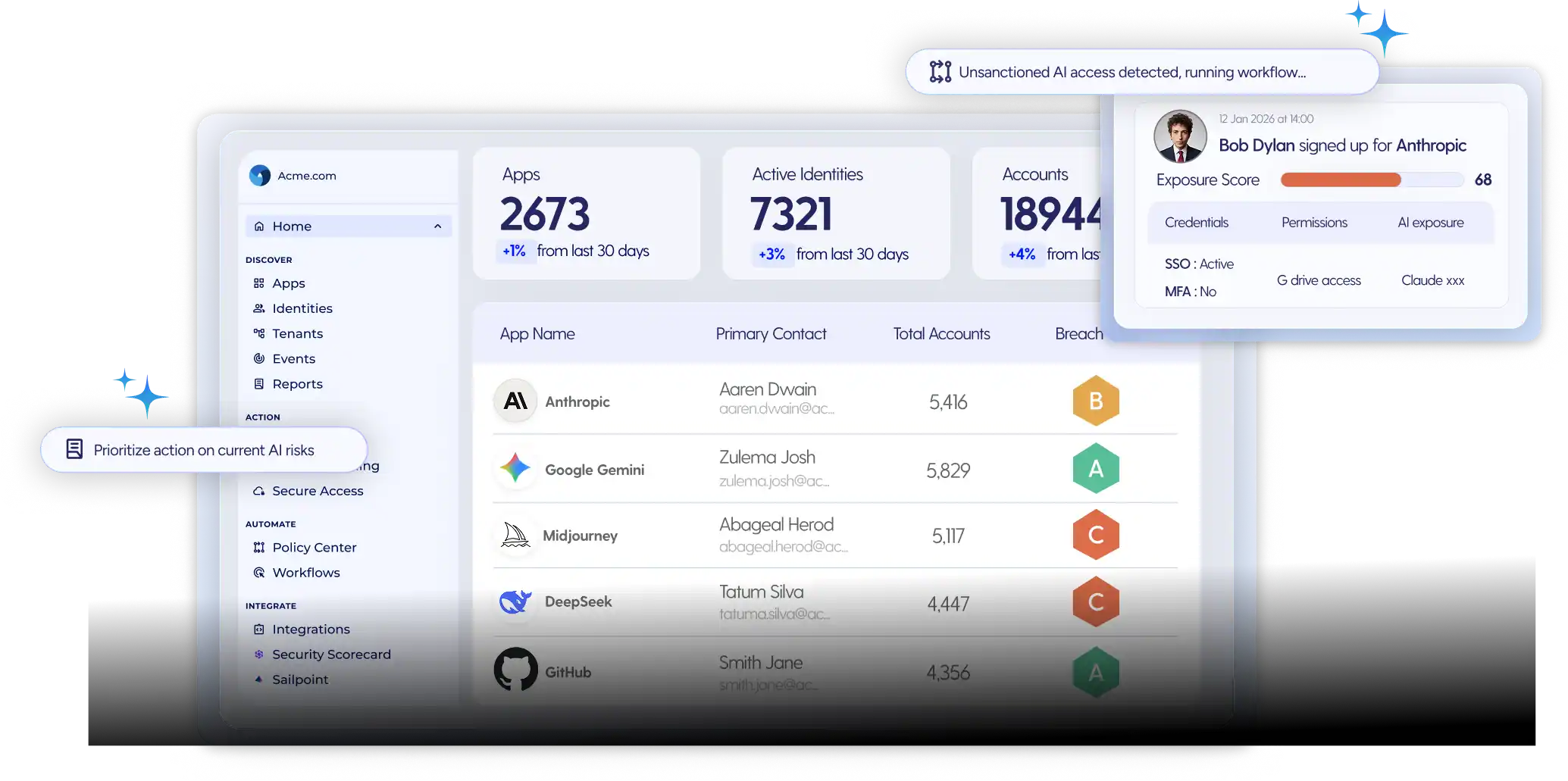
Obsidian Security governs AI agents that operate inside SaaS environments, discovering every agent, mapping what it can reach, and enforcing controls at runtime. It automatically discovers agents across platforms such as Amazon Bedrock, Azure Foundry, Copilot Studio, ChatGPT, Google Vertex, Salesforce Agentforce, and n8n, and maps each to its owner, connected applications, MCP servers, and models.
It surfaces excessive access and oversharing and right-sizes permissions based on what an agent actually uses, continuously scores agents against OWASP-aligned risk factors, and enforces guardrails at the execution layer to stop high-risk actions before they occur. It correlates agent activity with SaaS and identity telemetry to reveal risks that agent data alone would miss.
Key features include:
- Continuous agent discovery: Automatically discovers every agent the moment it appears, mapped to its owner, tools, MCP servers, and models, including shadow agents.
- Access right-sizing: Surfaces excessive access and oversharing and enforces evidence-based least privilege based on what agents actually use.
- Risk scoring: Continuously scores agents against OWASP-aligned risk factors when they are published or modified and prioritizes by blast radius.
- Runtime enforcement: Blocks unapproved or high-risk agent actions at execution time, with behavioral baselines to catch anomalous sessions.
- Identity resolution: Ties actions to the real owner and executor of each agent and identifies orphaned agents.
- SaaS and identity context: Correlates agent activity with SaaS and identity telemetry to surface risks such as sensitive data access across apps.
- Audit evidence: Maintains continuous, audit-ready records of which agents exist, who owns them, and what they can access.
Limitations (as reported by users on G2):
- Reporting and dashboards: Some reporting, dashboard, and threat-catalog capabilities lag more established SSPM tools, though they are improving.
- Cost at scale: The cost model can become steep as deployments grow.
- Setup and roadmap: Integration depth varies by platform, initial setup has a learning curve, and some customers want faster feature delivery.

11. Reco
Best for: Agentic posture and monitoring across the SaaS estate
Strengths: Agent and SaaS discovery, identity context, and alerting
Things to consider: Read-only model focuses on detection, not blocking
Reco delivers agentic security posture management across the SaaS environment using AI powered agents that monitor, analyze, and respond to risks. Its dynamic discovery tracks all apps, SaaS-to-SaaS connections, shadow SaaS, AI agents, and shadow AI tools, along with their users and data, and adds support for new apps quickly.
It uses an AI powered knowledge graph to connect identities, actions, interactions, and relationships, then alerts on exposure from misconfigurations, over-permissioned users, compromised accounts, and risky behavior. Specialized agents investigate alerts and produce incident narratives, analyze user behavior and identity risk, and generate prioritized remediation plans that integrate with existing security tools.
Key features include:
- Dynamic application discovery: Tracks apps, SaaS-to-SaaS connections, shadow SaaS, AI agents, and shadow AI tools, with their users and data.
- Knowledge graph analysis: Connects identities, actions, and relationships to surface exposure from misconfigurations and risky behavior.
- Alert investigation agent: Correlates security events across SaaS applications and builds incident narratives.
- Identity context agent: Analyzes user and machine behavior across connected apps and assesses identity risk.
- Remediation plan agent: Creates prioritized response plans and integrates with existing security and SIEM/SOAR tools.
- Posture management and compliance: Provides SSPM with continuous monitoring of configuration changes and compliance status across SOC 2, ISO 27001, NIST, and HIPAA.
- Broad integrations: Connects to 200+ SaaS applications, with new integrations added on request.
Limitations (as reported by users on G2):
- Detection focus: Operates largely in a read-only, agentless mode, so it detects and alerts on issues rather than directly blocking them.
- Remediation depth: Some users want more remediation actions built directly into the platform rather than handing off to other systems.
- Coverage dependence: The value delivered depends on integration coverage for the specific applications an organization actually uses.

12. Grip Security
Best for: Identity-first visibility over SaaS, AI tools, and agents
Strengths: AI and SaaS discovery, identity mapping, access controls
Things to consider: Setup complexity; some scanning and reporting limits
Grip Security approaches agent security from an identity-first angle, centering visibility and control on the identities that connect to AI tools, agents, and SaaS applications across an organization. It builds a near-real-time and historical inventory of AI and SaaS usage and maps each item to the identities and data associated with it.
Because it ties activity back to a specific identity or agent, the platform supports targeted guardrails and surfaces over-permissioned tools and non-human identities. It also maps hidden exposures introduced by third-party AI components, and combines posture management across SaaS and AI with automated response workflows.
Key features include:
- AI and SaaS inventory: Builds near-real-time and historical visibility into AI tools, agents, and SaaS applications in use across the organization.
- Identity mapping: Connects each application and AI tool to the identities and data linked to it, including non-human identities.
- Risk prioritization: Surfaces unsanctioned AI usage, over-permissioned tools, non-human identities, and weak SSO or password hygiene for prioritization.
- Posture management: Combines SaaS security posture management with AI security posture management, including model-level visibility and drift alerts.
- Access governance and automation: Automates workflows such as offboarding, password rotation during a breach, and approval flows.
- Exposure mapping: Maps exposures introduced by third-party AI components and app-to-app connections.
- Stack integration: Works alongside existing IAM and CASB tooling within the broader security stack.
Limitations (as reported by users on G2):
- Setup complexity: Initial setup and configuration can be complex, with a learning curve for new users.
- Reporting and scanning: Report downloads can be slow, internally named applications can be harder to interpret, and scanning scope has some limits.
- Cost: Pricing can be a budget consideration depending on the scope of deployment.
Related content: Read our guide to AI security posture management vendors
Conclusion
The cloud and SaaS tools on this list find agents once they're running in an account or tenant. The criterion most buyers skip is where an agent is defined: in your application code, next to the frameworks, models, and system prompts it depends on. If your team builds its own agents, start posture management there, before production.