Manage open source application risk
Developers rely on open source packages to build applications at speed—but if you can’t proactively manage open source components and dependencies, your organization is at risk.
Challenges
Speed at the cost of security
AppSec teams are between a rock and a hard place as they try to secure open source code in applications that are produced in ever-shortening development cycles.

Constant OSS updates
Open source packages are constantly updated, making it hard to find accurate, up-to-date information about vulnerabilities.
Time-strapped teams
AppSec teams forced to use outmoded legacy tools to manage vulnerabilities and updates across thousands—or tens of thousands—of packages can’t keep up.
Opportunity for hackers
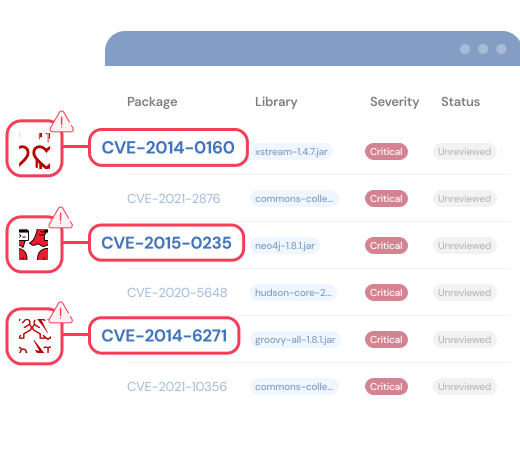
This opens up an enticing opportunity for cybercriminals, who see open source packages as a rich source of exploitable vulnerabilities and vehicles for creating malicious packages.
Opportunities
Prevent. Prioritize. Automate.
The key is to give developers and AppSec teams exactly the tools they need to not only remediate effectively, but also reduce the number of issues introduced in the first place—all while helping them work together.

Automated dependency updates
Alert devs within their own environment, with actionable information like info on vulnerable code, data flows, and training resources.
Spotlight experience
To rapidly identify and mitigate high-risk vulnerabilities, developers must quickly narrow down what matters most—which means time is crucial. One important element of that is to provide developers an embedded experience that highlights what’s critical.
Supply chain malware protection
With malicious package attacks an increasing presence in OSS registries, sniffing out threats like protestware, data stealers, and crypto miners is essential to protecting your application.
The solution
Mend SCA
Mend SCA identifies, maps, and analyzes open source vulnerabilities, enabling you to prioritize remediations based on application and enterprise risk.
Discover Mend SCA

“One of our most indicative KPIs is the amount of time for us to remediate vulnerabilities and also the amount of time developers spend fixing vulnerabilities in our code base, which has reduced significantly. We’re talking about at least 80% reduction in time.”


“When the product you sell is an application you develop, your teams need to be fast, secure and compliant. These three factors often work in opposite directions. Mend provides the opportunity to align these often competing factors, providing Vonage with an advantage in a very competitive marketplace.”


“The biggest value we get out of Mend is the fast feedback loop, which enables our developers to respond rapidly to any vulnerability or license issues. When a vulnerability or a license is disregarded or blocked, and there is a policy violation, they get the feedback directly.”


FAQs
How does Mend.io manage open source risk?
Mend SCA identifies, maps, and analyzes open source vulnerabilities across your codebase, prioritizes them by application and enterprise risk, and automates remediation through dependency updates and policy enforcement.
How does Mend.io’s reachability analysis help us decide what to fix first?
It traces whether your application actually calls the vulnerable code in each dependency. Unreachable vulnerabilities are deprioritized, so teams fix what’s exploitable instead of chasing every CVE.
Does Mend.io detect malicious open source packages?
Yes. Mend SCA detects malicious packages, including typosquats, dependency-confusion attacks, and packages containing data-exfiltration or backdoor code, helping teams identify and remove supply chain threats that traditional CVE scanning can miss.
How does Mend.io reduce open source alert noise?
Mend SCA prioritizes vulnerabilities using reachability, exploitability signals, and risk context, so teams can focus on the issues most likely to matter instead of treating every CVE the same. Mend Renovate then helps reduce the remediation burden by automating dependency updates and using Merge Confidence to help teams identify safer updates to merge.
How does Mend.io fix open source vulnerabilities?
Mend SCA identifies the safest upgrade path for vulnerable dependencies and can automate remediation through pull requests. Mend Renovate continuously keeps dependencies up to date, helping teams fix known vulnerabilities faster and reduce exposure to vulnerabilities before they’re disclosed.
Does Mend SCA catch transitive dependencies, or only the packages I list directly?
Both. Mend SCA reports every dependency it detects, direct and transitive, design-time and runtime, not just what’s declared at the top level of your manifest.
Does Mend.io’s malicious package detection catch packages an AI coding assistant “hallucinated” that an attacker then registered (slopsquatting)?
Yes. Mend.io’s malicious package detection runs on every dependency added to a project, regardless of whether a developer typed the package name or an AI assistant suggested it. The same checks apply once that package gets pulled into your build.
Can Mend SCA scan dependencies hosted on our own private registry, not just public ones?
Yes. Mend SCA scans private registries such as Nexus, Artifactory, Azure Artifacts, and internal npm or GitHub registries once you provide credentials, so components that never touch a public package index still get the same vulnerability and license checks.
Does Mend SCA rely only on package manifest files, or can it match dependencies when there’s no formal package manager?
Both. Mend SCA parses package manifest files to resolve direct and transitive dependencies, which covers supported package managers. When there’s no manifest to read, it falls back to file hashing and Smart Match to identify components, so dependencies still get detected in projects that don’t use a formal package manager.
Stop managing alerts.
Start reducing risk.
Join the teams reducing remediation effort by 75%.