Table of contents
Related resources


How to choose AI governance software in 2026: Top 7 criteria

TL;DR: Choose AI governance software by matching each tool’s capabilities to your risk, compliance (e.g., EU AI Act), and operational needs. Key steps include auditing your AI inventory, defining required controls (monitoring, ethics, audit trails), confirming CI/CD integration, and getting clear visibility into model performance and compliance.
What is AI governance software and how should you evaluate it?
AI governance software is a category of tools that oversee, manage, and control how your organization deploys and runs artificial intelligence systems. These tools help you set policies, monitor AI model behavior, and enforce compliance with internal standards and external regulations. Centralized dashboards, audit trails, and automated workflows give you transparency and accountability across the AI lifecycle.
The software typically integrates with other IT and development tools, collecting data on how AI models are built, tested, and deployed. It provides mechanisms for tracking model lineage, monitoring data inputs and outputs, and checking that AI systems stay trustworthy and ethical over time. Features such as automated documentation, risk assessment, and alerting for policy violations are common. They let you respond quickly when something goes wrong.
Use these seven criteria to choose AI governance software:
- Compliance and regulatory alignment: Documents alignment with privacy laws and frameworks (GDPR, EU AI Act) to reduce legal risk and build stakeholder trust.
- AI risk and compliance management: Provides automated risk assessment (for bias, data quality, security) and continuous monitoring to enforce adherence to organizational policies.
- AI component inventory and visibility (AI-BOM): Catalogs all models, datasets, and dependencies, offering traceability for impact analysis and simplifying compliance reporting.
- Policy enforcement and automated governance: Automates the creation and consistent enforcement of policies across the AI lifecycle so governance scales without losing control.
- Runtime protection and guardrails: Monitors and controls AI system behavior in real time, using guardrails to enforce limits and detect anomalous activity in production.
- Integration and scalability: Must integrate via APIs with existing IT and development tools and scale to handle increasing data, user loads, and policy complexity.
- Customization and flexibility: Lets you adapt policies, rules, and controls to match specific risk tolerance, industry needs, and different types of AI systems.
Why AI governance software is important
AI systems introduce new risks that traditional IT governance doesn’t fully address. As models make decisions that affect customers, operations, and compliance, you need clear controls and visibility. AI governance software provides the structure to manage these risks at scale.
- Manages risk across the AI lifecycle: Identifies and tracks risks from data collection to model deployment and monitoring.
- Keeps you compliant with regulations: Supports alignment with evolving regulations (e.g., data protection, AI-specific laws).
- Improves transparency and explainability: Provides visibility into how models are built, trained, and used.
- Enforces consistent policies: Applies standardized rules for model development, validation, and deployment.
- Enables continuous monitoring: Tracks model performance, data quality, and drift in production.
- Strengthens accountability: Assigns ownership for models and decisions.
- Accelerates audits and reporting: Centralizes records and generates reports automatically.
- Supports scalable AI adoption: Provides a repeatable framework for managing many models across teams.
Common use cases for AI governance
Securing AI-generated code
AI-generated code brings security challenges. Models can introduce vulnerabilities or use insecure coding practices. AI governance software helps you monitor and audit code created by AI systems, flagging suspicious patterns and enforcing secure development standards. Automated scanning tools detect security flaws, so code meets compliance and quality benchmarks before it reaches production.
Governance tools also provide traceability for AI-generated code, linking code changes to specific AI model outputs and user actions. This audit trail supports incident investigation and helps identify the origin of vulnerabilities. When you build governance into the code generation process, you reduce the risk of shipping insecure code and stay compliant with industry standards.
Open source and dependency risk governance
The widespread use of open source components and third-party dependencies increases the risk of vulnerabilities and license compliance issues. AI governance software inventories and monitors these dependencies across your AI projects and scans them for known vulnerabilities and license violations. Automated alerts and remediation workflows help teams address risks and reduce the likelihood of security breaches or legal exposure due to unapproved software use.
These tools also monitor open source components continuously, so your team applies updates and patches on time. An up-to-date inventory and enforced policies on open source usage reduce the operational risk that comes with fast-changing dependencies.
Securing AI in the software supply chain
AI models and components are often integrated into complex software supply chains, making it difficult to track and secure every element. AI governance software provides visibility into the supply chain, from data sources to model deployment, so you can identify weak links and enforce security controls. Governance tools map dependencies and monitor the flow of data and models to keep malicious or compromised components out.
These platforms also support supply chain security practices such as verifying model provenance, validating data integrity, and enforcing access controls. Automated compliance checks and real-time monitoring confirm that components meet security standards throughout the development lifecycle. A secured software supply chain lowers the risk of supply chain attacks and keeps your AI powered products and services reliable.
AI agent and automation governance
AI agents and automation tools increasingly perform complex tasks without human involvement, which raises concerns about oversight, accountability, and unintended actions. AI governance software lets you define, monitor, and enforce rules for AI agent behavior. You can set policies that dictate acceptable actions, escalation procedures, and limits on what agents decide independently.
The software also supports real-time monitoring and auditing of AI agent activities to detect policy violations or anomalous behavior. Automated alerting and response workflows help you contain issues. Governing AI agents and automation tools lets you balance automation against control and transparency.
You can’t govern AI you can’t see
Build a governed AI inventory, classify risk by data sensitivity and decision authority, and score your maturity without slowing your teams down.
Key criteria for choosing AI governance software
1. Compliance and regulatory alignment
Start by checking how well the software aligns with regulatory requirements. Confirm that the platform documents compliance with data privacy laws, ethical guidelines, and industry-specific standards. This includes audit trails, automated reporting, and support for regulatory frameworks such as GDPR, HIPAA, and the EU AI Act. Good compliance features reduce the risk of non-compliance penalties.
The software should also adapt to new regulations as they emerge, providing updates and customizable policy templates. Workflows that include legal and compliance teams keep governance processes aligned with your obligations. Prioritizing regulatory alignment reduces legal risk and builds trust with stakeholders, customers, and regulators.
2. AI risk and compliance management
Managing risk is central to responsible AI deployment. AI governance software should provide risk assessment tools that identify, evaluate, and prioritize threats across the AI lifecycle. This includes model bias, data quality issues, operational failures, and security vulnerabilities. Automated risk scoring, mitigation recommendations, and tracking of remediation activities help you work through risks systematically.
The platform should also monitor compliance continuously, so AI systems adhere to your policies and regulatory requirements. Continuous auditing, exception handling, and policy enforcement capabilities help detect and respond to compliance violations in real time. With strong risk and compliance management, you can scale AI initiatives and keep control and accountability.
3. AI component inventory and visibility (AI-BOM)
A complete and accurate inventory of all AI components, often referred to as an AI bill of materials (AI-BOM), is where governance starts. AI governance software should automatically catalog models, datasets, algorithms, and dependencies used across projects. This inventory lets you track component provenance, monitor updates, and identify security or compliance issues associated with each element.
Visibility into the AI-BOM supports impact analysis when vulnerabilities are discovered, so you can identify affected systems and take corrective action. It also supports transparency for external stakeholders and auditors who may require detailed information about the AI stack. A maintained AI-BOM improves traceability and simplifies compliance reporting.
4. Policy enforcement and automated governance
Enforcing governance policies consistently across the AI lifecycle is how you maintain control and reduce risk. AI governance software should support the creation, management, and enforcement of policies related to data usage, model development, deployment, and ongoing operations. Automated enforcement mechanisms can block non-compliant activities, trigger alerts, or require approvals before anyone makes high-impact changes.
Automation lets you scale governance across multiple teams and projects and stay consistent. Policy templates, customizable rules, and integration with development pipelines help embed governance requirements into daily workflows. Automated policy enforcement reduces errors and supports compliance as AI adoption grows.
5. Runtime protection and guardrails
AI models must operate within defined boundaries to prevent unintended or harmful outcomes. Runtime protection features in AI governance software provide guardrails that monitor and control AI system behavior in real time. These guardrails can enforce limits on model outputs, restrict access to sensitive data, and detect anomalous activity that may indicate misuse or malfunction. Intervention mechanisms, such as blocking actions or rolling back changes, help contain issues.
Runtime protection requires integration with production environments for continuous monitoring and response to emerging threats. Alerting, automated remediation, and detailed logging support incident investigation and compliance reporting. Runtime guardrails keep AI systems safe and aligned with your objectives.
6. Integration and scalability
Integration with existing IT, security, and development tools is a baseline requirement for AI governance software. The platform should support APIs, connectors, and plug-ins that enable data sharing and process automation across the technology stack. Integration with version control systems, CI/CD pipelines, and security platforms helps embed governance into everyday workflows.
Scalability matters too. You probably manage multiple AI projects and models across environments. The governance solution should handle increasing data volumes, user loads, and policy complexity without performance degradation. Multi-tenant support, role-based access control, and centralized management features support governance across large enterprises. A platform that integrates and scales well lets governance grow with your needs.
7. Customization and flexibility
AI governance requirements vary across organizations, industries, and use cases. The software should let your team adapt policies, workflows, and controls to match their risk tolerance and operational needs. This includes defining custom rules for model validation, data handling, and access control, as well as configurable approval processes for different stages of the AI lifecycle.
Flexible policy frameworks help adapt governance to different types of AI systems, from traditional machine learning models to generative AI and AI agents. The platform should support conditional logic, exceptions, and role-based configurations so that governance can be applied consistently without being overly rigid.
Customization should also extend to reporting and dashboards. Different stakeholders, such as engineers, risk teams, and executives, require different views into AI systems. Custom dashboards and reports give each group the insights it needs without unnecessary complexity.
AI governance software by governance criteria
The following table lists AI governance tools and how they meet the criteria above. Each tool is covered in more detail below.
| Category | Product | How it meets the criteria |
|---|---|---|
| AI Security and Code Governance | Mend AI | Strong AI-BOM, discovery, compliance mapping, policy enforcement, and runtime guardrails. |
| AI Security and Code Governance | Palo Alto Networks Prisma AIRS | Broad coverage from AI discovery to runtime protection and agent security. Best fit for organizations invested in the Palo Alto ecosystem. |
| AI Governance and Compliance Platforms | Credo AI | Broad governance coverage with registry, risk management, policy automation, runtime governance, and vendor oversight. |
| AI Governance and Compliance Platforms | IBM watsonx.governance | Excellent governance, compliance, monitoring, and GRC integration. Less focused on AI-BOM-style component inventories. |
| Model Monitoring, Observability, and Risk | Fiddler AI | Strong monitoring, guardrails, and governance support. Limited focus on AI-BOM and regulatory workflow automation. |
| Model Monitoring, Observability, and Risk | Monitaur | Compliance-focused governance and model risk management. Fewer integrations and limited runtime security capabilities. |
| Data Governance Platforms with AI Oversight | Collibra AI Governance | Strong registry, compliance, lineage, and governance foundation. Less emphasis on runtime protection and AI-specific guardrails. |
| Data Governance Platforms with AI Oversight | Securiti AI Security & Governance | Combines AI governance with data security, privacy, and policy controls. AI-BOM functionality is not a primary focus. |
Notable AI governance software in depth
How we selected these tools: We shortlisted AI governance software based on AI inventory and discovery (including AI bills of materials and shadow AI detection), risk and compliance management, policy enforcement and runtime guardrails, model monitoring, and integration and scalability across the AI lifecycle.
AI security and code governance
1. Mend AI
Best for: Securing AI components and AI-generated code in the SDLC
Strengths: AI-BOM, red teaming, prompt hardening, and policy enforcement
Things to consider: Runtime guardrails are supported within your own environment
Mend AI automates the discovery and risk assessment of the AI used inside applications, including models, frameworks, agents, and system prompts. It maintains a continuously updated inventory across the AI supply chain and surfaces hard-to-detect shadow AI that developers adopt without security or governance review. Mend AI ties each discovered component to the applications that use it and applies policy controls across the software development lifecycle.
Key features include:
- AI supply chain inventory and AI-BOM: Builds a real-time inventory of every model, framework, dataset, and dependency, and generates an AI bill of materials that updates as code changes.
- Shadow AI detection: Scans code to find AI models, agents, RAG pipelines, and libraries adopted without review, then maps them into the AI supply chain.
- AI red teaming: Runs prebuilt, customizable tests against conversational AI for prompt injection, context leakage, data exfiltration, jailbreaks, hallucinations, and bias.
- System prompt hardening: Scores prompts for risk using AIWE scoring, flags injection-prone or leak-prone patterns, and enforces hardened prompts before they reach production.
- Policy enforcement and AI risk visibility (AI-SPM): Defines and governs rules for AI components and provides AI risk visibility within supported environments, with automation workflows across the development lifecycle.
Limitations (as reported by users on G2):
- Interface design: Some users would like a more modern, updated user interface, though they note it does not detract from day-to-day usability.
- Pricing structure: The pricing model spanning multiple products can feel complex to evaluate, and some smaller teams find the cost harder to justify.
- Verifying findings: A few users mention it can be difficult to confirm whether a flagged item is a true positive without a clearer proof of concept.

2. Palo Alto Networks Prisma AIRS
Best for: End-to-end AI security from development to runtime
Strengths: Model scanning, red teaming, runtime protection, and agent security
Things to consider: Gets the most value within the Palo Alto ecosystem
Prisma AIRS is a centralized platform that secures AI agents, applications, models, and data across their lifecycle. It discovers AI across an environment, including shadow AI, and maps how agents, apps, and models connect. The platform tests AI for risks before deployment and enforces controls at runtime to stop manipulation, data exposure, and unsafe actions during live interactions. It scans third-party models for tampering, malicious scripts, and other supply chain risks before they reach production.
Key features include:
- Shadow AI discovery: Provides visibility into every AI agent, application, and model across an environment and identifies how they connect.
- AI model security: Scans third-party and proprietary models for malicious code, backdoors, deserialization threats, and unsafe dependencies across more than 35 model file types.
- AI red teaming: Simulates real-world attacks against AI agents and applications, including multi-turn and multi-agent scenarios, to surface vulnerabilities.
- AI runtime security: Monitors AI behavior and enforces real-time safeguards against manipulation, data exposure, and unsafe actions during live interactions.
- AI posture management: Gives visibility and control over AI training and inference data, the integrity of AI agents and apps, and access to deployed models.
- Agent security: Verifies agent identity and enforces runtime security to stop unauthorized actions as agents scale from pilot to production.
Limitations (as reported by users on Gartner Peer Insights):
- Ecosystem dependence: Reviewers note the platform delivers its full value when an organization is committed to the broader Palo Alto stack, and licensing can be a barrier for smaller firms.
- Configuration effort: Setting up granular policies can be cumbersome and carries a learning curve for administrators.
- Early-stage areas: Some capabilities feel newer or limited, and certain alerts and reports require extra tuning to fit a specific environment.

AI governance and compliance platforms
3. Credo AI
Best for: Enterprise AI governance from pilot to production
Strengths: AI registry, policy packs, framework mapping, and vendor governance
Things to consider: Onboarding can take time to stand up
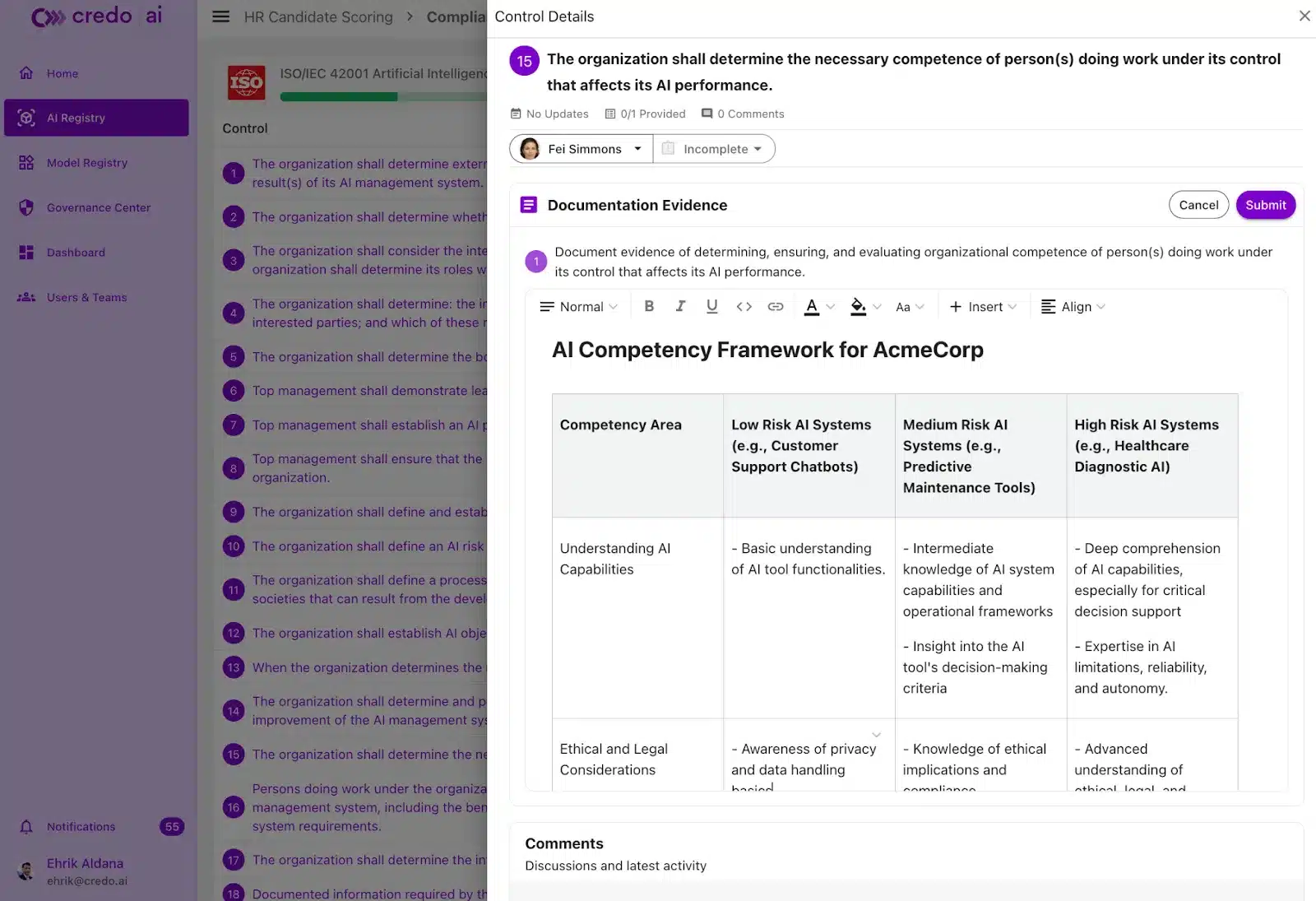
Credo AI is a platform for discovering, assessing, governing, monitoring, and reporting on AI systems across an enterprise. It maintains a central registry of AI agents, models, and applications, including third-party AI and shadow AI surfaced through discovery. The platform assesses risk continuously and in context, covering bias, security, privacy, and compliance, rather than relying on point-in-time snapshots. It encodes regulations and standards into reusable policy packs and automates workflows and documentation.
Key features include:
- AI registry: Discovers and catalogs every AI system across the enterprise, including agents, models, and applications, with shadow AI discovery.
- Risk intelligence: Runs continuous, contextual risk assessment across bias, security, privacy, and compliance.
- Policy packs and compliance: Provides prebuilt policy packs and automated workflows mapped to the EU AI Act, NIST, ISO/IEC 42001, and other frameworks, with audit-ready documentation.
- Runtime governance: Continuously evaluates agent traces to detect policy violations, drift, and unsafe behavior, with human-in-the-loop escalation.
- Governance agents (GAIA): Uses specialized agents to retrieve evidence, assess risk, generate governance plans, and support remediation.
- Vendor governance: Tracks and assesses third-party AI through a vendor registry and vendor portal.
Limitations (as reported by users on PeerSpot):
- Documentation and support: Some users feel documentation and customer support could be more detailed.
- Onboarding: Reviewers note onboarding can be lengthy and integration could be simpler.
- Customization: Scalability, flexibility, and reporting customization are areas users would like to see further developed.
4. IBM watsonx.governance
Best for: Enterprise AI assurance across hybrid, multi-vendor AI
Strengths: Governance graph, factsheets, risk monitoring, and GRC depth
Things to consider: Steep learning curve for new teams
IBM watsonx.governance is an enterprise assurance layer that combines AI governance with governance, risk, and compliance (GRC) capabilities across hybrid, multi-vendor environments. Its governance graph maintains a connected map of the AI estate, linking AI assets to policies, risks, and regulatory requirements so teams can trace what AI is in use, for what purpose, and under what controls. The platform automates lifecycle governance through factsheets that capture model metadata, and it monitors models for fairness, bias, and drift.
Key features include:
- Governance graph: Builds a connected map of AI assets, policies, risks, and regulatory requirements to trace controls and their effectiveness.
- Lifecycle governance: Automates model governance with customizable dashboards and factsheets that capture model metadata across the lifecycle.
- Risk management: Monitors fairness, bias, drift, and key LLM metrics with preset thresholds and alerts for issues such as toxic language or detected PII.
- Compliance automation: Translates regulations into enforceable policies and maintains continuous, audit-ready reporting backed by a large compliance content network.
- GRC integration: Connects AI risk to operational, third-party, business continuity, and IT risks, including integration with OpenPages.
- Agentic oversight: Adds monitoring and evaluation capabilities for agentic AI alongside generative and machine learning models.
Limitations (as reported by users on G2):
- Learning curve: Users describe a steep learning curve and suggest the interface could be simplified.
- Setup in hybrid environments: Initial setup and integration can be challenging, particularly for on-premises and hybrid deployments.
- Fit for smaller teams: Some reviewers find the centralized framework complex or extensive for smaller organizations with simpler needs.

Model monitoring, observability, and risk
5. Fiddler AI
Best for: Observability and monitoring for ML and LLM applications
Strengths: Drift and quality monitoring, explainability, and guardrails
Things to consider: Learning curve for teams new to AIOps
Fiddler AI is an observability and security platform for agentic, generative, and predictive AI. It provides end-to-end visibility into the agentic lifecycle, tracing agent steps and surrounding context, alongside monitoring for traditional machine learning models. The platform tracks data drift, concept drift, data integrity, hallucination, accuracy, safety, and security across tabular, NLP, computer vision, and large language model deployments.
Key features include:
- Agentic observability: Delivers end-to-end visibility, context, and control across the agentic lifecycle.
- Model monitoring: Tracks data drift, concept drift, data integrity, hallucination, accuracy, safety, and security across model types.
- Guardrails: Enforces enterprise AI policies in real time using fast guardrail models.
- Explainability and analytics: Provides model explanations, 3D UMAP visualization, and root cause analysis to diagnose model issues and drill into data segments.
- Governance and compliance: Centralizes control and accountability for AI governance, risk management, and compliance.
- Flexible deployment: Supports SaaS, on-premises, and cloud deployment with role-based access control and SOC 2 compliance.
Limitations (as reported by users on G2):
- Learning curve: Reviewers find the platform challenging for those new to AI, AIOps, and AI monitoring.
- No free tier: Some users would like a free version with a subset of features.
- Dashboard setup: Building dashboards could be more intuitive, though users describe it as a minor pain point.

6. Monitaur
Best for: Model risk governance in regulated industries
Strengths: Policy management, model documentation, validation, and vendor governance
Things to consider: Compliance-focused with fewer integrations
Monitaur is an AI governance platform built for highly regulated enterprises that need to define, manage, and automate governance across proprietary and third-party models. It establishes enterprise-wide governance standards and controls, unifying policies across model types and business functions such as underwriting, claims, and risk. The platform manages model inventory, controls, and collaboration while continuously monitoring model performance and applying standardized governance across systems.
Key features include:
- Policy and program design: Establishes enterprise AI governance standards, risk assessments, and controls, unifying policies across model types.
- Model inventory and controls: Manages inventory, controls, collaboration, and vendor governance in one system.
- Continuous monitoring: Tracks model performance and applies standardized governance across AI systems.
- Automated validation: Validates models at scale with consistent protocols and transparent reporting for auditors.
- Drift and bias testing: Includes drift and bias monitoring, stress testing, and transaction search.
- Vendor governance: Manages internal and third-party AI risks within a single system.
Limitations (based on publicly available sources):
- Scope focus: Public comparisons describe Monitaur as primarily compliance and documentation focused, with less emphasis on real-time threat detection or automated access control.
- Integrations: Publicly listed integrations are fewer than those of some broader AI governance platforms.
- Market presence: Its concentration on regulated industries and smaller market presence mean fewer public references.

Data governance platforms with AI oversight
7. Collibra AI Governance
Best for: Governing AI on a trusted data foundation
Strengths: Unified registry, trust score, compliance templates, and data lineage
Things to consider: Heavy upfront setup effort
Collibra AI Governance, delivered through its AI Command Center, is a control plane for managing AI agents and systems across the full AI lifecycle. It maintains a unified registry of every AI use case, model, and agent, connecting each to the data, policies, and use cases it depends on. The platform produces a trust score per system that aggregates documentation, data integrity, lifecycle status, and regulatory signals into a single metric, and it surfaces real-time governance dashboards for leadership.
Key features include:
- Unified AI registry: Manages every AI use case, model, and agent in a single system of record across the full lifecycle.
- AI trust score: Aggregates documentation, data integrity, lifecycle status, and regulatory signals into one score per system.
- Compliance assessments: Runs assessments using templates aligned to the AI UC-1 standard, the EU AI Act, and NIST AI RMF.
- Governance dashboards: Provides real-time visibility across AI use cases, models, and agents for leadership decisions.
- Code-first registration: Captures AI use cases from code through a developer CLI that syncs models, versions, and metadata into the registry.
- Data foundation: Connects AI to governed data through catalog, lineage, quality, and data recommendations.
Limitations (based on publicly available sources):
- Setup investment: Reviewers describe a large upfront effort to define domains, assets, roles, and the governance model during configuration.
- Performance at scale: Some users note catalog searches can slow slightly as the volume of metadata grows.
- Onboarding: Users would value industry-specific starter templates to accelerate adoption.

8. Securiti AI Security & Governance
Best for: AI governance tied to data security and privacy
Strengths: DSPM, data discovery, AI controls, and classification
Things to consider: Breadth brings a configuration learning curve
Securiti provides AI security and governance as part of its data and AI command center, which centralizes controls across hybrid multicloud and SaaS environments. The platform discovers and classifies data, including shadow and cloud-native assets, and connects that intelligence to how AI systems use data. It establishes controls for the safe adoption of AI technologies, including generative AI, and helps organizations comply with emerging AI regulations.
Key features include:
- Data security posture management: Secures sensitive data across hybrid multicloud and SaaS environments.
- Data discovery and classification: Discovers shadow and cloud-native assets and classifies data accurately.
- AI controls: Establishes controls for the safe adoption of AI technologies, including generative AI.
- AI compliance: Helps organizations comply with emerging AI regulations and demonstrate safe AI use.
- Safe enterprise AI: Supports data vectorization, curation, and sanitization, and protects AI interactions with context-aware firewalls.
- Data access governance: Monitors sensitive data access and enforces least-privilege controls connected to AI usage.
Limitations (based on publicly available sources):
- Interface usability: Public reviews note the user interface is not the most intuitive and can take time to learn.
- Feature delivery: Some users mention functional limitations and delays in rolling out certain identified enhancements.
- Configuration effort: The breadth of the data and AI platform means meaningful effort to configure controls across the estate.

Conclusion
Most buyers compare governance tools on policy features and skip the inventory question. Can the tool find the AI your developers already added without a review? Policy enforcement, compliance reports, and guardrails only cover the components the tool knows about, so test discovery first, on your own repositories.